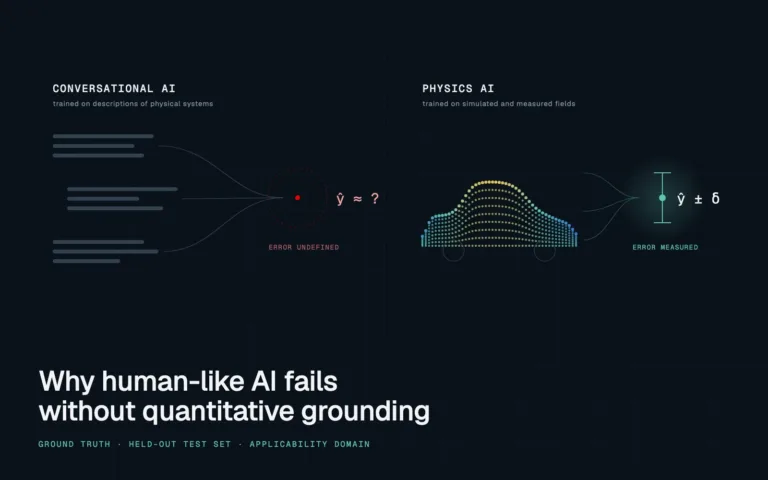
Models trained on CFD and FEA results predict fields for new geometries in near-real time.
Predictions apply within the geometry range of the training cases; solvers verify selected designs.
With fast prediction, geometry preparation and engineering decisions become the slowest design steps.
Neural Concept’s platform combines Physics Intelligence with Geometry and Program Intelligence.
Table of contents
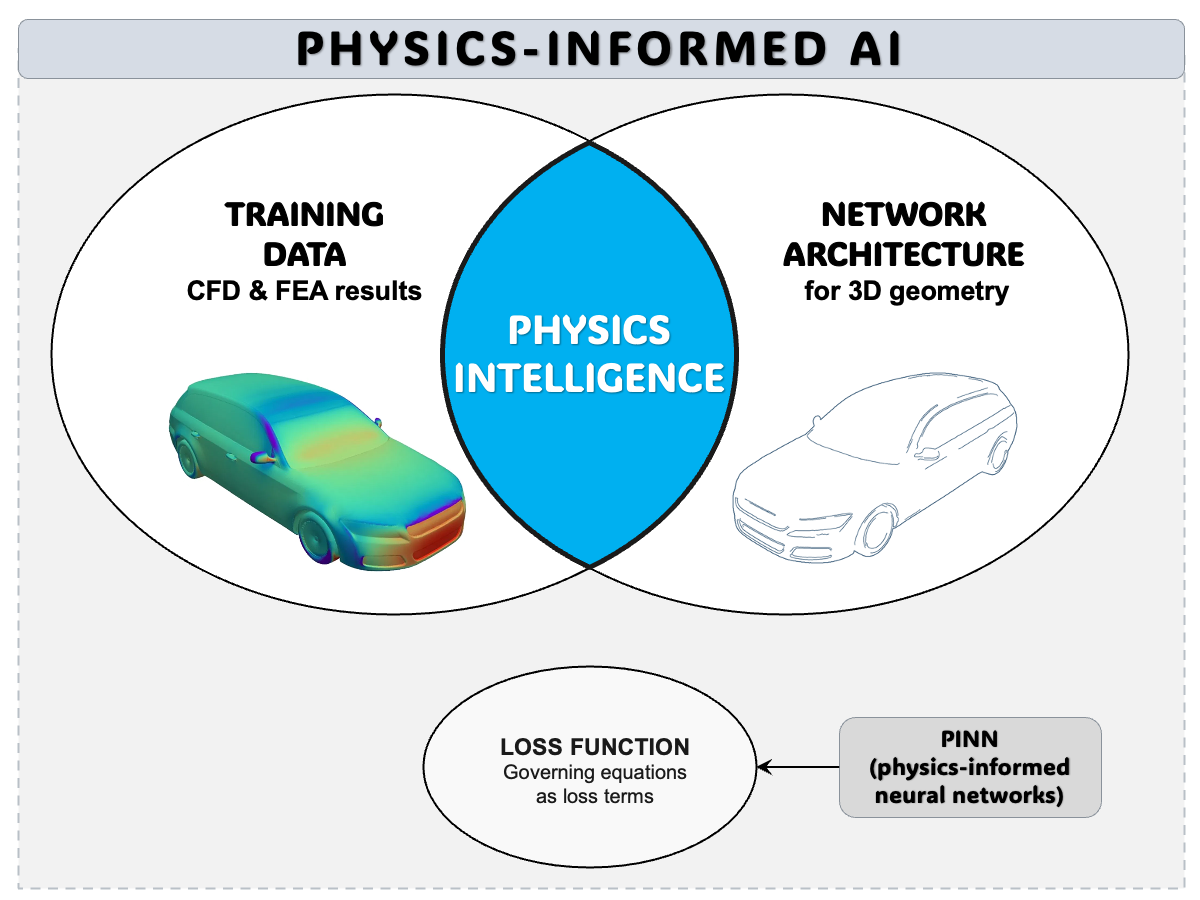
Physics-informed AI is machine learning that incorporates physics through training data, network architecture, or a loss function. For engineering professionals, engineering heads, R&D directors, and teams running product development or simulation workflows, Physics AI can predict pressure or stress fields for new 3D geometries in near-real time. As a result, engineers can evaluate many design variants before sending selected concepts back to trusted solvers for verification. The real impact of the trained models in production depends on how physics prediction combines with geometry generation, engineering rules, and solver-based validation.
We describe three routes for incorporating physics into machine learning, show how models trained on CFD and FEA results apply in fluid dynamics and structural mechanics, and examine production limits of these approaches. We also examine how rapid physics prediction fits into engineering workflows and how Neural Concept combines Physics Intelligence with Geometry and Program Intelligence.
Three routes for introducing physics into machine learning
Karniadakis and co-authors classify the methods for introducing physical laws into the learning process into three routes. They call each route a bias, in the machine learning sense of a prior assumption imposed on the model (Karniadakis et al., 2021):
Observational bias: the provided data are solutions of the governing equations, for example, CFD or FEA results.
Inductive bias: the network architecture incorporates physical laws as hard constraints, so that every prediction satisfies them by construction.
Learning bias: the loss function, the quantity minimized during training, adds the residuals of the governing equations and boundary conditions as loss terms. These terms act as soft constraints. PINNs follow this route (Raissi et al., 2019).
In product development, models trained on stored CFD and FEA results from engineering simulation follow the observational-bias route.
Figure 1. Physics Intelligence as the combination of CFD and FEA training data with a network architecture for 3D geometry.
Physics AI and numerical solvers
Numerical solvers require a new mesh and a full solution for each new design. In a comparison on the Poisson, Allen-Cahn, and semilinear Schrödinger equations in one to three dimensions, the finite element method matched or exceeded PINNs in solution time and accuracy (Grossmann et al., 2024). After training, PINNs evaluated the solution at new points faster than the finite element method in some experiments.
For models trained on CFD and FEA results, the cost lies in the solver runs that produce the training cases and in the training run. With an existing case archive, one only adds the training run. This cost is justified when engineers evaluate many design variants of one component family.
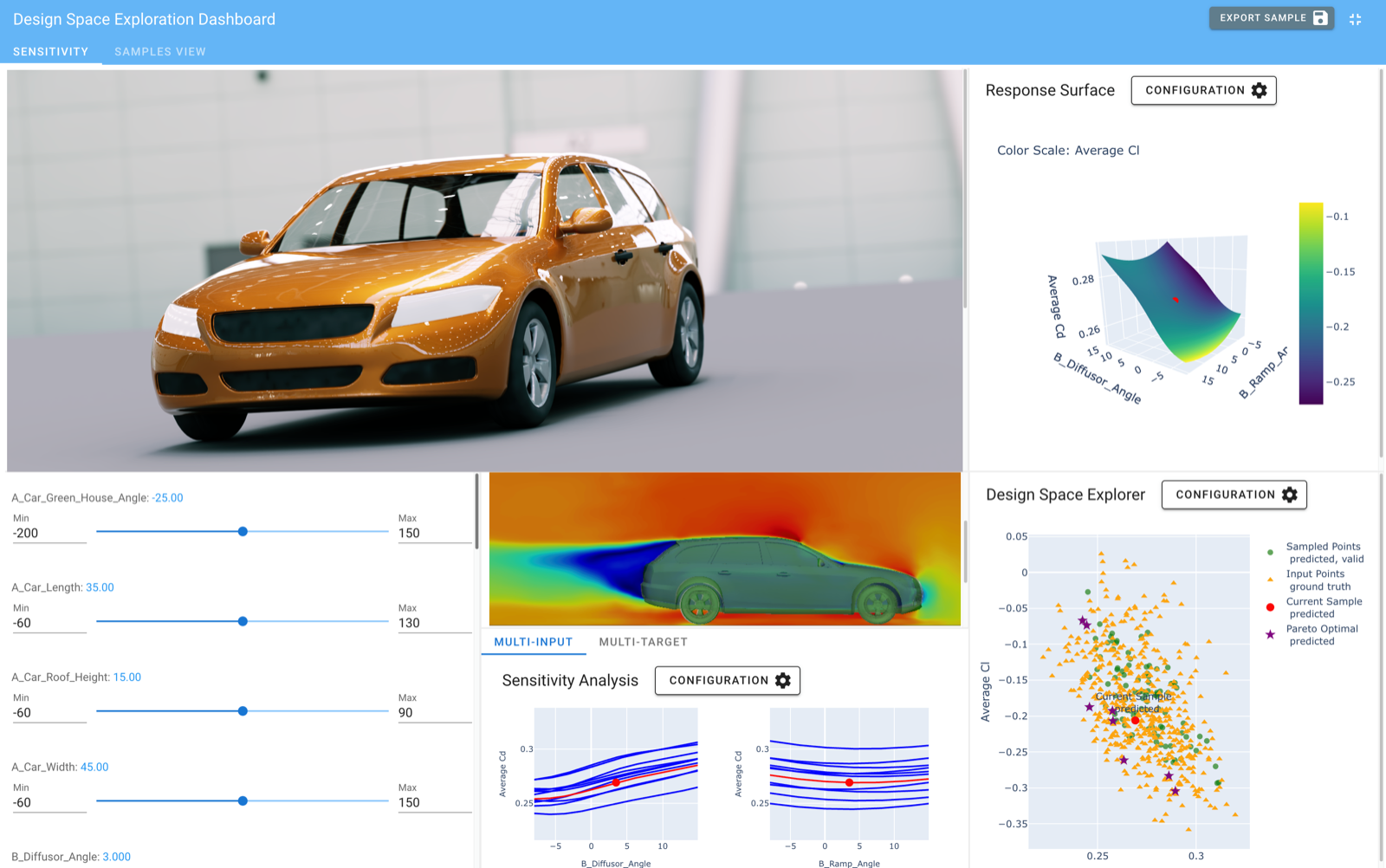
Trained models and numerical solvers complement each other: the solver verifies the designs selected by screening with the trained model. Figure 2 shows a physics-AI-based design space exploration of a car body. The geometry parameters in Figure 2 define the design variants; the trained model processes each variant’s 3D mesh.
Numerical solver
PINNs
Model trained on CFD or FEA results
New design
New mesh and full solve
New training run
Prediction in near-real time
Validity range
Physical models of the solver
The trained problem (standard PINNs)
Geometry range of the training cases
Typical role
Reference result and verification
Sparse-data and inverse problems
Screening of design variants
Figure 2. Design space exploration with physics AI of a car body: predicted flow field, drag sensitivity to geometry parameters, and drag versus lift for candidate designs (orange: CFD training cases; green: predicted designs; purple stars: predicted Pareto-optimal designs)
Limits of physics-informed AI in production
Krishnapriyan and co-authors report that standard PINN training methods produce good models for relatively trivial problems but can fail to capture the relevant physics for even slightly more complex problems. They attribute this difficulty to training: the physics terms make the loss-function minimization ill-conditioned (Krishnapriyan et al., 2021). These findings concern learning bias. In production, a PINN also requires a new training run for each new design.
In models trained on CFD and FEA results, the training cases alone represent the underlying physical laws. These models therefore generalize, that is, return reliable output fields for new input geometries, only within the geometry range of their training cases.
For a geometry outside that range, uncertainty estimates indicate whether a prediction is accurate enough to use. Engineers simulate designs that fail this check with the CFD or FEA solver. The new results extend the training set for the next retraining.
The bottleneck after fast evaluation
Once trained, a model fitted to CFD or FEA results returns a new design’s result in seconds. The duration of a design iteration then depends on the steps around the evaluation. Pierre Baqué, CEO of Neural Concept, writes in an article on the path to value in engineering AI: “If you think of it only as a replacement for simulation, you will be disappointed.”
Design preparation: each new variant requires CAD geometry and a simulation-ready model, with a CFD mesh or contact definitions for structural analysis.
Method selection: new concepts outside the data range and final sign-off require a full simulation with the trusted solver.
Engineering context: design rules, manufacturing constraints, and requirements determine which designs are acceptable. Specifications contain these rules, separately from the data.
Separate departments: Baqué describes the separation of simulation and design departments as a legacy of a time “when running a single simulation was a scientific achievement.”
The evaluation steps still determine how long each design iteration takes. Physics AI alone thus increases the number of variants evaluated within the same development process.
Physics Intelligence as one building block of Engineering Intelligence
Neural Concept’s platform connects a company’s CAD, CAE, and PLM tools and adds three capabilities, called Engineering Intelligences:
Geometry Intelligence: CAD understanding, design variant generation, shape morphing, and conversion of geometries into simulation-ready models.
Physics Intelligence: near-real-time performance prediction with physics AI, design comparison, and optimization, combined with the company’s trusted solvers.
Program Intelligence: structured knowledge of the design rules, constraints, requirements, and past decisions of a development program, such as a vehicle program.
Neural Concept describes these intelligences as capabilities for general-purpose AI agents. MCP Bridge connects agents to commercial CAD, meshing, and simulation tools, such as CATIA, ANSA, and Abaqus. Engineers set the goal and validate the results. In one customer case reported in October 2026, cleaning up a wheel rim geometry took about three minutes, compared with a day using the manual process.
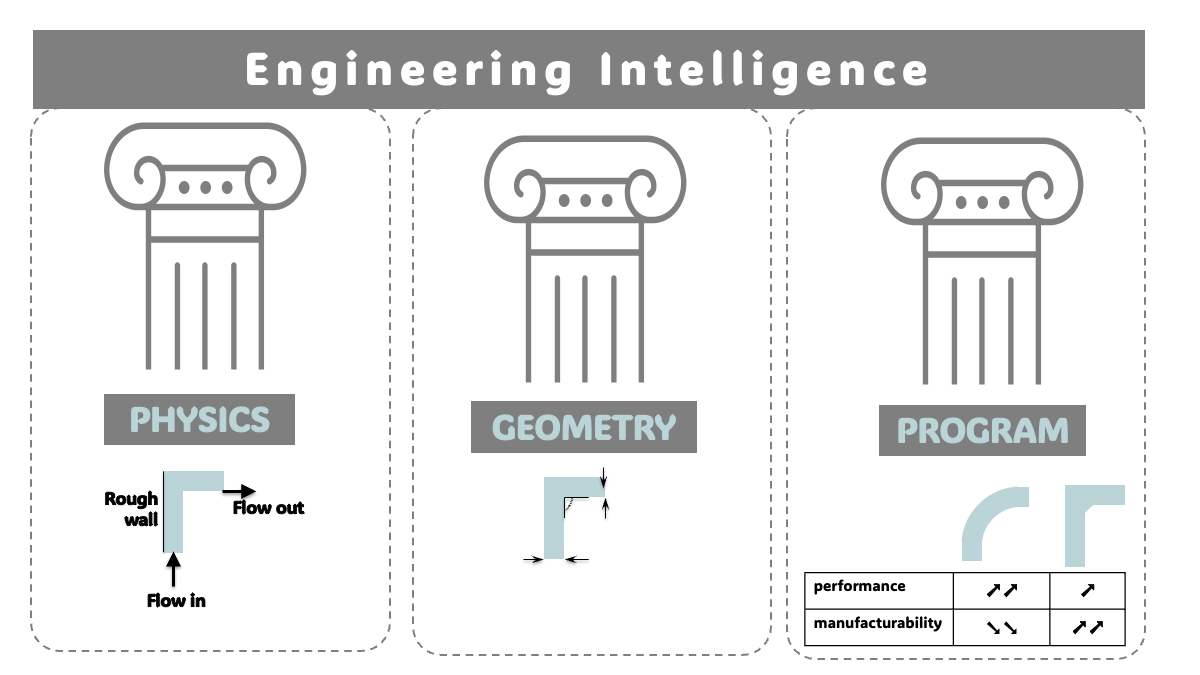
Figure 3 applies the physics, geometry, and program views to a simple component, a duct with a right-angle turn, highlighting the central role of geometric modeling in engineering design. The physics view covers the flow and the pressure loss. The geometry view defines the duct dimensions. The program view weighs a curved duct, with lower pressure loss, against two straight tubes joined at a right angle, with lower manufacturing cost. The compromise, dictated, for instance, by space and manufacturing constraints, is a fillet at the 90° angle that reduces pressure loss without significantly altering the original configuration.
Figure 3. Physics, geometry, and program views for a fluid mechanics case (→Physics) of a 90° bent duct (→Geometry) with performance vs manufacturability/cost considerations (→Program).
Three levels of engineering knowledge
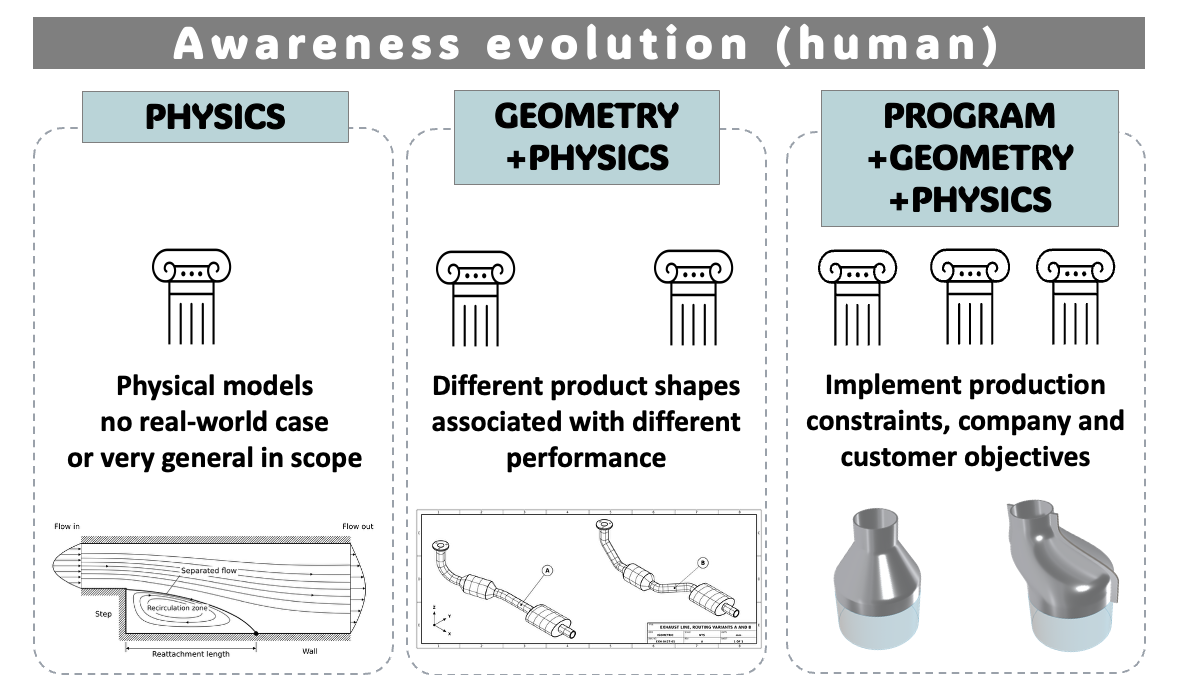
Engineering knowledge accumulates at three levels, in a natural order: physics, product geometry, and the program, meaning the design rules and past decisions of a development program. Company-specific design methods require prior knowledge of the governing equations and of product geometry, and they build on fundamental engineering design principles that structure decisions from concept to production. Over a career, engineers master the three levels in this order:
Physics: engineers and physicists hone their skills on idealized geometries. At this stage, geometry changes are secondary, parametric, and simple.
Geometry: engineers compare industrial shapes and write reports on why one solution performed better than another.
Program: engineers proactively guide design choices in collaboration with manufacturing specialists.
Figure 4 shows how these three knowledge levels build on one another. Combined with geometry, physics ranks product shapes by performance. Program knowledge adds production constraints and company and customer objectives.
Figure 4. Three levels of engineering knowledge, from general models (→Physics) via product shapes (→Geometry) to production constraints and company and customer objectives (→Program). Image source: Anthony Massobrio.
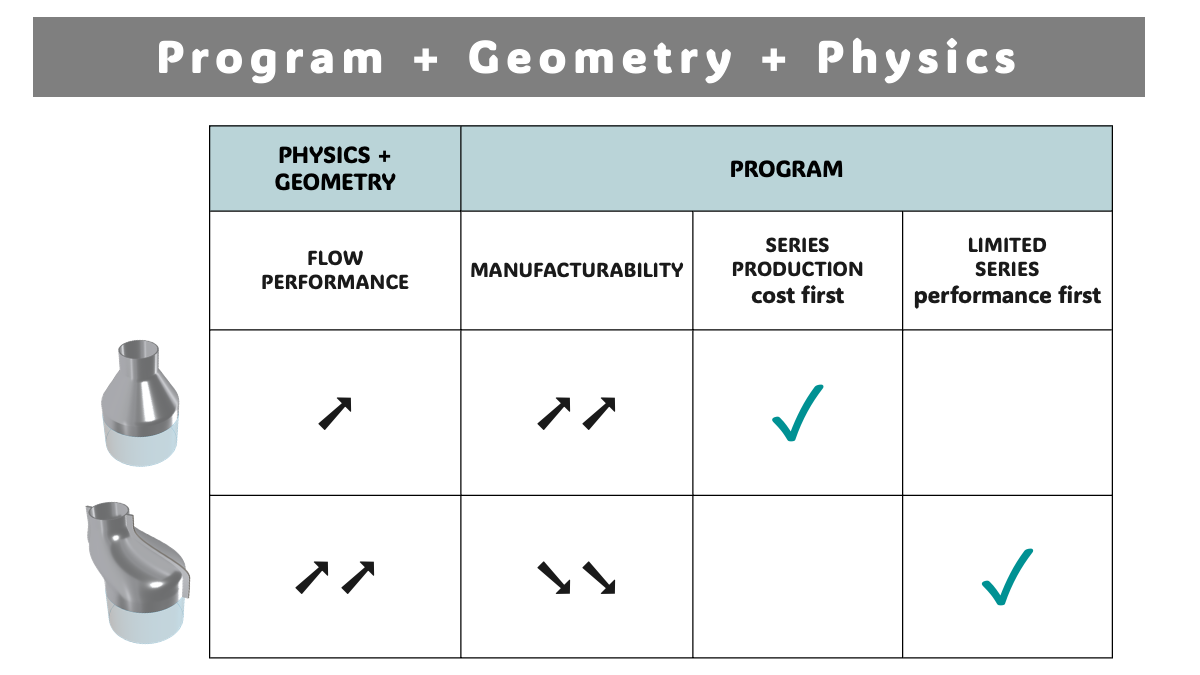
Design choices must be made, for instance, on two inlet cone designs for a catalytic converter:
A one-piece cone is deep drawn from a sheet-metal blank in several stages.
A more complex, higher-performing inlet can be assembled from two welded shells.
In the qualitative ratings in Figure 5, the two-shell cone has higher flow performance and lower manufacturability. Program knowledge, added to geometry and physics, determines the final design choice:
Figure 5. Program knowledge complements Physics and Geometry. Two inlet cone designs for a catalytic converter: qualitative ratings of flow performance and manufacturability, and the preferred design for series production and for a limited series
Engineers acquire program knowledge last, over a career. Neural Concept’s platform operates at the program level from the first design evaluation. Its physics AI models are trained on a company’s CFD and FEA results. Their predictions apply within the geometry range of these training cases. Program Intelligence provides AI agents with structured knowledge of the company’s design rules and past decisions. The platform evaluates each new design using Physics, Geometry, and Program Intelligence together.
Modern engineering applications of Engineering Intelligence
Neural Concept’s industry stories show how Engineering Intelligence optimizes products in fluid mechanics and structural mechanics applications, illustrating how AI supports mechanical engineering from simulation to design optimization.
General Motors, pedestrian safety:General Motors trained a Neural Concept model on crash simulation data from 11 vehicle programs. For new hood designs, the model assesses the Head Injury Criterion, a pedestrian-safety metric. One finite element impact simulation can take up to two hours on 256 CPUs; the story summarizes the outcome as “from weeks to seconds.”
Leonardo, aircraft and helicopter engineering: Leonardo engineers build and use AI models on their own tools and engineering data. They started using AI at Leonardo Helicopters in 2023. Its use now spans three divisions.
Evaluation criteria for physics-informed AI in product development
For heads of engineering and R&D directors, the evaluation of physics AI extends to the processes around the model, including whether the approach helps teams improve efficiency in engineering workflows:
Retraining scope: whether a new geometry requires a new run or belongs to the validity range of an existing model.
Design variant generation: whether new design variants are generated and converted into simulation-ready models automatically or prepared manually.
AI ownership: who owns the trained models and cases. Large language models are trained on public text. In contrast, a company’s physics data are its own CFD and FEA results. Ownership of the trained models therefore determines who benefits from these results.
CAD and CAE integration: whether the model processes geometries from the CAD toolchain in use and returns fields for the existing engineering system or CAE post-processing.
Production deployment: whether named companies run the approach in production.
Physics AI (Physics-informed AI) embeds physical laws into machine learning through three routes: data, architecture, and loss function.
For product development, geometric deep learning models trained on CFD and FEA results deliver pressure and stress fields for new geometries in near-real time. Stored CFD and FEA cases become strategic assets. With fast evaluation, geometry preparation and engineering decisions set the pace.
Neural Concept’s Engineering Intelligence Layer combines Physics Intelligence, Geometry Intelligence, and Program Intelligence with each company’s trusted simulation tools.
FAQ
What is physics AI, and how does it relate to physics-informed AI?
Physics AI is shorthand for physics-informed AI. Neural Concept’s physics AI models are geometric deep learning models trained on a company’s CFD and FEA results. In Karniadakis et al.’s classification, these models follow the observational-bias route, placing them within physics-informed machine learning. At Neural Concept, physics AI falls under Physics Intelligence, alongside Geometry Intelligence and Program Intelligence.
Is physics-informed AI used in computational fluid dynamics and structural mechanics?
Yes. Applications of physics-informed AI include CFD and structural mechanics. Models trained on CFD and FEA results are among several AI techniques used to solve complex physical problems in industrial design. For example, MAHLE used these models to improve a radial blower’s efficiency by about 15%. In motorsport, a Neural Concept study on F1 aerodynamics optimization reports surface-pressure predictions for front-end geometries in under 0.1 seconds.
How is physics AI used in material science to discover new materials or alloys?
Physics-informed methods support materials development, including characterizing new materials, by solving inverse problems and inferring material properties from limited data, such as indentation experiments (Lu et al., 2020). With Neural Concept, Mitsubishi Chemical Group provides customers with an optimized material law fitted to their test curves within a single day, rather than several weeks.
How do physics-informed neural networks approximate solutions with sparse or limited data?
PINNs, a framework developed by Raissi and co-authors, add the governing-equation residuals to the loss function (Raissi et al., 2019). Equations, such as conservation laws, provide information where measurements are missing. PINNs therefore need less data and can approximate high-dimensional functions with limited training data, such as solutions of nonlinear partial differential equations in 100,000 effective dimensions (Hu et al., 2024).
Are PINNs a mesh-free alternative to traditional numerical solvers?
Yes, PINNs are mesh-free. A PINN represents the solution as a continuous function of space and time and evaluates the governing equations at scattered points rather than on a mesh (Karniadakis et al., 2021). In a comparison of the Poisson, Allen-Cahn, and semilinear Schrödinger equations, the finite element method matched or exceeded PINNs in solution time and accuracy (Grossmann et al., 2024). PINNs are typically applied to sparse-data and inverse problems.
Do physics-informed models need retraining for each new geometry?
A trained PINN requires retraining for each new geometry or set of boundary conditions. Neural operators, such as DeepONet and the Fourier neural operator, approximate the solution operator of a family of partial differential equations (Lu et al., 2021; Li et al., 2021). Models trained on CFD and FEA results cover new geometries within their training range.
Can physics AI uncover governing equations from data?
Yes, in scientific discovery. Sparse regression algorithms uncover governing equations of nonlinear dynamical systems from measured data (Brunton et al., 2016).
Is physics AI suitable for real-time control systems in robotics?
Researchers have tested physics-informed models in model predictive control. Nicodemus and co-authors used PINN-based model predictive control for a multi-link manipulator (Nicodemus et al., 2022). For complex systems, real-time suitability depends on the network’s evaluation time relative to the physical system’s control period.
How reliable are physics AI predictions, and how is uncertainty quantified?
Reliable predictions require validation on blind test cases and an uncertainty estimate for each prediction, for example from Bayesian PINNs (Yang et al., 2021). For models trained on CFD and FEA results, designers simulate designs outside the model’s validity range with a trusted solver. Karniadakis and co-authors call for new mathematical theory and list equivariant architectures with built-in physical constraints as promising areas for future research (Karniadakis et al., 2021).
How can an aerospace engineer integrate physics-informed AI into design optimization workflows?
Integration starts with stored CFD cases for one component family. Domain experts define the design variables, objectives, constraints, flight scenarios, and the geometry range for the training cases. Optimization algorithms evaluate many candidates using the trained model instead of running a CFD analysis for each one. The CFD solver verifies the selected designs.
Is Neural Concept a surrogate modeling tool?
No, much more. Neural Concept provides the Engineering Intelligence Layer, a platform that connects a company’s CAD, CAE, and PLM tools for AI-native engineering. Physics Intelligence includes near-real-time performance prediction with physics AI. Geometry Intelligence adds CAD understanding and generates design variants. Program Intelligence adds structured knowledge of design rules, requirements, and past decisions. Through MCP Bridge, AI agents operate commercial CAD, meshing, and simulation tools.
Sources
The research papers cited in this article, in order of first citation.
Karniadakis, G. E.; Kevrekidis, I. G.; Lu, L.; Perdikaris, P.; Wang, S.; Yang, L. Physics-informed machine learning. Nature Reviews Physics 3, 422–440 (2021). doi:10.1038/s42254-021-00314-5
Raissi, M.; Perdikaris, P.; Karniadakis, G. E. Physics-informed neural networks: A deep learning framework for solving forward and inverse problems involving nonlinear partial differential equations. Journal of Computational Physics 378, 686–707 (2019). doi:10.1016/j.jcp.2018.10.045
Grossmann, T. G.; Komorowska, U. J.; Latz, J.; Schönlieb, C.-B. Can physics-informed neural networks beat the finite element method? IMA Journal of Applied Mathematics 89, 143–174 (2024). doi:10.1093/imamat/hxae011
Krishnapriyan, A. S.; Gholami, A.; Zhe, S.; Kirby, R. M.; Mahoney, M. W. Characterizing possible failure modes in physics-informed neural networks. NeurIPS 2021. arXiv:2109.01050
Lu, L.; Dao, M.; Kumar, P.; Ramamurty, U.; Karniadakis, G. E.; Suresh, S. Extraction of mechanical properties of materials through deep learning from instrumented indentation. Proceedings of the National Academy of Sciences 117, 7052–7062 (2020). doi:10.1073/pnas.1922210117
Hu, Z.; Shukla, K.; Karniadakis, G. E.; Kawaguchi, K. Tackling the curse of dimensionality with physics-informed neural networks. Neural Networks 176, 106369 (2024). doi:10.1016/j.neunet.2024.106369
Lu, L.; Jin, P.; Pang, G.; Zhang, Z.; Karniadakis, G. E. Learning nonlinear operators via DeepONet based on the universal approximation theorem of operators. Nature Machine Intelligence 3, 218–229 (2021). doi:10.1038/s42256-021-00302-5
Brunton, S. L.; Proctor, J. L.; Kutz, J. N. Discovering governing equations from data by sparse identification of nonlinear dynamical systems. Proceedings of the National Academy of Sciences 113, 3932–3937 (2016). doi:10.1073/pnas.1517384113
Nicodemus, J.; Kneifl, J.; Fehr, J.; Unger, B. Physics-informed neural networks-based model predictive control for multi-link manipulators. IFAC-PapersOnLine 55, 331–336 (2022). doi:10.1016/j.ifacol.2022.09.117
Yang, L.; Meng, X.; Karniadakis, G. E. B-PINNs: Bayesian physics-informed neural networks for forward and inverse PDE problems with noisy data. Journal of Computational Physics 425, 109913 (2021). doi:10.1016/j.jcp.2020.109913