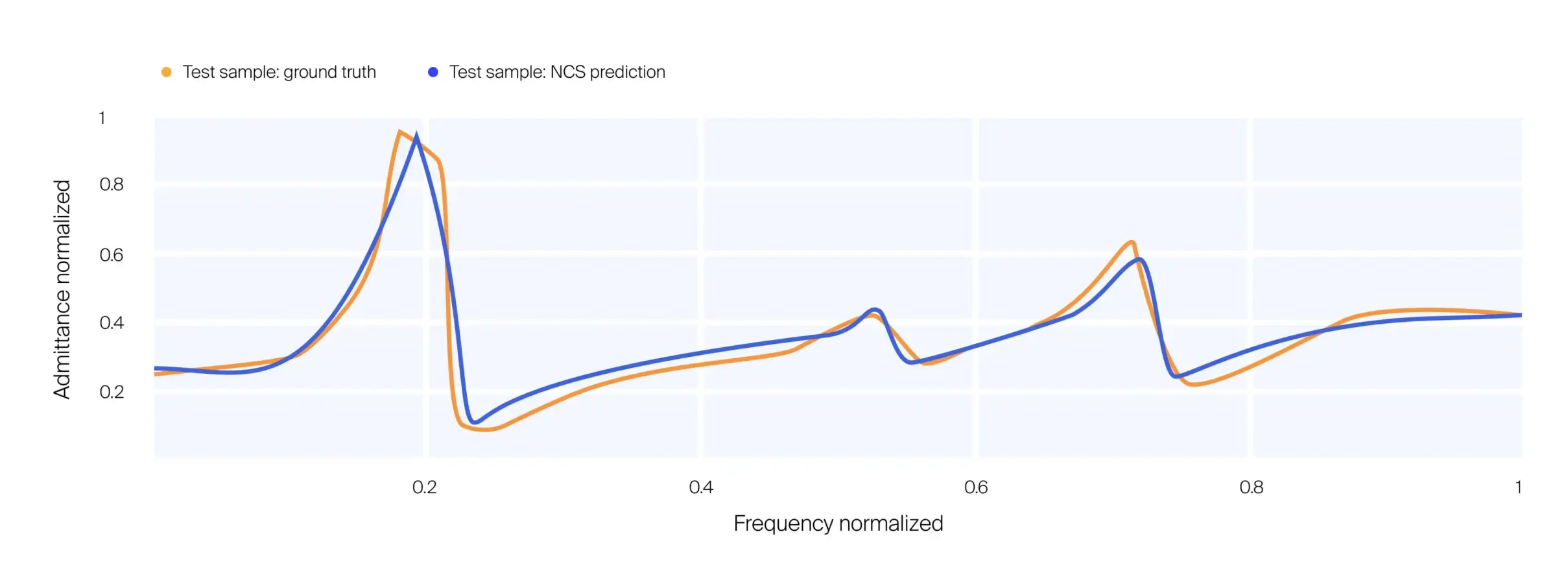
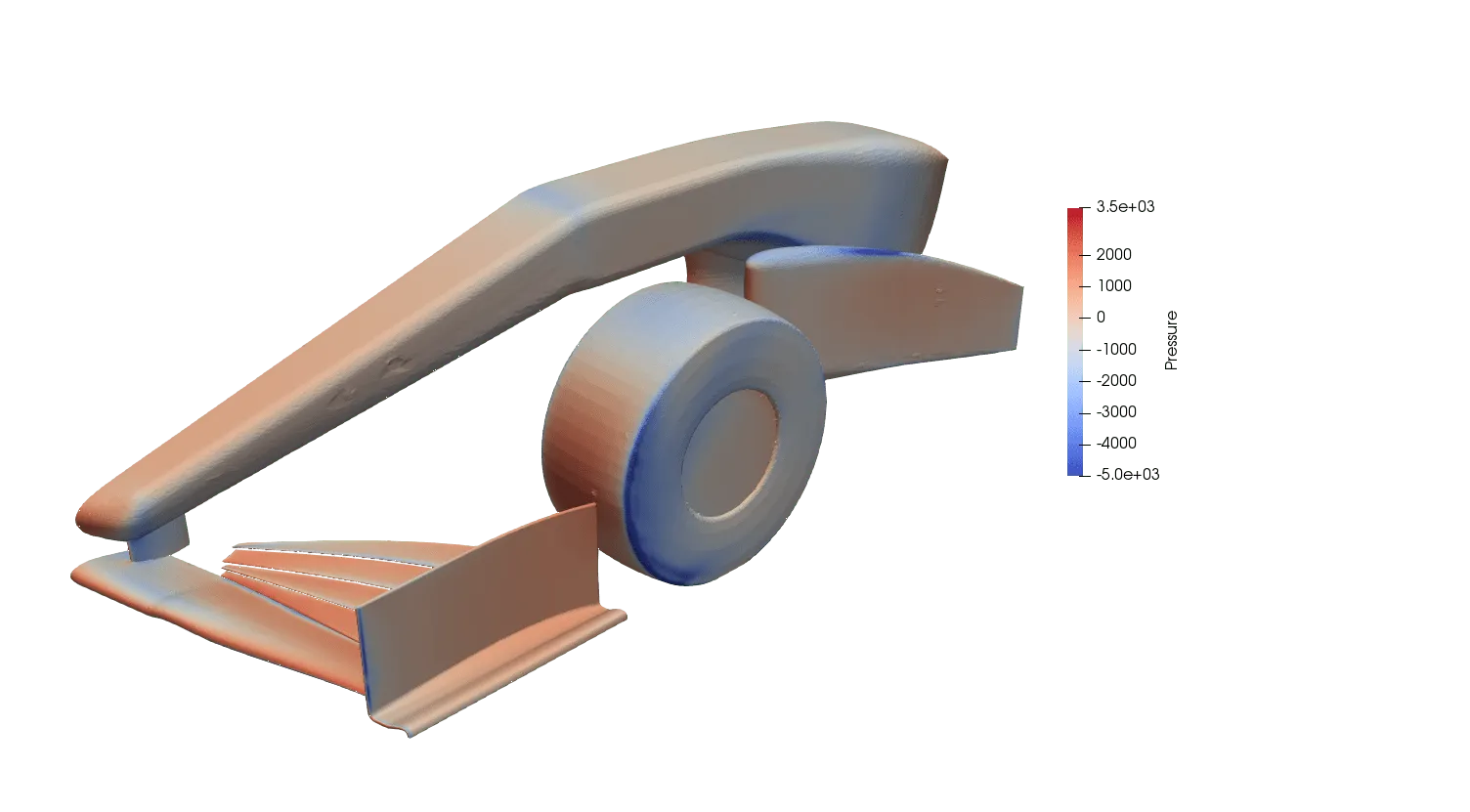
Generative AI vs Predictive AI in Engineering Contexts
The difference between generative and predictive AI is simple. Generative AI creates new content or designs, while predictive AI evaluates or forecasts outcomes from data. In engineering, generative models propose design candidates, while predictive models score them.
Here is how each AI approach works in an engineering context and what they can deliver together:
Predictive AI enables engineers to efficiently forecast key performance indicators within project timelines.
Generative AI produces thousands of new design options within set conditions (objectives and constraints).
Together, these AI methods enable optimization loops that shorten product design cycles from weeks to hours. Predictive surrogate models assess many designs with minimal computational cost, while generative AI produces designs that meet human objectives and constraints.
Table of Contents
What are Artificial Intelligence and Deep Learning?
What are the Core Differences of Generative AI vs Predictive AI?
Engineering Example: Aerodynamics
Generative AI Explained
How to Best Leverage AI?
AI Applications in Engineering: Case Histories
Summary Table
What are Artificial Intelligence and Deep Learning?
Artificial Intelligence (AI) is a field of computer science. AI focuses on building systems that can perform tasks typically requiring human intelligence. Examples are pattern recognition or language understanding. In engineering, the task is to provide a surrogate for simulation software that is originally driven by physical laws.
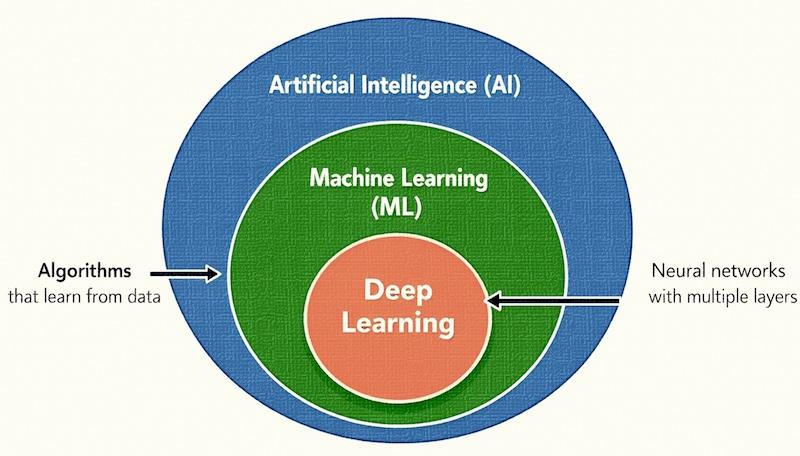
Key subsets of modern AI are:
Machine Learning: Algorithms that learn patterns from data to make predictions or decisions without being explicitly programmed.
Deep Learning is a subset of machine learning that uses multi-layer neural networks to automatically learn hierarchical representations from datasets, enabling tasks such as image recognition and language understanding.
Deep Learning Explained
Deep Learning enables models to learn nonlinear relationships in data. This capability is essential for tasks such as assessing structural failure in automotive components.
Deep Learning serves as the computational core for both predictive and generative AI. Deep Learning also powers natural language processing, a core component of many GenAI applications.
See: Goodfellow, I., Bengio, Y., & Courville, A. (2016). Deep Learning. MIT Press. URL (freely available online): https://www.deeplearningbook.org
What are the Core Differences of Generative AI vs Predictive AI?
Generative AI models learn from data to create new samples similar to, but not identical to, the training data. Predictive AI models analyze data patterns to estimate unknown or future values for decision-making.
What is Generative AI?
Generative AI (Gen AI) refers to models that learn from a dataset (training data) to produce new, statistically consistent samples that resemble the training data but are not identical to it.
Gen AI models act as "creators," for instance, in image generation.
Examples include Large Language Models (LLMs) like GPT and Claude, image synthesis models such as Stable Diffusion, and geometry-generation tools for engineering design. All are based on machine learning or deep learning.
What is Predictive AI?
Predictive AI refers to models that learn patterns in data through statistical analysis. Their focus is on statistical inference: estimating unknown or future values from observed data to support evidence-based decisions.
Predictive AI is deployed across industries, including:
Predictive maintenance of industrial equipment, reducing unplanned downtime
Demand forecasting in retail and supply chain management, improving inventory efficiency
Engineering performance prediction in Formula One aerodynamics, where surrogate models accelerate workflows traditionally based on cumbersome CFD simulations
Takeaway: Both generative and predictive AI extend engineers' capabilities. Integrating them enables creativity and forecasting beyond manual limits.
Engineering Example: Aerodynamics
Before deep learning was adopted, F1 aerodynamics teams relied on traditional methods. Engineers used expensive wind-tunnel experiments or sophisticated analytical models like the Navier-Stokes equations. These equations are highly nonlinear, making real-time solutions infeasible. Although CFD software accurately solves fluid flow equations, it requires costly high-performance computing resources and skilled personnel.
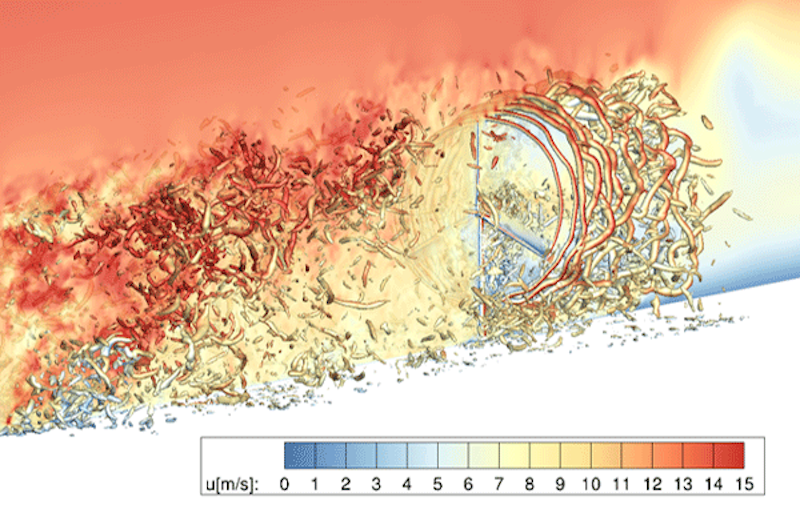
Data-driven (AI) predictive analytics gains a structural edge by learning from historical data to map nonlinear relationships. Once trained, a surrogate AI can predict the aerodynamic coefficients of a new shape. See the review article on Machine Learning to accelerate simulation.
Neural Concept's platform is deployed in exactly this way by the Visa Cash App Racing Bulls Formula One team, where predictive surrogates complement CFD to evaluate thousands of aerodynamic variants per iteration.
Generative AI Explained
Understanding the underlying principles of Generative AI tools further clarifies their potential for innovation.
Most generative AI systems are built on one of three architectural ideas: Transformer Models, Generative Adversarial Networks, and Diffusion Models. Each architecture was conceived to solve a different creative problem. Often, they are combined.
Transformer Models are the dominant architecture for language AI. Transformer models process sequences of text tokens at once, weighing each word against the others, enabling models like ChatGPT to write coherently across sentences.
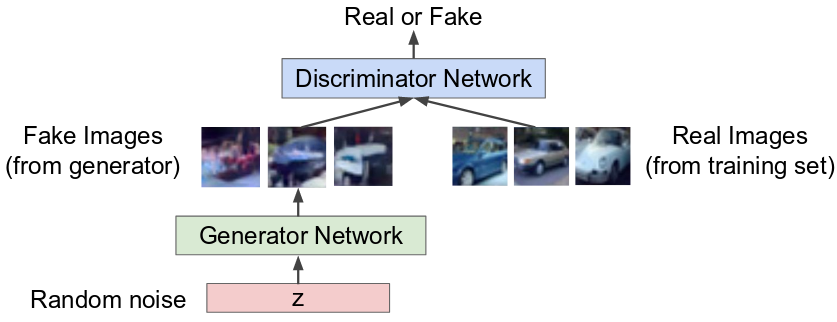
Generative Adversarial Networks pit two neural networks against each other: one network generates fake content; the other tries to expose it as fake. Driven by failure, the generator improves until its output becomes indistinguishable from reality.
Diffusion models "learn to create by first learning to destroy." Diffusion models are trained by adding noise to images, gradually degrading them, then reversing the process to produce images from noise.
Reference: Vaswani, A., et al. (2017). Attention Is All You Need. Advances in Neural Information Processing Systems (NeurIPS). https://arxiv.org/abs/1706.03762
Why is Data the Foundation of Generative AI?
Architectures shape how models think, while data shapes what they know. Therefore, data handling, augmentation, and synthesis are core engineering choices, not just preprocessing steps.
Practical data tips:
In engineering AI projects, always curate your training dataset to include edge cases and rare conditions your model may encounter in real-world deployments.
Augment your data with physics-aware transformations, such as rotating CAD models or perturbing boundary conditions, while ensuring that samples remain physically plausible.
This approach enhances model robustness and performance in novel or rare scenarios.
Real-world datasets are often too small, sensitive, or costly to collect. Two capabilities make generative AI practical:
Synthetic data generation allows a trained model to fabricate statistically plausible examples.
Few-shot learning allows a model to adapt to a new task from as few as five to ten examples, rather than thousands of labeled samples. It matters in industrial applications where labeled data is expensive.
Even when real data is available, it seldom covers all possible conditions. Data augmentation increases variety by transforming samples, such as rotating images, adding noise, or paraphrasing text. Generative AI further improves this process by producing augmentations that are both physically plausible and semantically diverse, reducing bias and overfitting.
Reference: Abdollahzadeh, M., et al. (2023). A Survey on Generative Modeling with Limited Data, Few Shots, and Zero Shot. arXiv. https://arxiv.org/abs/2307.14397
How to Focus on the Essential Difference of Generative AI vs Predictive AI?
Choose generative or predictive AI based on input data and required output.
Input Data: GenAI requires large-scale datasets with millions of samples, whereas predictive AI can operate with smaller, problem-specific datasets.
Typical Outputs: Predictive AI outputs are usually discrete, such as yes/no decisions, prices, or probabilities. GenAI outputs are unstructured, including paragraphs, images, or 3D models.
Common Architectures: Predictive AI often uses random forests or gradient boosting. GenAI typically uses transformers, such as the GPT series, or variational autoencoders (VAEs).
Explainability: Predictive AI offers a transparent approach that allows variables to be weighted. GenAI is often less transparent, making it harder to verify the logic behind its outputs.
Reference: IBM. (2024). "Generative AI vs. predictive AI: What's the difference?" IBM Think. https://www.ibm.com/think/topics/generative-ai-vs-predictive-ai-whats-the-difference
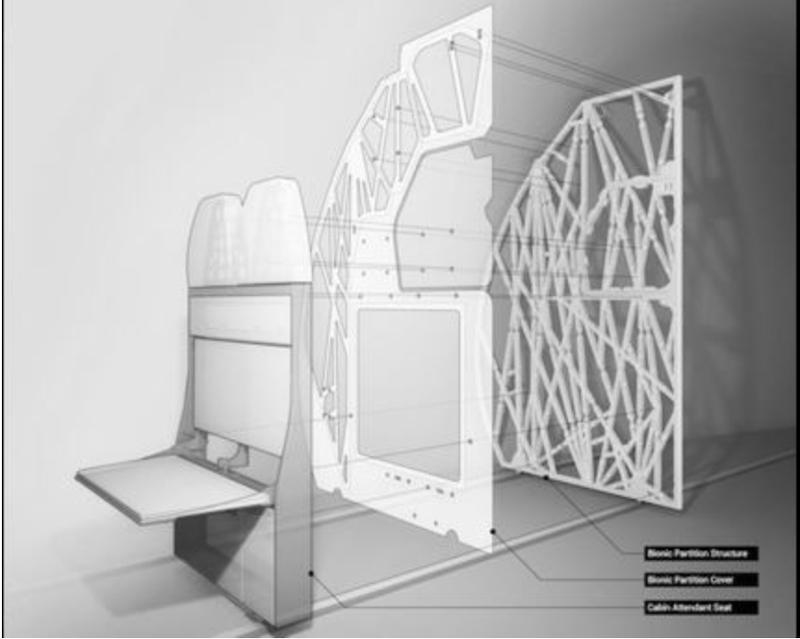
Generative Models Algorithms in Engineering Design
Engineers use generative AI through two main approaches.
Latent space exploration compresses CAD geometries into a low-dimensional space where each coordinate represents a valid design. Optimization searches this space for designs that meet constraints such as stress, weight, or manufacturing rules, then decodes them into geometry. Some systems add a second network to filter unrealistic geometries early, ensuring plausibility before simulation. Because the search spans dozens of variables instead of millions of mesh nodes, generating thousands of candidates is computationally feasible.
Direct geometry optimization works mainly in two ways.
Topology optimization starts with a solid block and removes material based on criteria like stiffness or weight, producing raw shapes that require translation into manufacturable geometry.
Mesh morphing begins with a baseline mesh and deforms it by displacing control points using radial basis functions, while maintaining mesh quality and the CAE setup, thereby enabling faster but limited exploration.
How to Best Leverage AI?
As of 2026, engineers have access to at least three AI approaches: predictive AI models, predictive AI models with optimization algorithms, and AI codesign pilots.
Predictive AI
Predictive AI learns from data to forecast outcomes. AI surrogate models reduce evaluation time from hours to milliseconds, supporting rapid design exploration and making AI-driven simulation valuable for product designers.
As noted by Baqué (2018) for CFD simulations,
"Since the simulation must be re-run each time an engineer wishes to change the shape, this makes the design process slow and costly."
See: Baqué, P., Remelli, E., Fleuret, F., & Fua, P. (2018). Geodesic Convolutional Shape Optimization. arXiv:1802.04016.
Shape Generation: Predictive AI and Optimization
Integrating a predictive model into an optimization loop shifts its role from forecasting to proposing solutions. In generative design, the optimizer proposes designs, the surrogate evaluates them quickly, and the loop iterates over thousands of options. The result is a novel shape meeting aerodynamic, structural, and manufacturing constraints.
The GenAI approach can revolutionize product design. For example, an automotive company could generate hundreds of new car bumper designs that maximize safety and minimize weight, automatically filtering out options that fail strict crashworthiness criteria. By evaluating these AI-generated candidates with predictive models, engineers quickly identify designs that outperform existing products.
AI Design Copilots: Predictive AI and Prompting
At CES 2026 in Las Vegas, Neural Concept demonstrated how to incorporate natural language into simulations. Engineers can now ask AI direct questions, such as "What happens to drag if I raise the roofline by 20mm?"
See https://www.digitalengineering247.com/article/neural-concept-debuts-physics-aware-ai-design-copilot.
AI Applications in Engineering: Case Histories
The case histories below show how industry leaders accelerate slow, iterative testing by training Deep Learning models on historical CAE simulation data (CFD or FEA).
Deep Learning models serve as surrogates for CFD or FEA, predicting physical behavior in near real time. Deep learning can enable over 10,000 predictions per day, supporting more design iterations. The generative approach uses algorithms to produce iterations, while humans define objectives and constraints.
TL;DR: The following cases are summarized in the table.
Organization | AI Application | Engineering Challenge | Key Outcome / Result |
|---|---|---|---|
Visa Cash App Racing Bulls (F1) | Predictive AI (Surrogate) | Accelerating CFD workflows for vehicle aerodynamics. | Evaluates thousands of variants per iteration. |
Airbus | Predictive AI (Surrogate) | Optimizing fuel efficiency across the entire commercial flight envelope. | Reduced prediction time from 1 hour to 30 milliseconds (3 orders of magnitude speedup). |
General Motors | Predictive AI (Surrogate) | Meeting global pedestrian safety regulations via crash simulations. | Predicts Head Injury Criterion in seconds rather than days, accelerating safety assessments. |
MAHLE | Generative & Predictive Loop | Designing an EV radial blower for air conditioning. | Explored millions of iterations; achieved 15% more efficiency and 4 dB noise reduction. |
SenseFly / AirShaper | Generative & Predictive Loop | Maximizing autonomy range through lift-to-drag optimization. | Generated an optimized airfoil-like fuselage while maintaining lift targets. L/D ratio increased by +4.25%, drag reduced by -6.25% at max L/D |
UAV Aerodynamics: Design Optimization
This optimization aimed to maximize a UAV's autonomy range, using a module within the AI tool to define objectives and constraints.
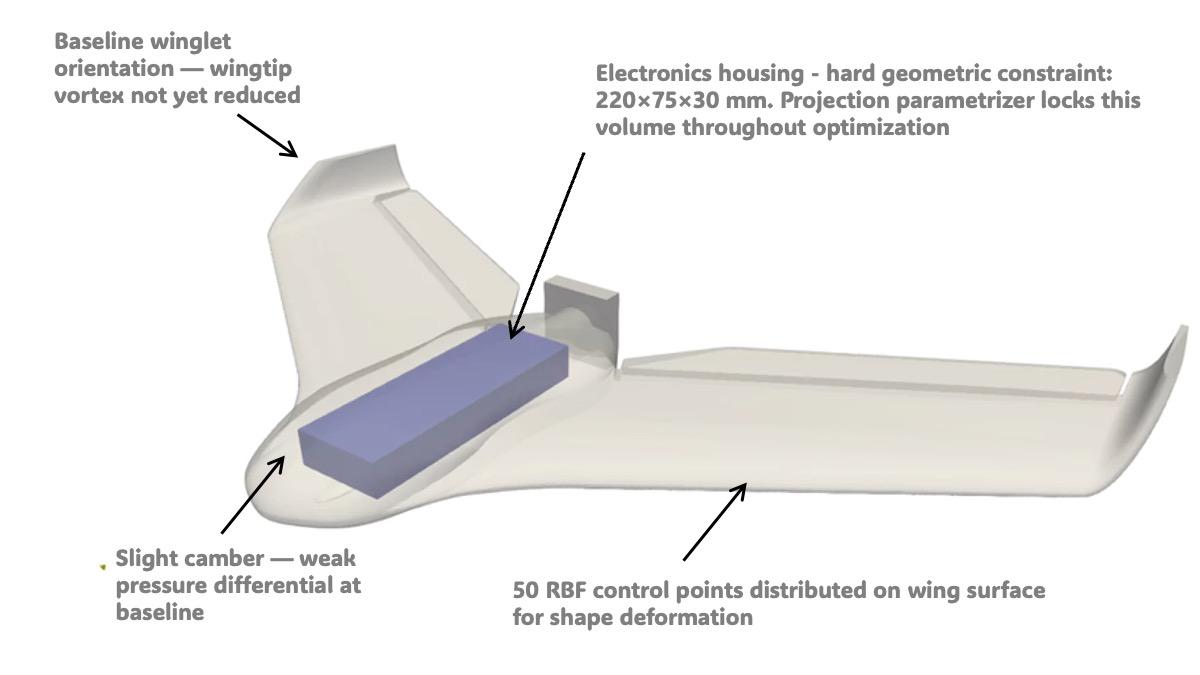
The objective is to maximize the lift-to-drag ratio while maintaining a lift greater than 8 N. Multiple configurations are generated during the optimization iterations, as shown in the figure below.
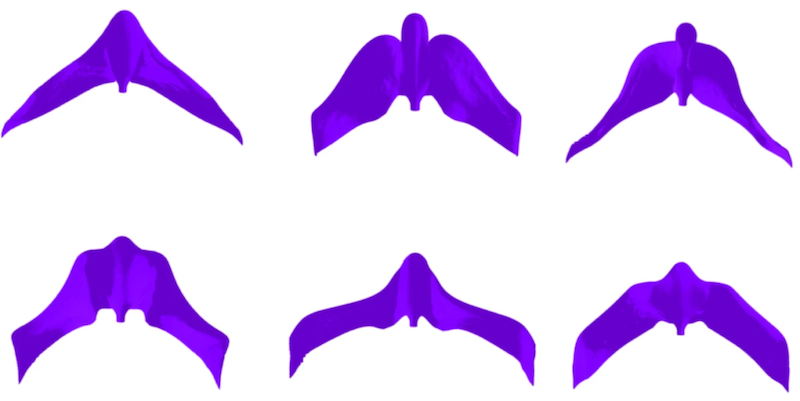
In this project, supported by the Neural Concept platform, the optimized fuselage adopted a more airfoil-like design, featuring a low leading edge and significant camber along its length.
The lift-to-drag ratio increased by 4.25%, and the drag was reduced by 6.25% at maximum L/D.


For more information, please refer to the white paper on UAV aerodynamics.
Automotive: Generative and Predictive AI Loop
Together, generative and predictive form a closed optimization loop. Generative AI proposes, predictive AI evaluates; the cycle repeats.
What once took weeks of compute time and engineering hours is compressed into hours, with solution quality improving with each pass.
MAHLE explored virtually millions of design iterations to develop a radial blower for EV air conditioning, landing on a component that is 15% more efficient and 4 dB quieter than its predecessor.
Aerospace: Reducing Lead Times with Airbus
Traditional aerodynamic simulations for a commercial aircraft's flight envelope can require hours per data point.
Challenge: Evaluating thousands of operating conditions, such as velocity and angle of attack, to optimize fuel efficiency.
Solution: Airbus reduced prediction times from hours to milliseconds with an AI surrogate.
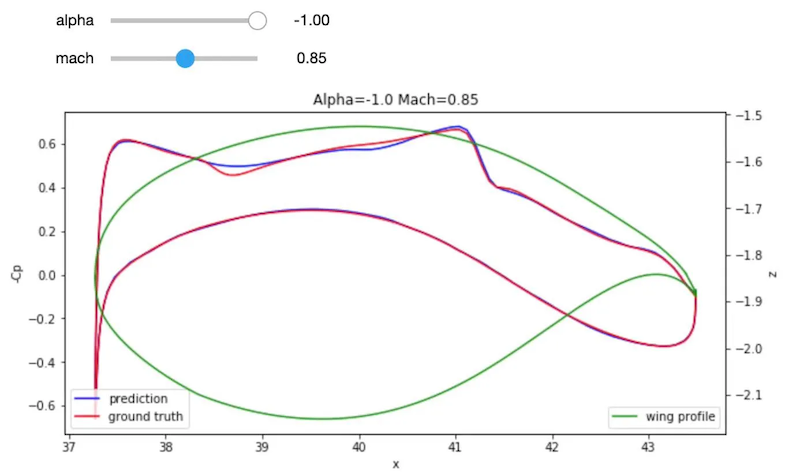
Result: Engineers can now analyze the entire flight envelope in seconds. Airbus reduced the average time to predict the pressure field on the aircraft's exterior from 1 hour to 30 milliseconds, achieving a speedup of over three orders of magnitude.
Refer to the Airbus aerodynamics optimization case for more details.
Automotive: Predictive AI for Pedestrian Crash Safety - General Motors
Meeting global pedestrian safety regulations requires numerous design iterations, each involving hundreds of finite element crash simulations. At that volume, traditional FEA becomes the bottleneck: a single simulation run can take hours, and a full vehicle program spans over 100 impact locations for adults and children across multiple design variants.
General Motors addressed this by training Neural Concept's AI platform on internal crash-simulation data from 11 vehicle programs.
The resulting surrogate model predicts the Head Injury Criterion, a vital metric in pedestrian crash safety, for new vehicle geometries in seconds rather than days.
Engineers can now assess crash safety performance continuously throughout the design process, rather than waiting for simulation queues to clear, giving them a real-time view of how geometric changes affect pedestrian protection before any physical test.
Summary Table
Here is a comparison of generative and predictive AI across engineering use cases, outputs, data, and performance trade-offs in practical workflows.
Feature | Generative AI | Predictive AI |
|---|---|---|
Objective | Creation & Expansion: To generate new, novel design candidates or data points that don't yet exist. | Evaluation & Forecasting: To analyze existing data and predict specific performance outcomes or future states. |
Primary Output | New content, 3D geometries, synthetic datasets, or optimized design variations. | Performance scores, failure probabilities, KPIs, and data-driven forecasts. |
Engineering Use Case | Proposing 1,000 aerodynamic wing shapes that fit within specific physical constraints. | Forecasting the drag coefficient or structural stress of a specific wing design in milliseconds. |
Role in Workflow | The "Creator". Engine for design exploration and innovation. | The "Evaluator". Acts as a surrogate model to replace slow, traditional simulations. |
The loop above — generative AI proposing shapes, predictive AI scoring them in milliseconds — is what Neural Concept builds as an engineering intelligence layer. Trained on your own CAD and simulation history, it turns a design space that once took weeks of CFD or FEA to explore into an iteration loop measured in hours, the same pattern behind the Airbus, General Motors, and MAHLE cases above. It is already used by more than 70 OEMs and Tier 1 suppliers.
Ready to combine generative exploration with predictive evaluation on your own designs? Discover the Neural Concept platform.
FAQ
What does each type of AI produce?
Generative AI produces novel content, such as a new F1 wing shape. Predictive AI focuses on estimating future events and trends, i.e., predicting outcomes for content such as "how will this new F1 wing aerodynamics perform?"
What is the core difference between generative AI and predictive AI?
Generative AI uses deep learning models to create new content, while predictive AI employs statistical algorithms to analyze data and make predictions. Generative AI is trained on datasets containing millions of samples, whereas predictive AI can work with smaller, targeted datasets.
Which type of AI is easier to interpret?
Generative AI models often lack explainability, making it difficult to understand their decision-making processes, whereas predictive AI estimates are generally more explainable because they rely on statistical methods.
What are the differences in generative vs. predictive treatment of data?
Generative AI works best with large amounts of data to deliver new creative content. Predictive works best with high-quality data to deliver accurate predictions.
How can Gen AI help humans and business processes?
Generative AI can produce content more quickly than human employees, thereby increasing workplace productivity. Generative AI can help businesses save time, lower costs, and optimize resources.
What are the typical outputs of each approach?
Predictive AI outputs are typically discrete and structured: a yes/no classification, a numerical score, or a probability between 0 and 1. Generative AI outputs are unstructured and open-ended: a paragraph of text, a rendered image, or a new CAD geometry. In engineering, predictive AI outputs a drag value or a stress field; generative AI outputs a candidate shape that satisfies a set of constraints.
What are common applications of predictive AI?
Predictive AI applications include business forecasting, risk analysis, fraud detection, and personalized recommendation systems. Predictive AI can help retail businesses predict customer purchasing behavior to optimize supply chain and marketing strategies. Predictive AI can analyze patient data to assist with early disease detection by identifying historical patterns.
How does generative AI support software development?
Generative AI helps developers by generating code from natural language prompts, reducing time spent on boilerplate and repetitive tasks. Models like GitHub Copilot and GPT can suggest functions, translate code, and generate tests. Gains vary by task: code generation and refactoring benefit most, while architecture remains human-driven.
How is generative AI used in education and media?
Generative AI can be used in educational settings to create unique learning materials for students. Generative AI can also produce speech and music. Generative AI can generate original art or realistic images from natural-language descriptions.
What algorithms underpin each type of AI?
Predictive AI uses regression, decision trees, and classification algorithms. Generative AI uses neural network architectures, such as Generative Adversarial Networks, to generate content. Choosing between them depends on your specific business goals, expectations, and needs.
What do generative AI and predictive AI have in common?
Both generative AI and predictive AI require significant computing power and datasets to function effectively and predict future outcomes of designs. Both learn from historical data, but generative AI uses that learning to create new content while predictive AI uses it to forecast future outcomes.
What role does data quality play in the AI revolution?
The shift from raw data to actionable intelligence is central to both generative and predictive AI. Predictive models need high-quality data to forecast trends reliably, as input noise compounds errors. Generative AI adds another layer: beyond learning from existing data, it can produce synthetic datasets and new samples when real-world data collection is impractical. Gen AI transforms data science workflows by extending models trained on a few examples with plausible synthetic samples.
What are the key differences between generative and predictive?
Predictive AI focuses on future predictions for structured tasks: given big data on past behavior, it estimates what comes next, whether that is an equipment failure or a demand spike that drives inventory management decisions. Generative AI applications are broader: they produce software code, text, images, and synthetic datasets that share the statistical properties of real-world data. The key differences are in the objective. Predictive AI narrows uncertainty about future outcomes; generative AI expands the space of possibilities.