From weeks to seconds: how GM is moving pedestrian safety to the start of vehicle design
- Customer
- General Motors
- Industry
- Automotive
- Application
- Pedestrian crash safety
- Outcome · Time to insight
- From weeks to seconds
Overview
At NVIDIA GTC 2025, General Motors presented an AI co-pilot built on the Neural Concept platform and trained on crash simulation data from 11 vehicle programs. Validated by GM’s engineers, it assesses a key pedestrian safety metric for new designs, turning what once took weeks of simulation into real-time feedback.
Challenge
Pedestrian safety rarely sells a car. But it protects the people most exposed on the road.
For pedestrians and cyclists, the vehicle’s front end is their protection. In the US alone, a pedestrian was killed every 72 minutes in traffic crashes in 2023, according to NHTSA. Global standards such as GTR and NCAP make vulnerable road user protection a requirement for every new vehicle, for adults and children alike.
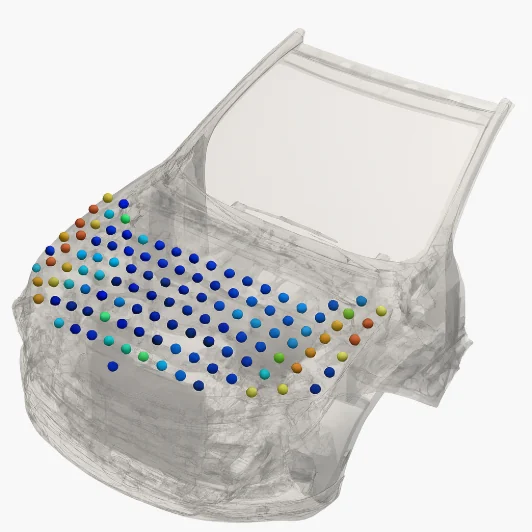
Meeting them means evaluating hundreds of impact scenarios: different body types, speeds, angles and impact locations across the hood. Each one traditionally requires a full finite element simulation, often two hours and up to 256 CPUs per run.
A single design iteration can take weeks, and safety competes with other attributes. A bumpier hood might better protect pedestrians, yet degrade aerodynamics, reduce range and clash with styling. When every extra iteration puts the program timeline at risk, designers may settle on a compromise where a better one could have been found.
Solution
GM’s crash data trained the co-pilot. GM’s engineers validated it.
Powered by Neural Concept, GM set out to give its designers a 360° view of the design process, with decisions assisted by AI and fully data-driven. The aim: more fluid access to crash performance information, so the right level of pedestrian safety can be guaranteed while working on every other vehicle attribute.
The approach turns the crash simulation data GM generates every day into a model that learns the underlying physical behavior. GM’s engineers trained the co-pilot on internal data spanning 11 vehicle programs, GTR and NCAP standards, and more than 100 impact locations per vehicle, for both adults and children. It learned to assess the Head Injury Criterion, a critical pedestrian safety metric, without relying solely on finite element analysis.
The work presented at GTC set out to verify that the co-pilot could assess these safety metrics on new designs, and potentially recommend design improvements or trade-offs. GM’s engineers confirmed it captured nuanced, localized interactions, such as how wiper motors or latches influence hood deformation.
“At General Motors, we are actively exploring the transformative potential of Artificial Intelligence in vehicle design and engineering. Through our collaboration with Neural Concept, we’ve been able to evaluate the significant value and high potential of AI-driven workflows, particularly in accelerating design processes and predictive modelling. This collaboration is helping us to structure and define a roadmap that will enable us to integrate these innovative methodologies effectively across our organization, ensuring we can fully leverage their capabilities to enhance efficiency in engineering workflows, enabling faster exploration of design possibilities.”
Impact
Weeks → secondsTime to pedestrian safety insight
11Vehicle programs in the training data
The first outcome is a validated AI co-pilot for VRU safety, built on GM’s proprietary crash data. It gives safety specialists a way to accelerate their daily work and build better recommendations.
What’s next
The next phase brings the co-pilot earlier in the design process, directly to designers working across disciplines.
Related content
- NVIDIA GTC 2025 session Revolutionize Pedestrian Safety: AI-Powered Crash Worthiness
- Press release Neural Concept Demonstrates Engineering AI Platform Integrated with NVIDIA Omniverse Blueprint at NVIDIA GTC
- ADAS & Autonomous Vehicle International AI, GM and VRUs (September 2025)
Read next