AI defect detection for smarter quality control
Defect detection is decisive in manufacturing. A single undetected defect can trigger costly recalls, damage reputation, and lead to post-sale liabilities: for instance, warranty costs can exceed the original production cost. Strong quality control prevents these losses in high-volume, low-margin production.
AI-based defect detection uses computer vision and machine learning to automatically inspect parts on the production line. A model trained on labeled examples reads an image or sensor signal from each unit and, in milliseconds, decides whether it meets specification, then records where and how any defect occurs.
This guide is written for quality and manufacturing engineers, operations managers, and engineering leaders. It covers what undetected defects cost and how to deploy detection on a production line.
AI defect detection enhances manual visual inspection, which is error-prone and slow in high-volume settings. Artificial intelligence reduces information costs and extends inspection to situations once considered too complex or expensive to monitor. Learn more about industrial AI.
The cost of not deploying AI systems for data-driven automated inspection is high. When companies fail to identify defects and faulty products reach customers, they face returns, warranty payouts, and falling sales:
- 75% of manufacturers experienced a product recall in the past five years.
- Of those, 48% put the cost of a single recall at $10 million to $49.99 million before brand damage, delayed launches, and plant shutdowns.⁽¹⁾
Even internal defects erode margins through scrapped materials, rework, and halted production lines, and severe automotive or electronics failures have caused losses in the billions.
What are defects in manufacturing?
A defect is any deviation from the intended design or functional specification of a product that affects performance, reliability, or safety. As a first defect classification, product defects fall into three groups:
- surface defects (scratches, cracks, discolorations),
- hidden defects beneath visible layers (delaminations, voids),
- internal defects within the material or structure.
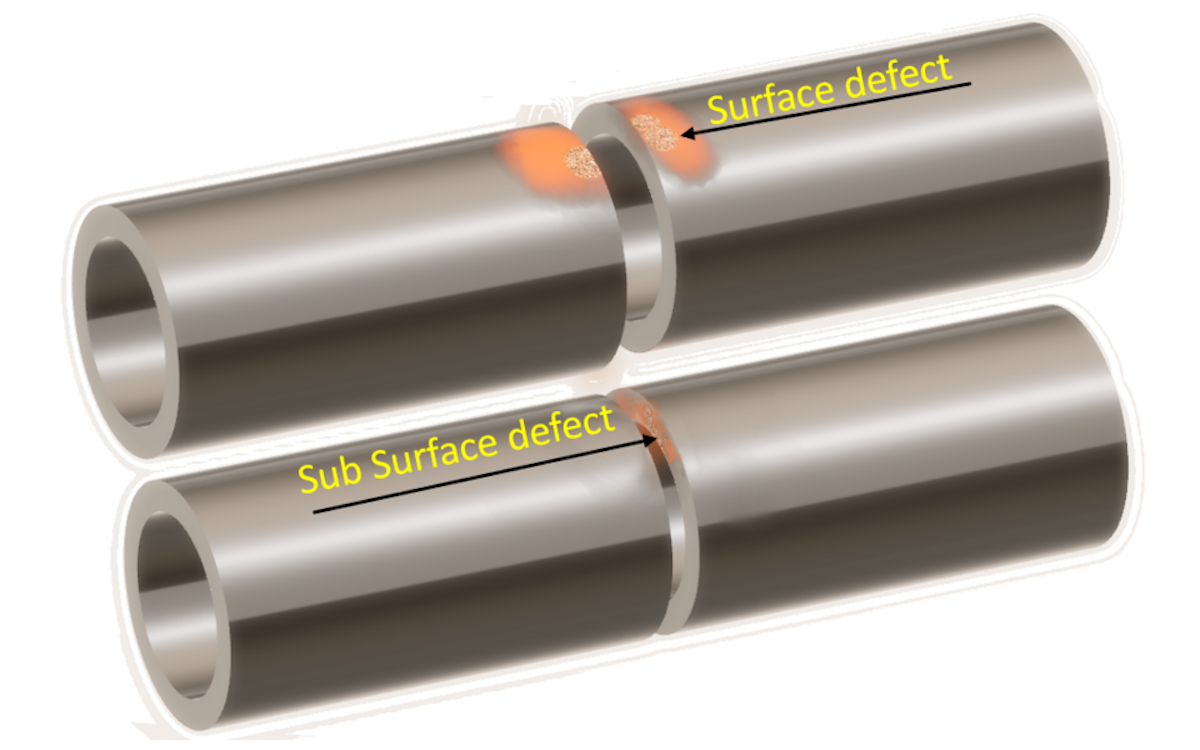
Defects occur because of material and process variation, fatigue damage under cyclic loading that initiates cracks from pre-existing flaws (see cyclic loading and fatigue), tool wear or misalignment, process parameter drift, environmental effects, human error, and assembly errors.
From manual inspection to computer vision
Defect detection evolved from individual craft judgment to statistical process control and, more recently, to the data-driven computer vision that defines Quality 4.0.
Early production
In early production, inspection was inseparable from skilled judgment. Statistical quality control then introduced probabilistic reasoning: variability was measured and managed rather than assumed away. W. Edwards Deming showed that up to 94% of defects stem from systemic causes only management can fix, and he advocated building quality into the production process rather than relying on post-production human inspection.
Automated detection
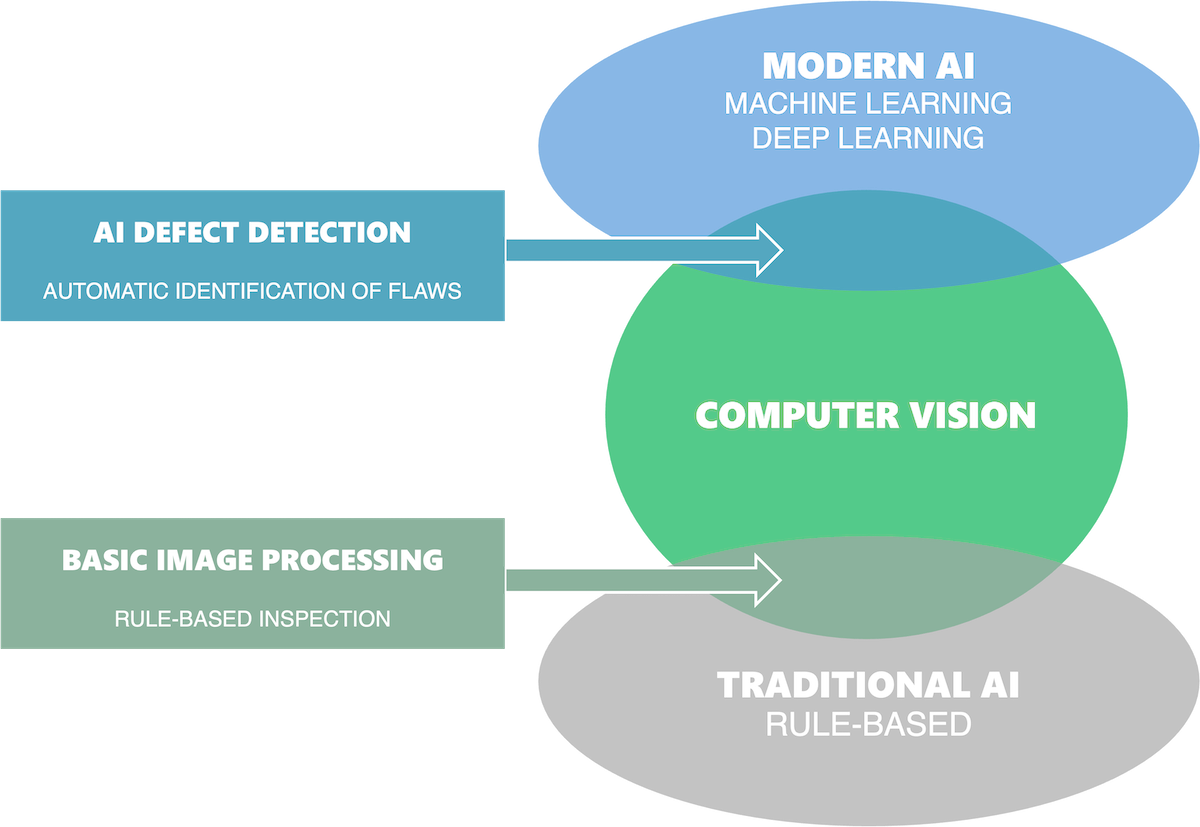
Automated defect detection followed, embedding sensors and rule-based computer vision systems directly into production lines (see the advantages of manufacturing automation).
These systems handled stable defects but struggled with complex textures, changing illumination, and previously unseen flaws, while human inspectors suffer fatigue, limited attention at speed, and inter-operator variability. These limits motivated data-driven methods that learn defect patterns from collected data rather than relying on fixed rules.
Optimal inspection
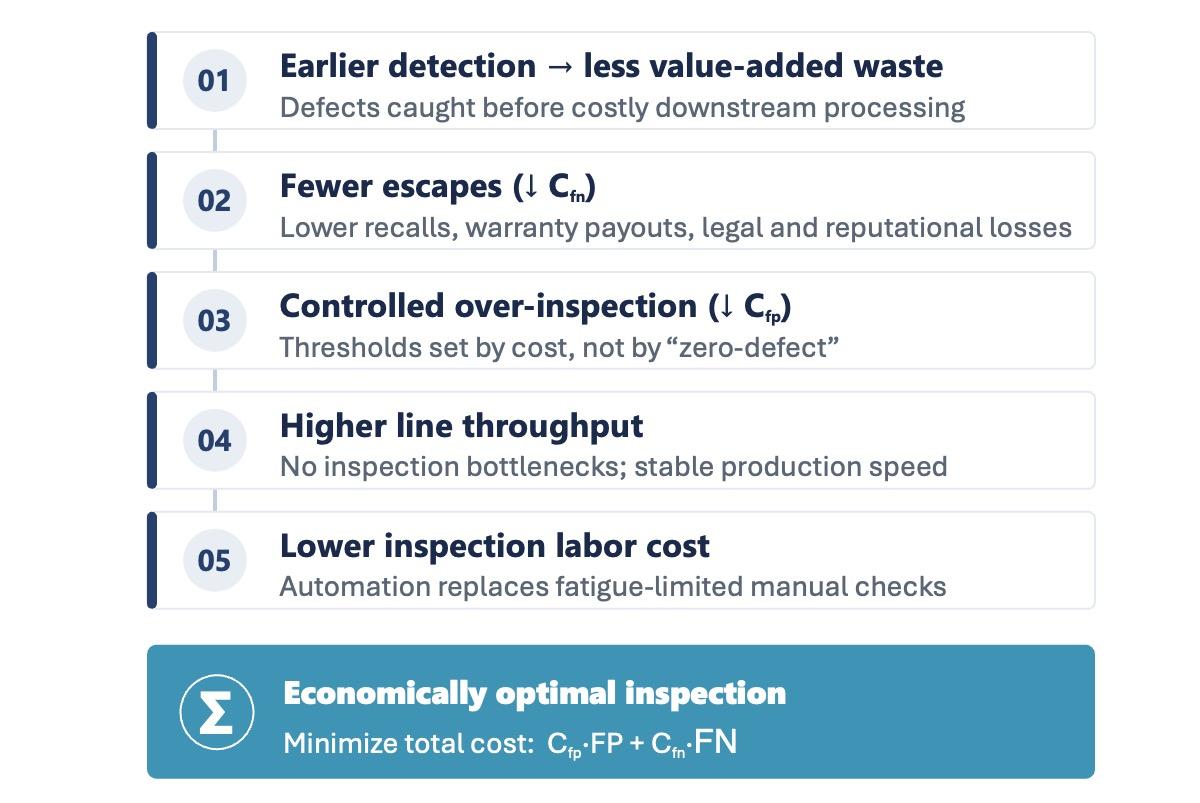
In defect detection, decisions carry economic weight beyond pure statistics. Balancing false positives (unnecessary rework) against false negatives (missed defects) requires cost-weighted thresholds. The goal is optimal inspection that minimizes total expected cost, rather than chasing maximum detection at any price.
ConceptDefinitionImplicationFalse Positive (Type I)Defect flagged where none existsWastes inspection resources; unnecessary reworkFalse Negative (Type II)Real defect missedDefective product reaches customer; liability riskCost-Weighted ThresholdDecision threshold incorporating costs of errorsBalances false positives vs false negativesOptimal InspectionDetection level minimizing total expected costAccepts some misses to reduce over-inspection costs
How does AI detect defects?
With AI, defect detection relies on machine learning and deep learning models trained on production data rather than hand-written rules.
These systems differ from everyday LLMs such as ChatGPT (read this perspective on the engineering experience in AI).
They are purpose-built for vision and signal analysis (see the key differences between ML and LLM).
How AI works in defect detection
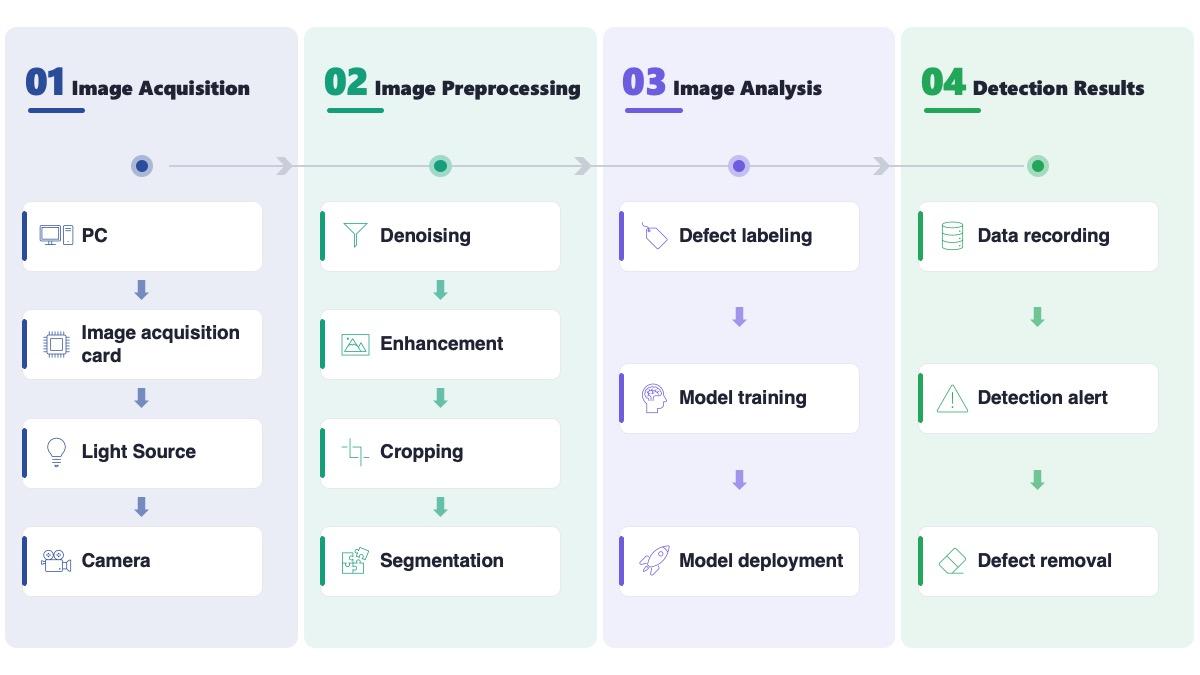
AI-based defect detection combines industrial imaging with machine learning algorithms trained on real production data to detect defects and identify defective products automatically:
- Image acquisition: high-resolution cameras and sensors capture large volumes of visual data on the assembly line under tightly controlled lighting conditions.
- Training: performed offline. Engineers collect and label datasets of good parts and known defect types. Model training runs on proprietary labeled data or on pre-trained models, and the development process repeats whenever new defect types or conditions appear.
- Detection and localization: the deployed AI model classifies each part, names the defect, and locates it with bounding boxes or heatmaps to drive rejection or operator review.
- Real-time inference runs in milliseconds per image on industrial PCs or edge devices, enabling integration with high-speed lines.
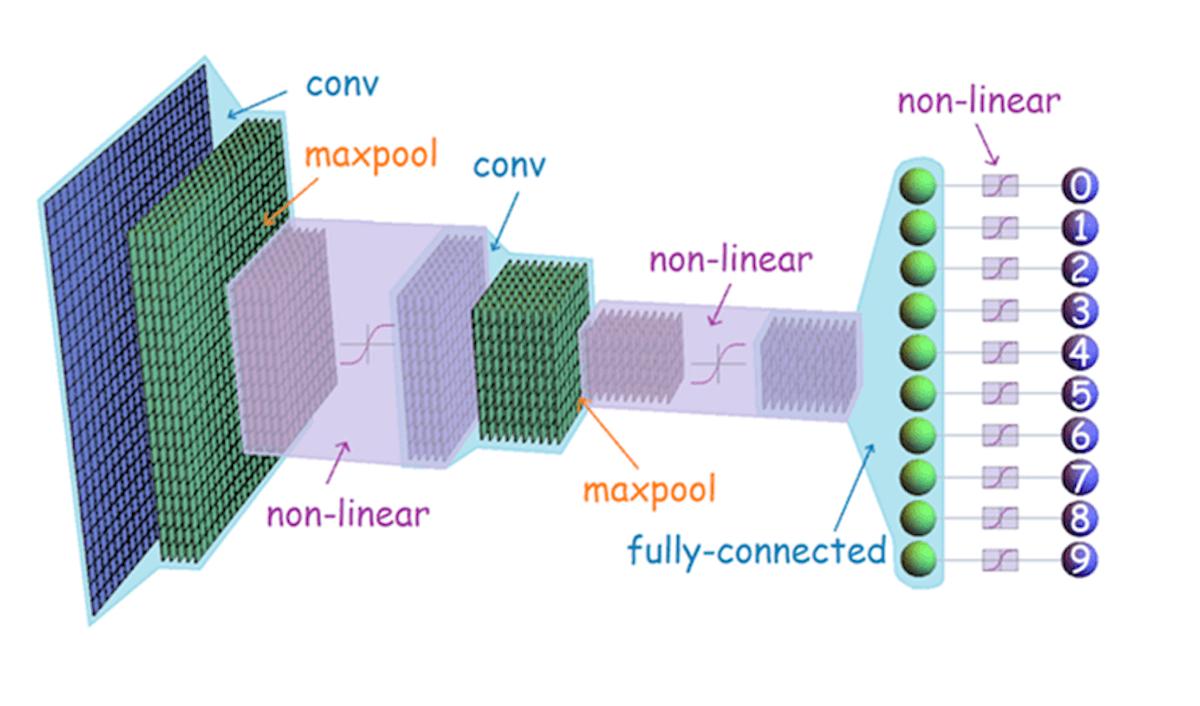
Most modern AI visual inspection relies on convolutional neural networks (CNNs): early layers extract edges and textures, while deeper layers encode defect semantics.
Computer vision algorithms built on advanced AI algorithms and trained on large datasets of labeled images detect flaws and surface defects with remarkable precision, catching even the smallest imperfections that the human eye misses at line speed.
Why AI inspection outperforms manual inspection
Unlike human inspection, AI does not fatigue. AI works without performance loss, analyzes thousands of images per second, and scales across multiple inspection points.
It delivers automated quality control through advanced AI algorithms that interpret visual data to spot defects, improve operational efficiency, and reduce waste.
Rather than replacing engineers, automated inspection removes repetitive tasks, allowing engineers to focus on root cause analysis.
AI defect detection across industries
AI defect detection solutions apply across automotive, electronics, aerospace, pharmaceuticals, food and beverage, and consumer goods. Impact is greatest in high-volume sectors where defects cause recalls or safety risks.
Electronics
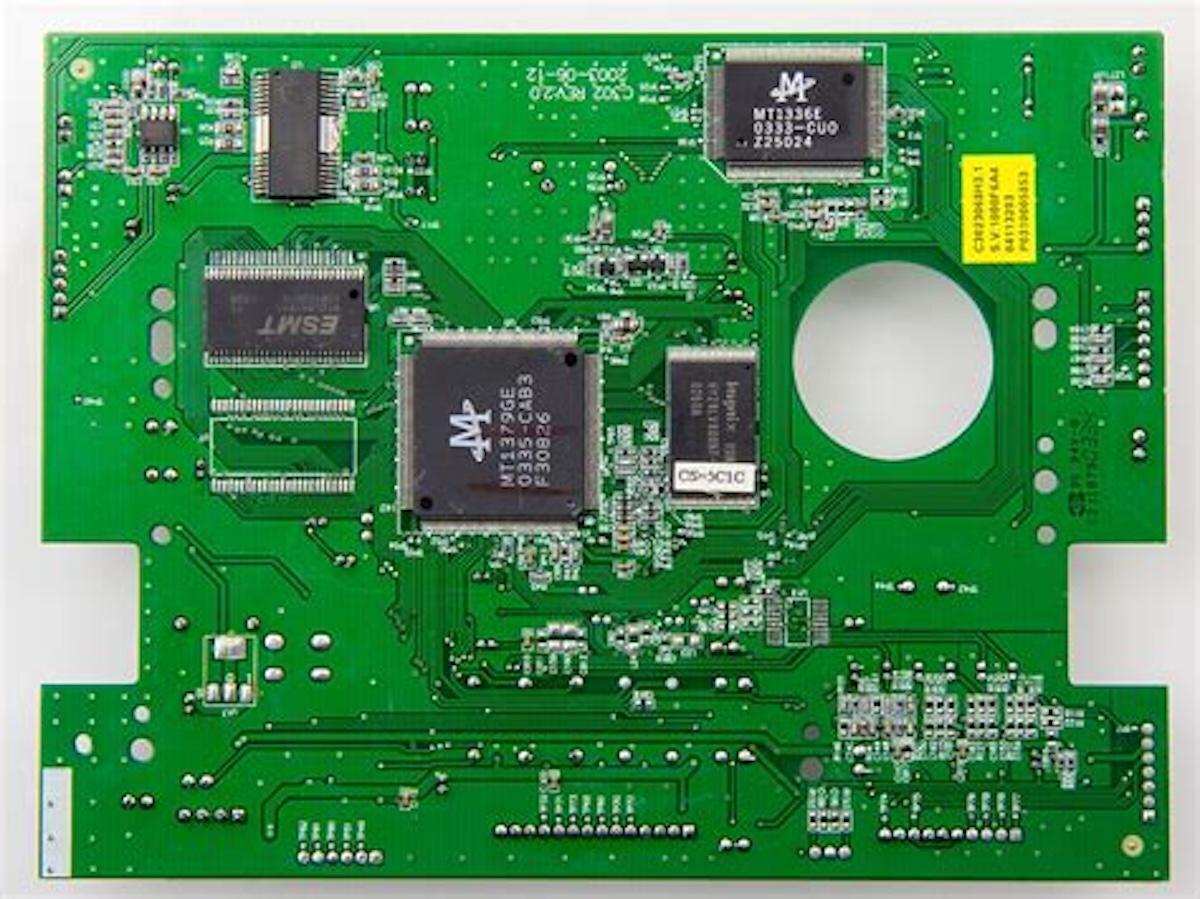
On printed circuit boards, common defects include solder bridges, insufficient solder, and component misalignment, any of which can cause shorts or field failures. High-resolution cameras image every board, and CNN-based AI visual inspection detects a 0.1 mm misalignment that humans miss at speed, flagging defects at 95-99%+ accuracy and cutting scrap.⁽²⁾
Automotive industry
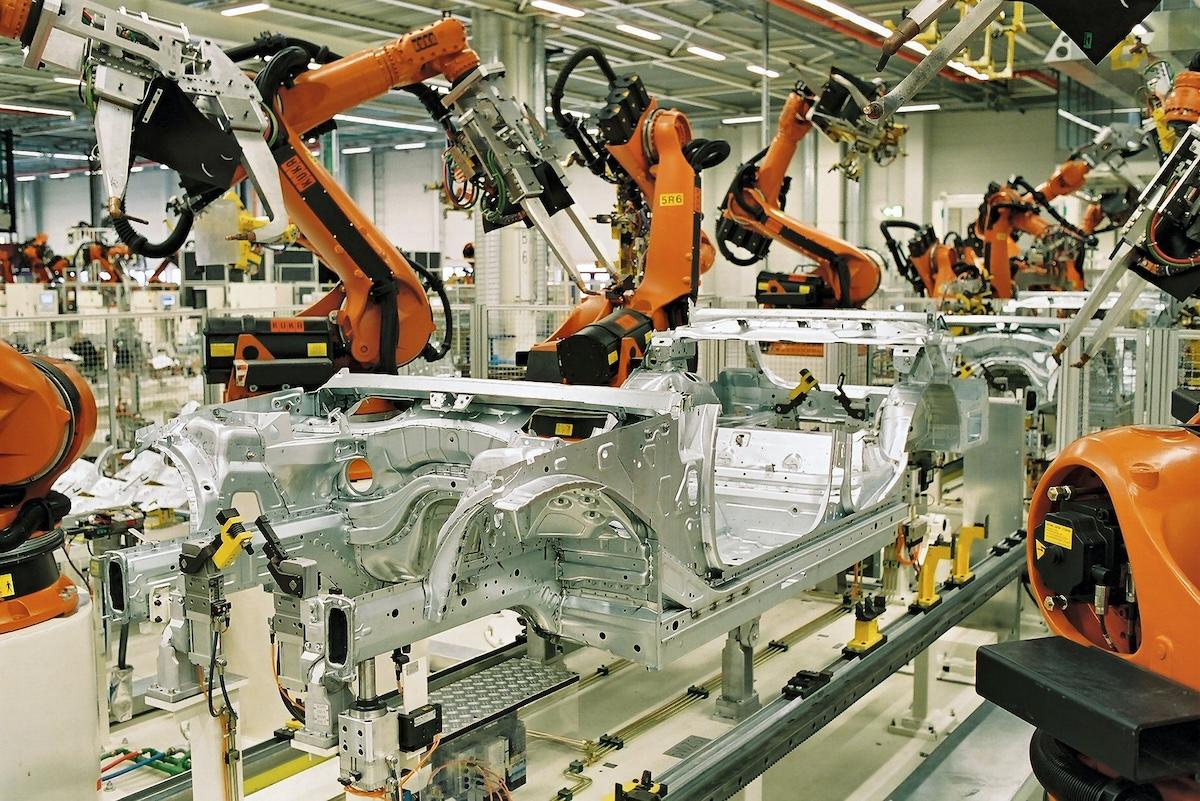
On automotive assembly lines, AI scans body panels for surface scratches and structural cracks in real time, classifying their severity and marking their exact locations. BMW uses CNN models to inspect painted surfaces, reducing flaws by nearly 40% and lowering warranty claims (learn more about modeling structure and fatigue with AI).⁽³⁾
Food packaging
In sealed food packaging, defects such as incomplete seals or foreign objects can lead to contamination and spoilage. AI inspects every package at high speed, comparing it to learned examples of perfect seals and instantly removing faulty products, as in SolVision seal inspection.⁽⁴⁾
Textiles
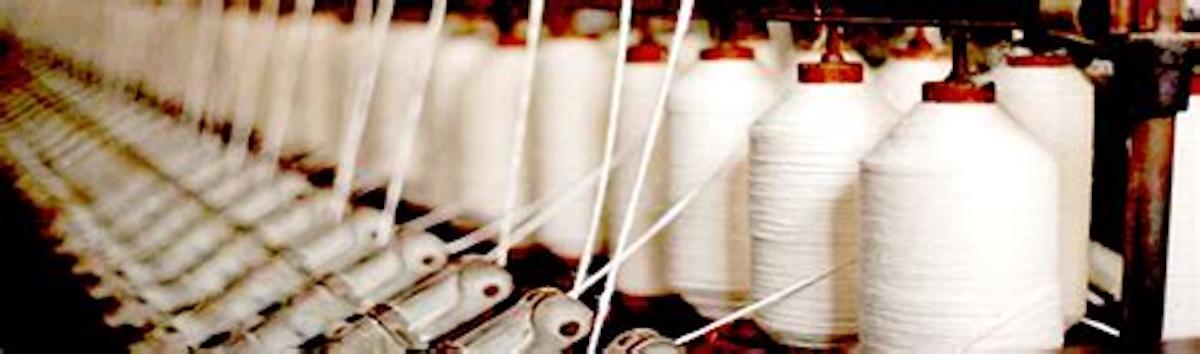
In the textile industry, AI imaging detects different defects such as holes, broken yarns, stains, and color inconsistencies in continuous fabric streams, identifying issues that threshold-based systems miss and supporting sustainable manufacturing processes by reducing downstream waste.
Challenges in adoption
Adoption raises technical and economic challenges. Technically, model accuracy depends on representative training data covering normal variation, rare defects, and borderline cases; labeling is costly, and errors propagate. Manufacturing environments are not static, so changes in materials, lighting, or suppliers require periodic retraining. Integration must synchronize with line speed and rejection mechanisms without creating bottlenecks.
Economically, upfront investment in hardware, software, and process redesign can be significant for low-margin producers. The business case rests on avoided downstream costs: less waste, fewer recalls, lower warranty exposure, and steadier throughput, which improve operational efficiency. Returns are highest where defect costs and volumes are high (see the role of AI in predictive maintenance).
Best practices
To deploy an AI defect detection system reliably, manufacturers should:
- Start with representative data. Collect diverse labeled images that span product variations, common and rare defect types, and acceptable parts.
- Label accurately and consistently. Expert labeling with clear defect definitions reduces false positives and missed defects.
- Integrate with the production line. Position high-resolution cameras at critical points and connect to existing quality control systems and rejection mechanisms.
- Monitor and retrain. Track precision and recall, and retrain on new data as designs and materials change to hold accuracy above quality standards.
- Enable traceability. Turn the digital records into data-driven insights and a proactive approach to quality.

From detection to elimination
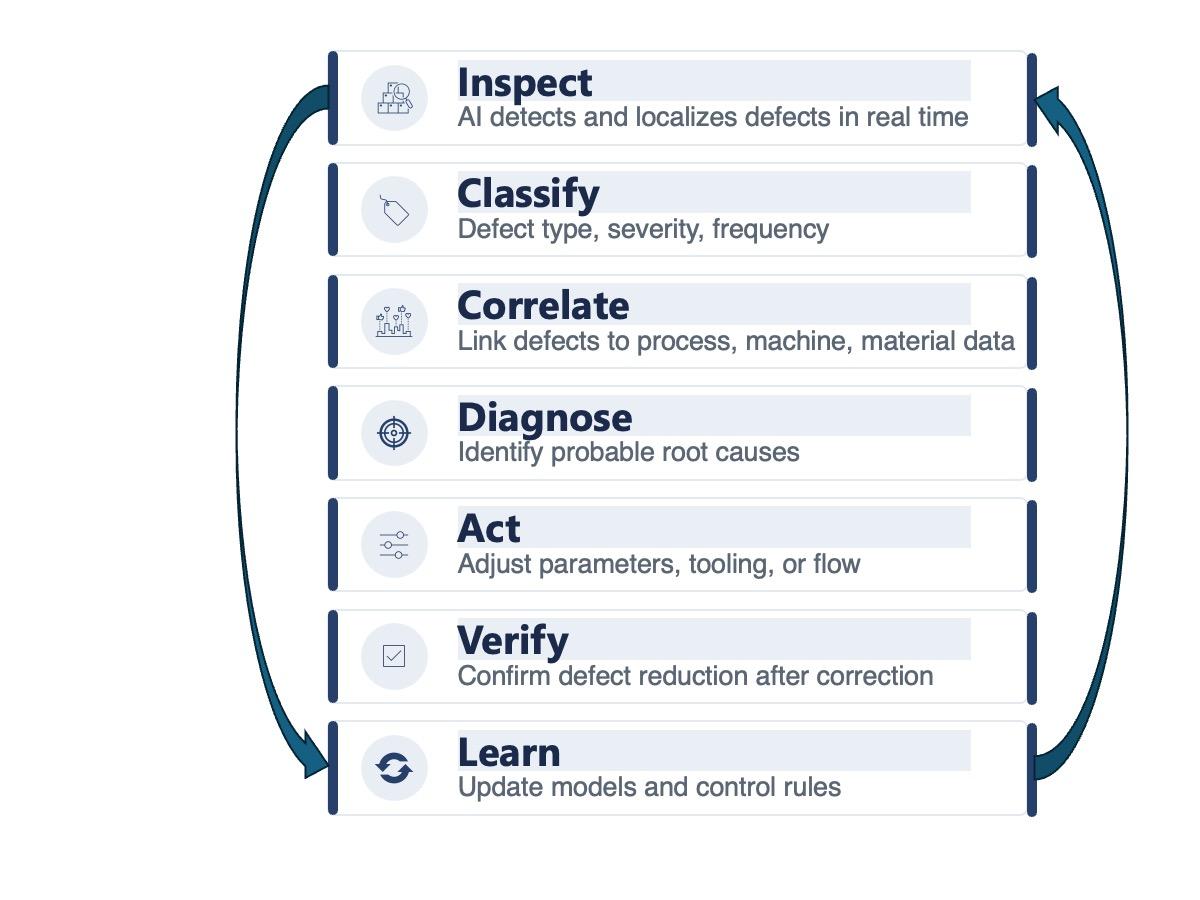
This guide covered what defects look like, how AI spots them, and where it applies, but detection alone does not eliminate defects. Feeding defect data back into design and process control is what removes recurring quality issues at the source.
Neural Concept's Design Copilot works upstream on the supply side, guiding component design toward quality and performance targets from the first iteration and cutting defects that a detection system would otherwise catch downstream. Sitting above existing CAD, CAE, and PLM systems, the Intelligence Layer for Engineering serves both sides of the make-or-buy relationship.
Conclusion - key takeaways
AI defect detection moves quality control from sampling to automated inspection of every unit.
The essentials:
- What it is. Computer vision and machine learning models, trained on labeled production data, inspect each part and decide in milliseconds whether it meets specification, catching flaws too subtle or too fast for manual inspection.
- Why it pays. A single missed defect can cost more in recalls and warranty claims than a batch earns, so high-volume, low-margin lines see the strongest return.
- How it compares. AI inspection achieves 95-99% accuracy, compared to 70-85% for manual methods, maintains that accuracy without fatigue, and scales across multiple inspection points.
- Cost-weighted decisions. Inspection aims at the lowest total expected cost, balancing false positives against false negatives, rather than the highest raw detection rate.
- What deployment needs. Representative, accurately labeled data and periodic retraining as materials and line conditions change.
- Beyond detection. Feeding defect data upstream into design and process control removes recurring defects at the source, where Neural Concept's Design Copilot operates above existing CAD, CAE, and PLM systems.
FAQ
What types of defects can AI detect?
AI defect detection systems identify a wide range of product defects depending on data availability. The trained AI analyzes incoming product images instantly, identifying anomalies like cracks, discoloration, or faulty seals, and can detect patterns hard for the human eye to catch, including sub-micron micro-cracks in semiconductors with up to 99% accuracy.
How accurate is AI defect detection?
The accuracy of AI defect detection systems depends on the quantity and quality of the data used for training. Data quality and labeling effort significantly impact model accuracy, so AI models must be trained on examples of products and defect types. Continuous improvement through new data is essential, and deep learning models, particularly CNNs, are trained on large datasets of labeled images to learn patterns associated with various flaws.
How does the AI inspection pipeline work?
High-resolution cameras and sensors collect vast amounts of visual data of products on the assembly line. Models classify the defect type and pinpoint its location using bounding boxes. AI analyzes thousands of images per second, handling high-volume production, while Edge AI processes images locally on manufacturing equipment to minimize latency, allowing near-instantaneous rejection of faulty parts. Building such systems requires a structured plan that covers data collection and model training.
What are the main benefits?
AI defect detection can help reduce waste and decrease maintenance costs in manufacturing. Early detection reduces material waste and lowers costs related to rework and recalls, and AI systems work 24/7 without fatigue, ensuring consistent quality across all shifts. Automated defect detection significantly reduces operational costs and improves manufacturing efficiency, prevents defective parts from proceeding down the assembly line, and creates a permanent digital record that simplifies regulatory audits. AI can even oversee entire factory workflows, adjusting production parameters to avoid bottlenecks.
Which industries use AI visual inspection?
AI visual inspection can be applied across multiple industries, including automotive, electronics, aerospace, pharmaceuticals, food and beverage, consumer goods, manufacturing, and agriculture.
Can AI defect detection systems be customized and scaled?
Yes. AI defect detection systems can be tailored to specific production environments and defect types, adapt to various materials for scalable inspection, and integrate with existing production lines to enhance quality control. They continuously learn from new data and analyze large datasets of labeled images to accurately classify new inputs. No-code platforms allow users to build and deploy custom models without extensive programming knowledge.
How does AI defect detection compare to traditional inspection methods?
AI offers higher accuracy (often 95-99% vs 70-85% for manual methods), real-time processing without fatigue, and better adaptability to new defects through learning. Traditional rule-based or human inspections struggle to detect subtle flaws, handle variability, and keep up with high-volume line speed.⁽⁵⁾
Is defect detection the same as predictive maintenance?
No. Defect detection evaluates product quality by identifying nonconforming products or components, while predictive maintenance is a proactive approach that anticipates equipment failures using machine data. The two are complementary rather than interchangeable.
What is the role of digital twins?
Digital twins provide a virtual, physics- or data-based replica of the production process. Deviations between the twin and real production data help identify defects, trace root causes, and distinguish process drift from true product anomalies.
Sources
(1) https://www.etq.com/resources/survey-manufacturing-recalls-2025
(2) https://www.sciencedirect.com/science/article/abs/pii/S0925231224013468
(3) https://www.jidoka-tech.ai/blogs/ai-visual-inspection-case-studies-roi
(4) https://www.solomon-3d.com/case-studies/solvision/inspecting-packaging-seals
(5) https://www.indium.tech/blog/traditional-vs-ai-semiconductor-defect-detection