Redefining what engineers dare to imagine: AI-driven aircraft design at Leonardo
- Customer
- Leonardo
- Industry
- Aerospace
- Application
- Aircraft and helicopter engineering
- Outcome · Adoption
- From one division to three
Overview
Leonardo, a global leader in aerospace, defense and security, is making AI part of everyday engineering. What began in 2023 as a single application at Leonardo Helicopters now spans three divisions, Helicopters, Aeronautics and Digital Solutions, built on Leonardo’s own tools and engineering data. Engineers explore a wider design space and reach design decisions faster. At GTC Berlin 2026, NVIDIA featured the collaboration among Europe’s industrial leaders.
Challenge
Aerospace is one of the hardest places to bring AI into engineering.
In Leonardo’s helicopters and aircraft, a single design decision can carry years of consequence. On every programme, engineers would like to explore more alternatives than the time allows. Certification and design optimization require large numbers of simulations, while the industry faces growing pressure to shorten time-to-market as designs become more complex.
Aerospace also asks more of AI than most industries do. Aircraft noise is regulated, certification is demanding, and European aviation authorities are still working out how AI itself will be certified.
These come on top of the hurdle AI meets in most engineering organizations. It usually starts with innovation and research teams, at a distance from the engineers accountable for the designs. To matter, it has to become something engineering owns: AI models that engineers can build and use themselves, day after day.
Solution
Built inside Leonardo’s environment, by the engineers who own the designs.
Neural Concept’s answer to that last hurdle was to bring the AI to where the engineering already happens. Its platform works on top of the CAD, CFD and mesh-editing tools Leonardo’s teams use every day and learns from their own high-fidelity engineering data, so Leonardo’s engineers can build and use the AI models. In Aeronautics, the work goes one step further and runs on davinci-1, Leonardo’s own high-performance computing infrastructure, so the whole chain, from tools and data to computing power, stays within Leonardo. Owning that chain also protects what sets Leonardo’s products apart: the engineering behind them.
Engineering AI creates value when engineering owns it. At Leonardo, the engineers accountable for the designs are the ones building and using the models. That is what turns a method proven in research into a workflow three divisions now rely on every day.
The collaboration began in 2023 with a demanding first problem: aeroacoustics at Leonardo Helicopters, a regulated discipline where both the fidelity requirement and the cost of exploration are high. The roles were clear from the start: AI is used to widen the exploration, while Leonardo’s trusted tools and high-fidelity simulation keep the final word on the results.
As that first piece of work grew, it spread across three divisions. Within Leonardo Helicopters, it moved from rotorcraft noise to the foundry, where the company casts its own transmission parts, and to the air ducts that keep cockpit windows clear. Aeronautics took it further, into multidisciplinary optimization across 2D and 3D geometries, and Digital Solutions became the third division to adopt it. Leonardo Helicopters now has a dedicated data science team implementing these technologies at scale. Across the divisions, engineers explore far more design variants, test alternatives earlier in development and reach decisions faster. Three years on, the AI runs in Leonardo’s environment, in the hands of its own engineers.
AI is to product design today what CAD was to the drawing board. CAD transformed the way we design. With AI applied to engineering, we are redefining what we dare to imagine.
Impact
3 divisionsHelicopters, Aeronautics and Digital Solutions
~10Engineers trained to build and use AI models
For Leonardo, the result goes beyond faster engineering on individual problems. AI-based modelling is becoming a practical, accessible tool that engineers rely on in their everyday work, rather than an asset kept for research. The work runs on NVIDIA accelerated computing, and for Tim Costa, Vice President and General Manager of Industrial and Computational Engineering at NVIDIA, “AI is essential to the future of aerospace engineering, giving engineers the speed and insight to pursue more ambitious designs.”
What’s next
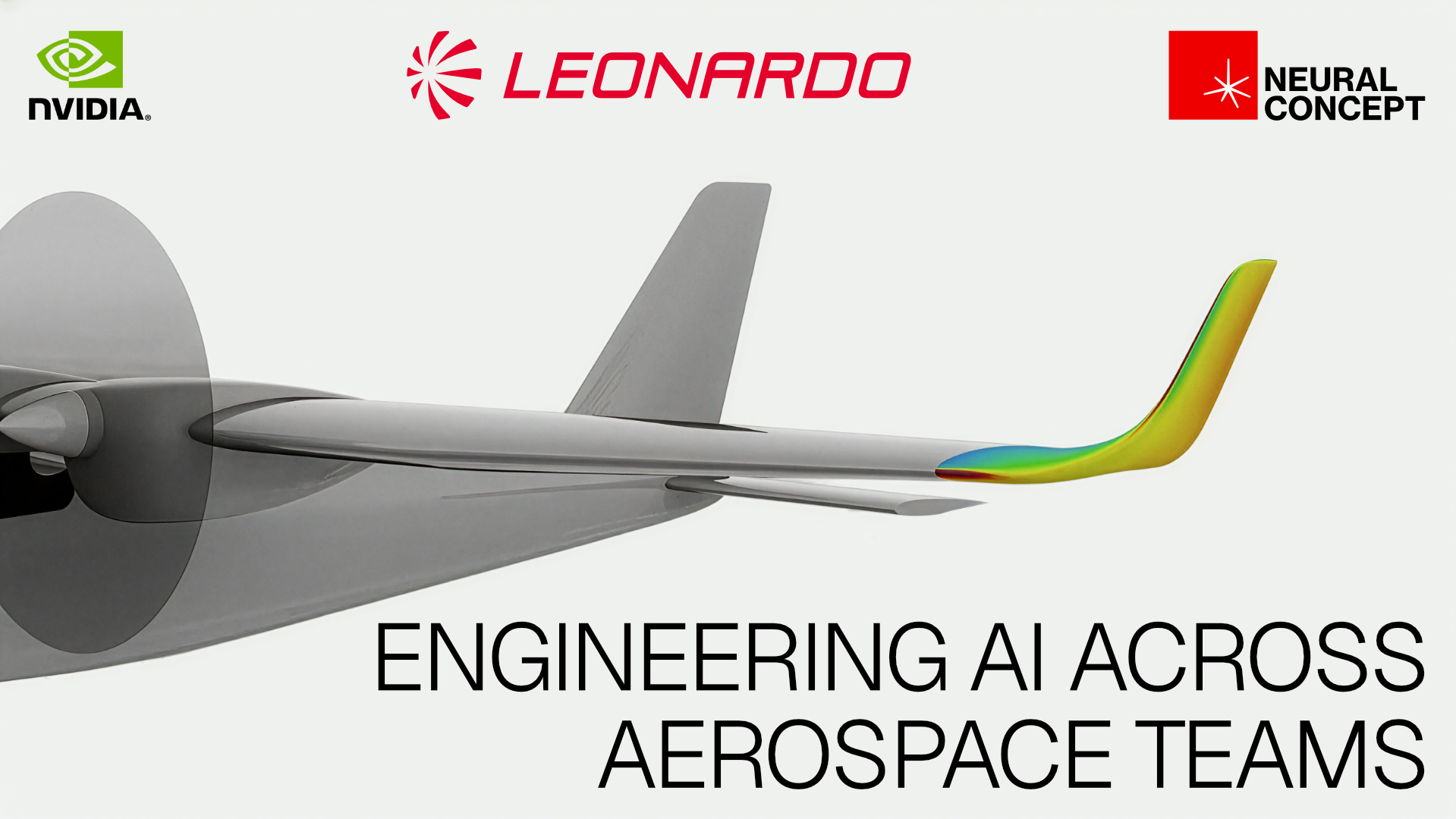
The direction is AI-driven aircraft design, and the next steps extend it across disciplines and into production. In Aeronautics, the teams have started with a multi-physics optimization of a winglet, treating several physics together, with NVIDIA Omniverse libraries used to visualize the geometry and its simulated physics in one view. At Leonardo Helicopters, the plan is to connect design with production, feeding feedback from the foundry floor back into engineering.
Related content
- Press release Leonardo and Neural Concept Expand Engineering AI Collaboration Across Aerospace Teams
- NVIDIA Blog Europe’s Industrial Leaders Reinvent Engineering and Manufacturing With NVIDIA (GTC Berlin 2026)
- Video How AI and accelerated computing are reshaping aerospace engineering workflows (AIAA SciTech 2026 panel)
Read next