Leonardo and Neural Concept Expand Engineering AI Collaboration Across Aerospace Teams
Table of contents
- Since 2023, Leonardo has worked with Neural Concept to bring AI into engineering workflows, starting in Helicopters and now spanning Aeronautics and Digital Solutions.
- Leonardo engineering teams can explore many more design options earlier in development, at lower computational cost.
- Nearly ten engineers are trained across the three divisions. The workflows run on NVIDIA A100 GPUs, and first work is visualized using NVIDIA Omniverse libraries.
Engineering AI Across Multiple Teams
Leonardo, a global leader in aerospace, defence and security, builds products where a single design decision carries years of consequence. On every programme, engineers face the same trade-off: many alternatives would be worth exploring, but the time available to explore them properly is limited.
In 2023, Leonardo Helicopters began working with Neural Concept on an aeroacoustics workflow, where both the fidelity requirement and the cost of exploration are high. That first piece of work has since grown into a collaboration across Helicopters, Aeronautics and Digital Solutions, with nearly ten engineers trained across the three divisions.
It has also grown in scope. In Aeronautics, the work now covers multidisciplinary optimization across 2D and 3D geometries, with multiple applications and deployment work on davinci-1, Leonardo’s own high-performance computing infrastructure.
“AI is to product design today what CAD was to the drawing board. CAD transformed the way we design. With AI applied to engineering, we are redefining what we dare to imagine.” said Salvatore Grimaldi, VP Innovation Management and Technology Labs, Leonardo Aeronautics.
Bringing AI into day-to-day engineering operations
Leonardo’s engineering teams share the same constraint across Helicopters and Aeronautics: certification and design optimization call for large numbers of simulations, and the computational cost of producing them has to come down without giving up accuracy.
A second challenge sits alongside the first: surrogate models and AI pipelines usually start out in innovation and research activity, and they have to be made robust enough for engineering teams to use them day after day.
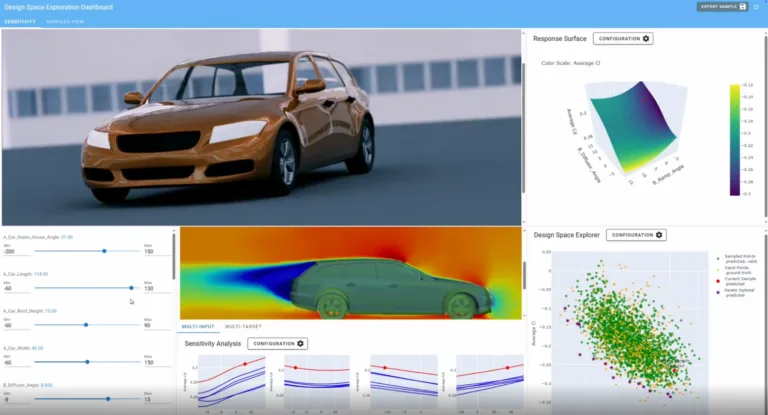
Neural Concept’s platform works on top of Leonardo’s existing CFD and mesh-morphing tools. It learns from their high-fidelity simulation data and gives engineers AI models they can use to explore and optimize designs. It also shortens the time needed to build these models and puts them within reach of engineers who do not have programming or machine-learning expertise.
Once a model is trained, engineers can explore a far wider range of design variants in a fraction of the time. They can test alternatives earlier in development and make faster decisions, without waiting days for a high-fidelity simulation to return.
“Engineering AI creates value when engineering owns it. At Leonardo, the engineers accountable for the designs are the ones building and using the models. That is what turns a method proven in research into a workflow three divisions now rely on every day.” said Pierre Baqué, CEO and Co-Founder, Neural Concept.
The workflows run on NVIDIA A100 GPUs, and the teams have started working with NVIDIA Omniverse libraries to enable multi-physics optimization of a winglet, where engineers can see the geometry and its simulated physics together.
“AI is essential to the future of aerospace engineering, giving engineers the speed and insight to pursue more ambitious designs,” said Tim Costa, Vice President and General Manager of Industrial and Computational Engineering at NVIDIA. “Neural Concept’s AI models, running on NVIDIA accelerated computing, help Leonardo explore a broader design space and make faster decisions earlier in development. The teams’ initial winglet optimization work with NVIDIA Omniverse libraries brings geometry and simulated physics together to help engineers visualize design performance.”
“AI is essential to the future of aerospace engineering, giving engineers the speed and insight to pursue more ambitious designs,” said Tim Costa, vice president and general manager of industrial and computational engineering at NVIDIA. “Neural Concept’s AI models, running on NVIDIA accelerated computing, help Leonardo explore a broader design space and make faster decisions earlier in development. The teams’ initial winglet optimization work with NVIDIA Omniverse libraries brings geometry and simulated physics together to help engineers visualize design performance.”
Today, Leonardo is making AI-based modelling a practical and accessible tool. Engineers explore a wider design space and reach product design decisions faster, and AI is now part of day-to-day engineering workflows.