Agentic AI Engineering: Neural Concept and NVIDIA NemoClaw in Practice
Engineering teams already use AI in many forms. What is missing is the possibility to connect entire workflows into systems that run with less manual coordination. This is what agentic AI engineering makes possible: end-to-end workflows where AI handles the coordination between steps, freeing engineers to focus on decisions rather than execution. Electric motor design for next-generation EVs is one of the clearest test cases: requirements are demanding, trade-offs are tightly coupled, and the cost of slow iteration is high. It is where we put this into practice.
Electric motor design as an agentic engineering target
Electromagnetics, thermal behavior, mechanical integrity, and NVH all interact in electric motors, yet many teams still handle them in sequence. Dedicated eMotor tools help, but mainly inside a limited set of standard templates. They increase speed where designs are already familiar, while more differentiated geometry often pushes teams back into slow, manual CAE loops. Scripting and automation promised a way out, but in practice, they're hard to build, unstable to run, and rarely survive the transition from one project to the next.
This is what makes the problem worth solving.
One Neural Concept customer in the automotive supply chain, working on next-generation electric vehicle components, reduced component weight by 12%, improved torque by 9%, and cut development timelines by 75%.
The collaboration of Neural Concept and NVIDIA NemoClaw takes it further.
How Neural Concept leverages NVIDIA NemoClaw
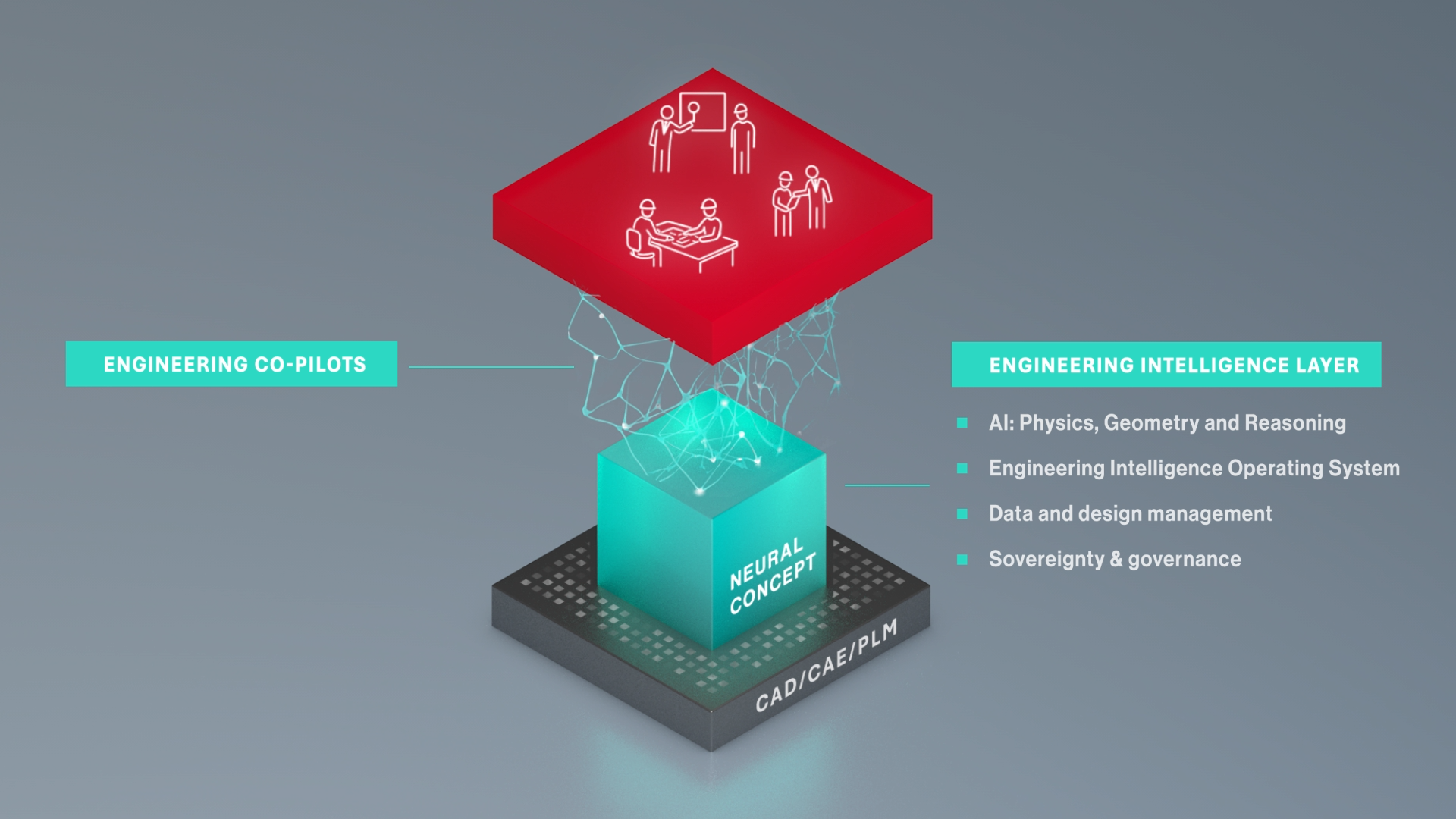
Neural Concept provides the engineering intelligence layer. It sits above the digital engineering layer, including CAD, CAE, PLM, and turns tools, data, and engineering knowledge into operational workflows. In this collaboration, Neural Concept brings geometry, physics, optimization, and the design copilot experience — the engineering OS that structures the exploration and offers the interfaces for the engineer to control every action.
The real bottleneck in motor development is often a lack of continuity between steps. Engineers need a way to move from requirements to an executable exploration process, then from one design space iteration to the next, without rebuilding the workflow by hand each time. Neural Concept is built for exactly this. An engineer can start from project requirements, use agentic interactions to define or refine a design space, run optimization workflows, review Pareto trade-offs, and evolve the next iteration of the space as new information appears. The key benefit is that the design space evolves, grows and becomes easier to adapt as the project progresses. Teams do not need to commit too early to a fixed geometry or a frozen workflow.
"Building workflows that can reason about geometry, physics, and design trade-offs requires a level of engineering specificity that general-purpose AI doesn't provide,” said Théophile Allard, CTO, Neural Concept. “That's the layer Neural Concept operates at. Paired with NemoClaw's long-running agent infrastructure, that intelligence stays active across the full arc of a design campaign — through every iteration, every tool, every handoff."
NVIDIA NemoClaw complements this from another angle. Some parts of engineering iterations do not fit inside a single interactive session. They require context to persist across time, across tools, and across enterprise systems. NemoClaw adds that long-running agent capability. It can stay connected to sources provided by Neural Concept, as well as other material such as company documentation and Slack, preserving context across iterations, and keeping the engineering loop running between sessions.
Neural Concept is where the engineering-native intelligence lives, where geometry, optimization, physics-aware reasoning, and human review come together in a purpose-built environment. NemoClaw extends that environment by adding persistence, orchestration, and enterprise connectivity around it. The two systems can communicate agent to agent, but they play different roles. Neural Concept is the engineering brain; NemoClaw makes it autonomous over time, maintaining context and coordination outside the narrow boundaries of one engineering session. For eMotor teams, the result is a shift: requirements, design exploration, optimization, and review stop being disconnected steps and start operating as one continuous process.
Where this points for engineering teams
"Engineering teams are under growing pressure to orchestrate complex workflows while contending with mounting design complexity, tighter iteration cycles, and the cost of losing context at every handoff," said Timothy Costa, vice president and general manager of computational engineering at NVIDIA. "With the NVIDIA NemoClaw blueprint, Neural Concept's engineering intelligence layer can help turn disconnected engineering steps into an autonomous computational engineering process."
Engineering processes across domains follow the same pattern — and are evolving towards the same future. Neural Concept provides the engineering intelligence layer and operating system to structure and execute the workflow. NVIDIA NemoClaw adds the long-running agent infrastructure that makes it autonomous at scale. The direction is clear: engineering workflows are moving from isolated tools and manual handoffs toward connected systems that learn, adapt, and compound over time. The organizations that build this capability now will carry it as a structural advantage.
Read NVIDIA's Computex announcement