RFQ manufacturing: What is it and how to optimize it?
A request for quotation (RFQ) is a formal buying process. An RFQ in manufacturing asks qualified suppliers to price a requirement the buyer has already defined, and each supplier replies with a firm quote.
The request for quotation (RFQ) is built around measurable commitments: quantities, tolerances, lead times, and standards. Commitments convert plans into binding actions and save time at every downstream stage by preventing rework.
Clear requirements set upfront for scheduling, performance, and quality support informed decisions throughout the procurement process. When those requirements are incomplete, deviations in cost or delivery propagate through the production chain, compounding at each handoff.
In RFQ manufacturing, the requirement is typically defined by drawings and tolerances, so each quote reflects engineering judgment about whether the part can be made to specification at the quoted price.
This guide covers the full RFQ process in manufacturing, from structuring the document to evaluating supplier responses, including when to use an RFQ rather than an RFP and how suppliers use physics-aware AI to respond faster.
This guide is for procurement and sourcing teams that issue RFQs, and for the application engineers and program managers who prepare supplier responses.
What You’ll Learn:
- How suppliers using physics-aware AI predict part performance directly
- The seven steps manufacturers follow to build an effective RFQ
- How an AI-first design platform accelerates product simulation and cuts end-to-end development time
- RFQ vs. RFP
- Industry-specific requirements
| Aspect | What it means | How to optimize |
|---|---|---|
| When to use an RFQ | Specifications are clear, and the buyer is ready to purchase | Send only after specs are stable; unclear requirements cause inaccurate quotes |
| What it includes | A detailed description of the product or service | Provide full specifications, drawings, and quality requirements |
| Process flow | The buyer sends the request to prequalified suppliers, who reply with price and terms | Automate distribution and response tracking with procurement software |
| Benefits for buyers | Competitive pricing, quality assurance, informed decisions | Integrate with ERP and inventory systems for real-time comparison |
| Benefits for vendors | A clear chance to compete and demonstrate value | Use physics-aware AI to respond faster with technical data |
To understand how this document connects to the stages that follow it, see the chapter “From RFQ to production” in the article “AI in automotive industry: applications and innovations”.
Contents
- Suppliers and customers in manufacturing
- What are the key steps in the RFQ process?
- How to create an effective RFQ?
- How to choose the right sourcing approach?
- RFQ vs. RFP
- Evaluating and comparing quotes
- Purchase order and contract fulfillment
- How do suppliers win with AI engineering predictions?
- AI predictions accessible to more staff
- Key advantages of AI predictive engineering in the RFQ context
- Measured results across suppliers
- Speed as a competitive advantage
- Strengthening outcomes
- Supply chain integration and lifecycle
- Quick RFQ template
To learn more, also explore this blog post on AI and manufacturing.
Suppliers and customers in manufacturing
A modern car is assembled from roughly 30,000 individual parts. No single company produces all of them.
- The company that designs and sells the finished vehicle is the OEM (Original Equipment Manufacturer). Most of the parts it assembles are purchased from a multi-level network of suppliers.
- The network is structured in defined levels, called tiers.
- The first level is the Tier 1 supplier, which delivers complete systems directly to the OEM, for example, a braking system or a battery pack.
- Below it, Tier 2 suppliers provide the components used inside those systems, such as the cells that make up the battery pack.
Regulated industries apply the same tiered structure on a larger and more demanding scale.
Each link between two levels in this network corresponds to a purchase, and most purchases begin with an RFQ. A wing bracket or an HVAC module begins the same way: an engineer writes a specification, sends it to qualified suppliers, and compares the quotations they return.
What are the key steps in the RFQ process?
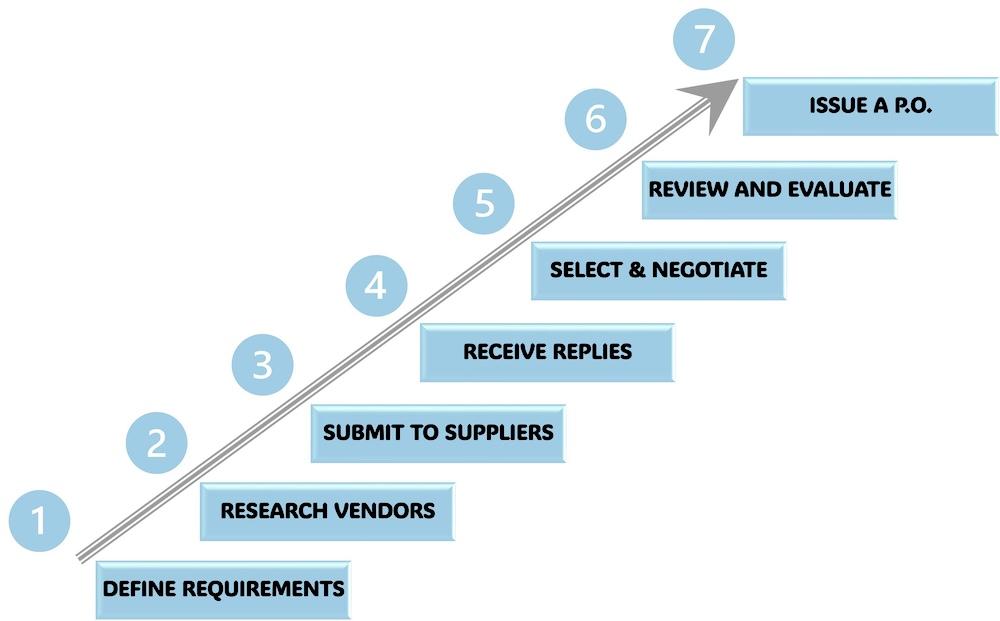
The seven steps for manufacturers in the RFQ process are:
- First step - define requirements: exact specifications, materials, services, quantities, and applicable standards. Incomplete specs at this stage are the most common source of quote variance.
- Research potential vendors: Identify potential suppliers by examining past performance, certifications, and sector experience relevant to the project.
- Submit to suppliers: Send the package to prequalified bidders with enough lead time for each to produce a complete response with detailed pricing.
- Receive replies: Collect supplier responses.
- Review and evaluate: Procurement scores each answer against pre-established criteria covering cost, technical compliance, delivery, and supplier qualifications.
- Select and negotiate: The award typically goes to the lowest-price compliant bid. Use negotiation to refine delivery and payment terms, not to rewrite specifications.
- Issue a Purchase Order: Formalize the agreement with a P.O. that references all specification documents and agreed terms.
Reference: Lysons, K. and Farrington, B. (2020) Procurement and Supply Chain Management, 10th ed., Pearson Education.
How to create an effective RFQ?
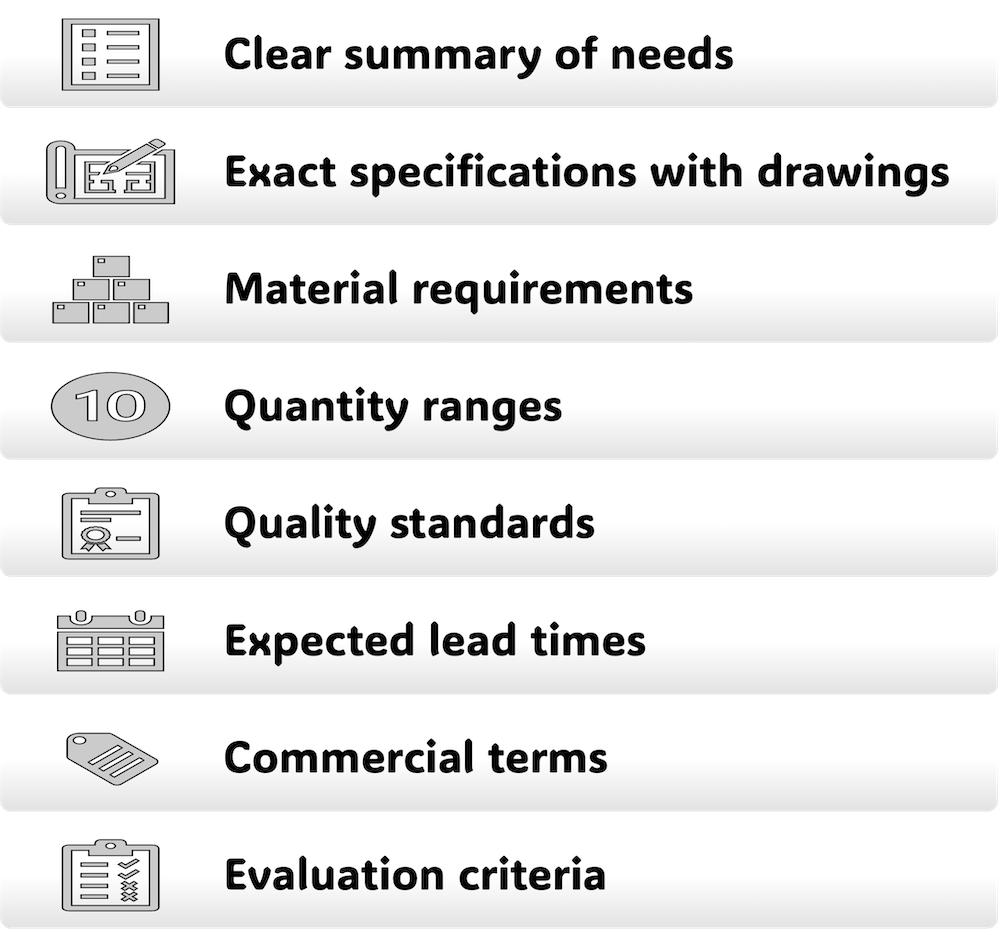
An effective RFQ opens with a company introduction and a clear need statement, then carries the full technical package.
Preparing comprehensive documentation saves time for both the buyer and the vendor. The document should open with a company introduction and a clear need statement.
The technical package must include 2D drawings, 3D CAD models, and a complete Bill of Materials covering parts, materials, quantities, and services in scope.
How to choose the right sourcing approach?
Use an RFQ when the specifications are complete and you need comparable prices. Use an RFP when the problem is defined but the solution is still open. Procurement teams work with these two documents, and matching the document to the situation prevents mismatched expectations between buyer and supplier.
RFQ vs. RFP
- A request for quote (RFQ) is the right instrument when specifications are complete, and the buyer needs comparable pricing to select a chosen vendor.
- A Request for Proposal (RFP) is appropriate when the problem is defined, but the solution is open: the buyer wants suppliers to propose solutions and alternative approaches, not just price a fixed design.
| Dimension | RFQ (Request for Quote) | RFP (Request for Proposal) |
|---|---|---|
| When to use | Specifications are complete and finalized | Problem is defined but solution is open |
| What’s specified | Complete design, materials, tolerances, performance targets | Requirements and constraints only |
| Supplier’s role | Price a fixed design | Propose solutions and alternative approaches |
| Decision basis | Comparable pricing among vendors | Technical feasibility, innovation, approach quality |
| Buyer’s flexibility | Low; design is locked | High; willing to consider alternatives |
| Response effort | Minimal; supplier executes standard quote | Significant; supplier develops custom proposal |
| Best for | Cost-competitive commodities, repeat orders | Complex problems, custom solutions, innovation |
Evaluating and comparing quotes
Evaluation criteria must be set before quotes arrive. Total cost includes shipping, payment terms, order minimums, and tooling or setup fees. Vendor reliability weighs heavily: a supplier who consistently delivers late costs more money than the price difference suggests. A weighted scoring system makes the trade-off between cost, lead times, and certification requirements explicit and auditable. For example, some projects prioritize quality certifications over speed; others prioritize lead time when the production schedule is the binding constraint.
Purchase order and contract fulfillment
After vendor selection, the buyer issues a purchase order that includes a cost breakdown, quantities, references to specification documents, delivery terms, and a payment schedule. The procurement team then establishes communication channels and reporting procedures. Once onboarding steps are completed, the buyer monitors fulfillment against the contract and accumulates performance data for the next sourcing cycle.
How do suppliers win with AI engineering predictions?
Suppliers succeed by providing physics-based performance data with quotes in minutes instead of days. Traditional RFQ responses involve manual CAD review and full FEA or CFD runs, which take days and limit supplier flexibility. Sales engineers can’t explore design alternatives or suggest cost trade-offs promptly. When managed effectively, the RFQ process can create substantial returns by keeping information consistent across functional and geographic silos.
AI predictions accessible to more staff
With 3D deep learning deployed as purpose-built apps, these capabilities make the same performance prediction available in minutes and accessible to more staff:
- An application or sales engineer responding to the RFQ can run a prediction without waiting for a simulation specialist
- A program manager can compare options against the buyer’s requirements before the bid is committed
- Because each prediction returns in minutes, the supplier can explore more of the design space defined by the buyer’s specifications, evaluating additional geometry and material variants within the same time allowed for the response

Key advantages of AI predictive engineering in the RFQ context
- Performance feedback in minutes rather than the days a full solver run takes, delivered through an AI-first design platform
- Design space exploration at thousands of geometry points per day, including generative design variants
- Performance predictions trained on high-fidelity CAE datasets and evaluated at each design point
- Automated cost and performance trade-off analysis with material and tolerance optimization
- Real-time collaborative exploration between Tier 1 suppliers and OEMs, or between Tier 2 and Tier 1, within agreed design constraints
Measured results across suppliers
Suppliers running physics-aware AI in their RFQ workflow can draw on results reported by Neural Concept across more than 70 OEMs and Tier 1 suppliers:
- up to 10x faster product simulation
- up to 75% shorter end-to-end development time
- up to 30% gains in characteristics such as efficiency and aerodynamics
Speed as a competitive advantage
Speed of response is a competitive variable in its own right. In a survey of more than 400 manufacturing buyers and procurement engineers, Paperless Parts found that 67% expect a quote within 24 hours and only 6% will wait longer than three days. A supplier that returns physics-based performance data within that time provides a level of technical justification that suppliers quoting on price alone cannot provide at the same speed.
Source: “Paperless Parts Launches Search Function to Make Quoting Manufacturing Jobs Faster and More Accurate,” Business Wire, January 27, 2021.
Strengthening outcomes
A rigorous RFQ process does more than select a vendor for a single project. It builds the supplier database, making the next sourcing cycle faster and the one after that more competitive. Registering and qualifying new vendors before they are needed, rather than during a crisis, protects the supply chain when a primary vendor cannot deliver.
Supply chain integration - what are the five KPIs for vendor performance?
Five KPIs are standard across mature organizations: on-time delivery rate, defect rate, quote time, cost variance relative to the initial bid, and responsiveness to change orders.
Tracking these metrics across the full vendor lifecycle converts individual RFQ events into a structured supplier development program. In fact vendor performance should be measured continuously, not only at contract award.

Quick RFQ template
The RFQ Is Won on Speed and Engineering Evidence
The RFQ has always been a test: who can meet a specification, at the right price, at the right time? What has changed is the speed at which that answer must be delivered, and the level of justification it must carry. When 67% of manufacturing buyers expect a quote within 24 hours, the supplier’s ability to respond is no longer just a logistics question; it is an engineering question.
A disciplined RFQ process, with well-structured documents, pre-qualified vendor lists, and weighted evaluation criteria, reduces friction at every step. But the suppliers who consistently win are those who can attach physics-based performance data to their price within the response window. Faster response is only part of the advantage: knowing with far greater confidence how a design will perform before committing to a price means tighter cost estimates, better margin control, and fewer surprises after award.
This is exactly what Neural Concept makes possible. By connecting agentic engineering workflows, physics prediction models, and purpose-built applications that surface only the data each role needs, the platform links every stage of the engineering cycle into a single intelligence layer. Engineers get performance predictions in minutes rather than days. Program managers can explore the design space before the bid is committed. And engineering evidence, grounded in proprietary simulation data, goes directly into the quote.
A rigorous RFQ process builds a stronger supplier base with every cycle. Adding this kind of engineering intelligence turns each response into a demonstration of capability, converting the RFQ from a pricing formality into the moment where the best-engineered answer, delivered fastest, wins the work.
Ready to respond to RFQs with engineering evidence, not just a price? Discover the Neural Concept platform.
FAQs
How does the RFQ process work?
The RFQ process starts when the buyer sends a complete specification package to prequalified suppliers, who then submit responses. The procurement team evaluates these responses based on cost, technical compliance, and delivery to choose the best vendor.
Can predictive analytics help a vendor win more RFQs?
Yes. Predictive analytics enables suppliers to evaluate design feasibility, manufacturing costs, and part performance without running full FEA or CFD simulations. The result is faster quote turnaround, tighter pricing confidence, and the ability to include geometry comparisons and material trade-off analysis directly in the bid, a level of technical justification that competitors without AI capability cannot match at the same speed.
What are the best platforms for managing RFQs in manufacturing?
Procurement platforms for manufacturing typically offer template libraries, supplier databases, automated tracking, and side-by-side comparison tools. The platforms that deliver the most operational value integrate directly with the ERP or inventory system that governs purchasing decisions.
What quality and compliance best practices belong in a manufacturing RFQ?
Quality and compliance standards belong in the RFQ whenever they affect acceptance of the part. Common ones include ISO 9001 quality-management certification, RoHS compliance for electronics, and the inspection requirements the buyer will apply on receipt. Aerospace adds AS9100 and AS9102 First Article Inspection, and medical devices add their own regulatory records. Stating these in the RFQ lets each supplier confirm capability before quoting, rather than after award.
How should RFQ replies be evaluated for manufacturing projects?
Build a weighted scoring matrix before quotes arrive. Score each response on cost, quality certifications, lead time, and past performance. Calculate the total cost of ownership rather than the unit price. Interview the top two or three vendors before final selection to surface operational details that written proposals do not capture.
What instructions should an RFQ give suppliers?
An RFQ should give clear instructions for completion, a firm submission due date, and exact directions on how to submit the quote, so every supplier can prepare a comparable response. Allow enough time for each bidder to formulate a complete answer before that due date. During the Q&A period, give all participating suppliers the same clarifications, which keeps the process fair and the bids comparable.
How does automation improve the RFQ process?
Automation improves the RFQ process by handling the repetitive work that slows procurement down. Quote parsing, matrix population, and status tracking are directly related to how fast a quote comes back, and automating them lets the team streamline the workflow and reach decisions sooner. It also raises accuracy, since one set of data feeds every comparison rather than being entered manually. In most cases, this lets the client determine the best-qualified supplier faster and spend the saved time on evaluation and negotiation.
Are there free RFQ resources and templates?
Industry associations publish free ebook guides, RFQ templates, checklists, and procurement best-practice resources. Many procurement software vendors offer downloadable templates as part of their product documentation.