What Is PLM in Manufacturing and Where Engineering AI Fits
This article explores what is PLM in manufacturing and the role of Artificial Intelligence in this technology. PLM is based on the idea that collaboration promotes cost savings.
Product Lifecycle Management (PLM) tools minimize costs and rework by ensuring all teams use the same, accurate data, reducing mistakes, scrap, and recalls from concept to end-of-life management.
PLM acts as a key component of a manufacturing company’s business strategy. PLM tools are often bundled with Computer-Aided Design (CAD) and Computer-Aided Engineering (CAE) packages. They serve as a strategic framework for corporations and, unlike CAD and CAE, are not intended for “specialists”.
Decision-makers in manufacturing companies share a common pressure: the product development process takes longer and costs more than it should. For design engineers specifically, PLM addresses this directly by automating routine tasks and freeing up time for design work, with a streamlined product development.
What is the business value of AI (Artificial Intelligence) added to PLM in manufacturing? Can it help meet market demands? Short answer: AI gives PLM superpowers. It extends what PLM can do: from managing data to actively shaping design decisions in real time.
- Engineering AI helps engineers evaluate more design candidates in less time, without adding headcount or extending review cycles. Engineering AI can turn engineers into super-engineers. Thus, AI changes the inputs engineers work with and the speed at which they can validate decisions. This is where PLM’s value actually compounds.
- Analogously, there is AI-facilitated empowerment of PLM. Within PLM technology, AI can act as a transformative element, taking it to the next step: “PLM 5.0”, a vision consistent with the EU Commission’s concept of “Industry 5.0” (see Note [1] for further details).
- The article’s AI “flavor” is engineering AI. AI is often associated with “everyday” tools like Large Language Models (LLMs). Engineering AI platforms, however, go much further.
How can AI help engineers to leverage PLM? Follow us:
- The article explains the fundamentals of product lifecycle management while highlighting how AI-driven engineering tools integrate to reduce rework rates, shorten change cycles, and give cross-functional teams a shared factual baseline for product decisions
- PLM tools can leverage AI applications and benefits in industrial design.
- Read on to see in practice how AI is shaping the future of manufacturing!
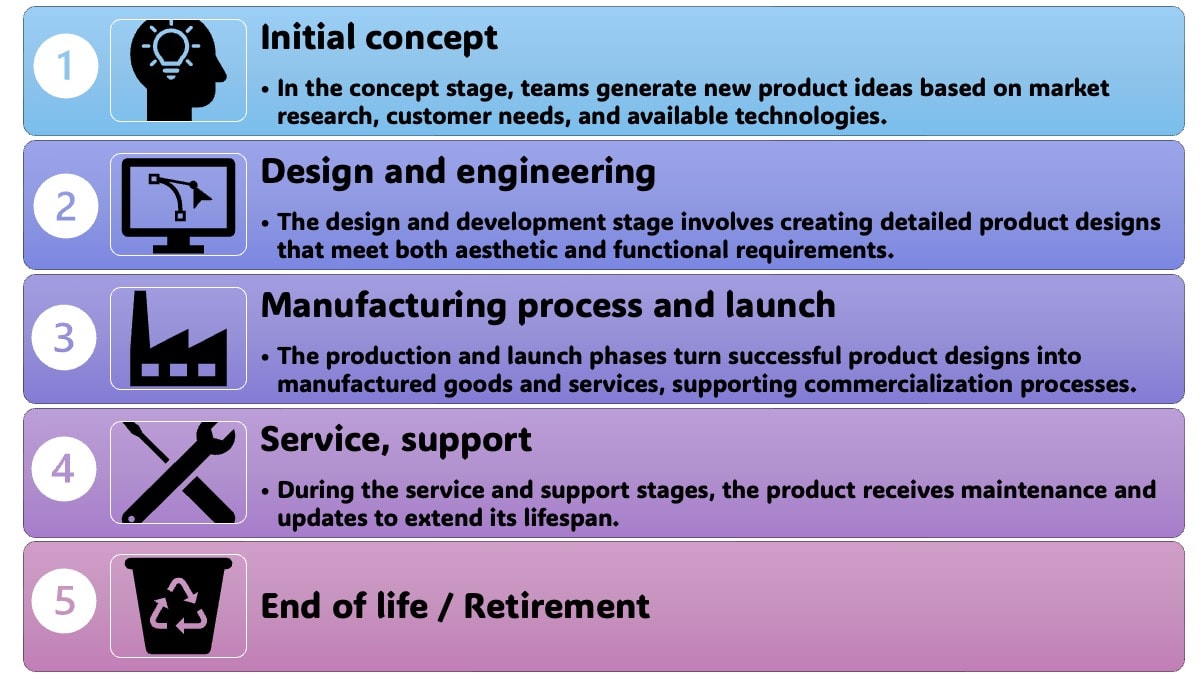
Table of Contents:
- Definition of PLM Software
- What Is a PLM Solution for Manufacturers?
- Evolution of PLM Data
- From Initial Concept Development to End-of-Life
- Lifecycle Management: Stages in Manufacturing
- PLM Software Advantages
- What Are the Main PLM Software Solutions? Local and Cloud PLM
- Digital Foundation: Digital Thread and Digital Twins
- Collaborative Tools and Change Management
- Benefits of PLM Software in Manufacturing Business
- Implementation Roadmap for a PLM Solution
- Metrics, Risks, and Best Practices
- Evolution of PLM
- Where Engineering AI Fits in PLM
Definition of PLM Software
Product lifecycle management (PLM) means managing a product throughout its entire lifecycle.
PLM software centrally manages this process, from ideation through retirement.
In manufacturing:
- PLM software encompasses processes, data, and people across the product lifecycle
- It ensures consistency from raw materials to the end of life
- It does collect the company’s data to enable better collaboration and decision-making across departments.
The PLM scope covers the full product journey, all while integrating with supply chain management (Material Flow Management) and other business systems:
- capturing ideas
- engineering designs
- production planning
- quality assurance
- service support
- disposal/retirement
What Is a PLM Solution for Manufacturers?
Product Lifecycle Management (PLM) in manufacturing refers to the comprehensive management of a product’s lifecycle, from conception to eventual disposal.
Manufacturing Challenges
Some of the most evident manufacturing challenges addressed by PLM are:
- fragmented data,
- long development cycles,
- compliance pressures
- coordination issues across global teams.
Many of these problems stem from reliance on legacy tools that hinder collaboration and data management.
Core Modules in PLM Tools in the Manufacturing Process
PLM tools address these issues by providing a single source of truth for data. PLM eliminates data silos and enables controlled processes.
To achieve this in practice, core PLM software modules typically include:
- Front-End Innovation & Requirements Definition
- Product data management (including CAD technology: CAD files and CAD data)
- Bill of Materials (BOM) management
- Document management
- Change lifecycle management
- Workflow automation (read, for instance, about design automation and its benefits)
- Project management
- Quality management
PLM vs ERP vs PDM
PLM tools focus on product-centric activities: design, engineering, and innovation.
PLM tools manage engineering data, computer-aided design (CAD) files, requirements, and changes throughout the product lifecycle, supporting product development from initial design through manufacturing and beyond.
- Enterprise resource planning (ERP) emphasizes operational execution: procurement, production scheduling, inventory, finance, and logistics.
- While ERP handles transactions in the manufacturing-to-delivery pipeline, PLM governs the creative and technical upstream processes.
- PLM differs from product data management (PDM), which primarily handles file storage and revision control for CAD data. PLM systems extend beyond PDM to encompass broader lifecycle processes, stakeholder collaboration, and integration with downstream functions. See how to increase design efficiency with AI-powered CAD.
As PLM frameworks evolve, manufacturers are increasingly turning to product development automation to eliminate lifecycle bottlenecks, making it essential to understand design automation and its benefits before committing to a digital transformation strategy.
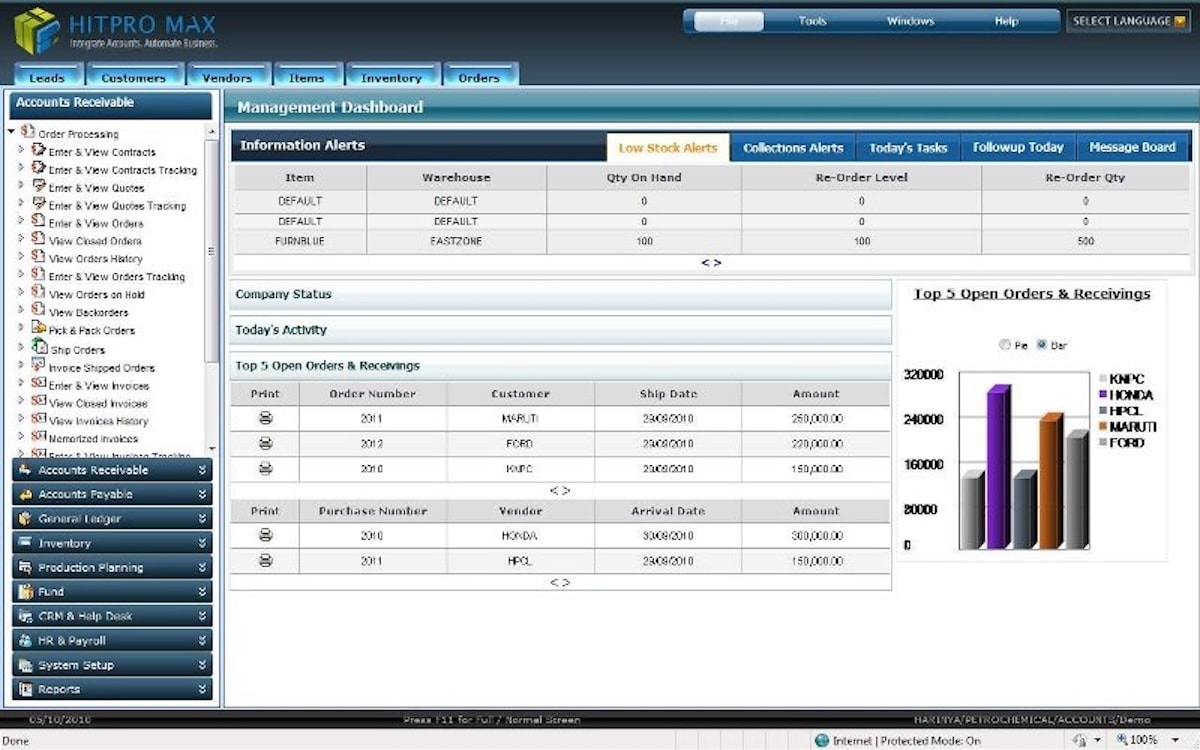
Lifecycle Management: Stages in Manufacturing
PLM systems are designed to optimize and monitor the lifecycle, providing real-time insights and supporting sustainability efforts at every stage. PLM supports various stages of a product’s life cycle, as listed below.
Key Stages
Those include:
- Initial concept
- In the concept stage, teams generate new product ideas informed by research into customer needs and available technologies.
- Design and engineering
- The design and development stage involves creating detailed product designs that meet both aesthetic and functional requirements.
- Manufacturing process and launch
- The production and launch phases turn successful product designs into manufactured goods and services, thereby supporting commercialization processes.
- Service, support
- During the service and support stages, the product receives maintenance and updates to extend its lifespan.
- End of life / Retirement
Stakeholders’ Map of Stages
- Concept: Marketing, R&D, product managers
- Design: Engineers, designers, simulation specialists
- Manufacturing: Production engineers, partners in Material Flow Management, and quality teams
- Service: Field support, maintenance crews, customers
- End of life (Phase-out): Sustainability officers, recyclers, compliance experts
Evolution of PLM Data
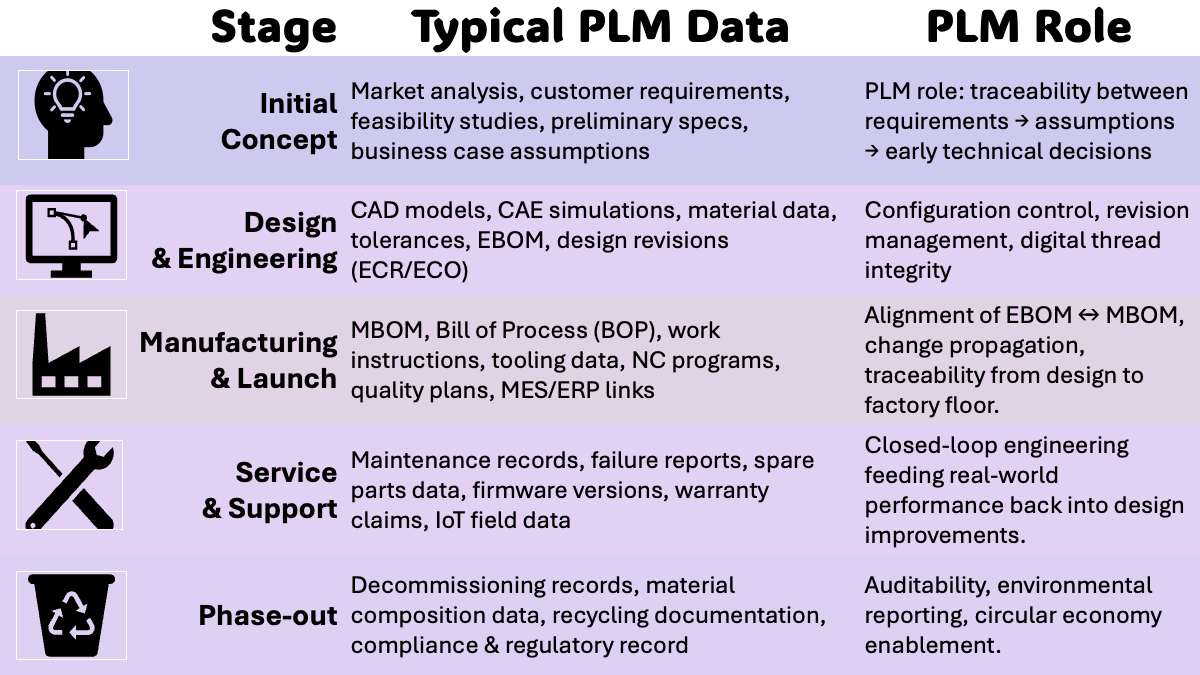
PLM data evolves like this,s maintaining traceability across the entire digital thread:
uncertain conceptual information →
→ structured engineering models →
→ executable manufacturing data →
→ field performance data →
→regulatory and sustainability records.
The following table captures what typical PLM data for each stage is and what the PLM role is:
From Initial Concept Development to End-of-Life
Here’s a brief review of the product lifecycle:
- In the initial concept stage, teams gather external signals via market research and translate them into early requirements. Ideas are evaluated for feasibility before any significant engineering resource is committed, using AI-assisted scoring to rank options objectively rather than by internal preference.
- Design and Engineering: Manage CAD and BOM with central repositories for files, revisions, and configurations. Teams enforce check-in/check-out and BOM sync. Validation involves reviews, simulations, prototyping, and compliance to catch issues early.
- Manufacturing Process: Translate designs into actionable manufacturing process plans by defining process routings, tooling, and assembly sequences. PLM integrates with manufacturing execution systems for seamless handoff. Document process routings, work instructions, and quality controls to ensure repeatability and traceability in downstream manufacturing.
- Support end-of-life: Plan service workflows using data, manuals, and catalogs. Track warranties, repairs, and upgrades. Phase out inventory, support, and follow disposal protocols to reduce environmental impact.
PLM Software Advantages
PLM software features intuitive interfaces, AI/ML integration, IoT connectivity, and SaaS models.
Preliminary definitions:
- IoT connectivity enables PLM systems to gather and exchange real-time data from connected devices, sensors, and machines
- SaaS models are cloud-based software delivery methods in which applications are hosted by the vendor, accessed via the internet, and automatically updated.
- Compliance certifications ensure that the PLM system meets international standards for quality, data protection, and regulatory requirements.
Advantages of PLM software:
- Organizations benefit from real-time collaboration, scalability, and cloud-based solutions that optimize the manufacturing-to-delivery pipeline and enhance customer-centric features.
- Leverage IoT data to deliver real-time insights into product performance and customer feedback, enabling more responsive decision-making and supporting digital twin and digital thread initiatives.
- Cloud deployment offers accessibility from any location, automatic updates, lower upfront costs, and elastic scaling. Teams access up-to-date information across the extended enterprise.
- A cloud-based PLM solution can prioritize data security, encryption, access controls, compliance certifications (e.g., ISO, GDPR), and vendor reliability.
What Are the Main PLM Software Solutions? Local and Cloud PLM
The Product Lifecycle Management (PLM) market features several leading solutions, particularly suited for manufacturing businesses.
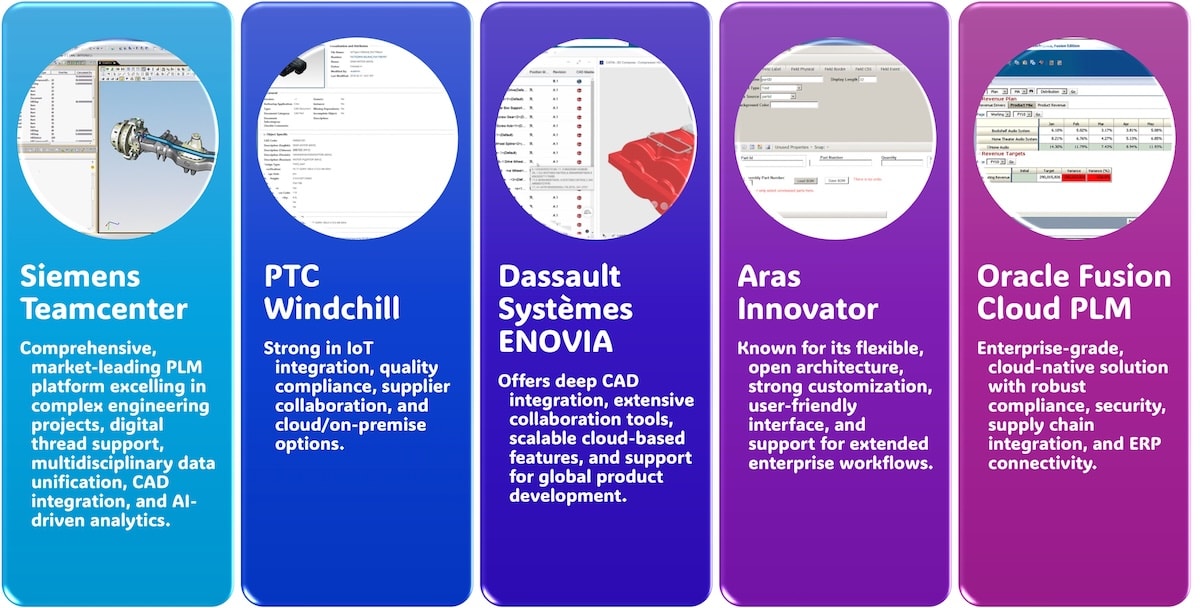
Here are five among the solutions recognized and adopted in PLM:
| Solution | Details | Comments |
|---|---|---|
| Siemens Teamcenter | leading PLM platform in complex engineering, digital thread, data unification, CAD, and AI analytics. | Often rated a Leader (e.g., in Forrester Wave 2025) and suits large manufacturers. |
| PTC Windchill | including Windchill+ and Arena PLM) excels in IoT, quality, supplier collaboration, and cloud/on-premise options | ranking highly for manufacturing workflows |
| Dassault Systèmes ENOVIA | part of 3DEXPERIENCE, offers deep CAD integration, collaborative tools, scalable cloud features, and supports global development | deal for seamless engineering and enterprise collaboration. |
| Aras Innovator | features flexible, open architecture, strong customization, user-friendly interface, and enterprise workflow support. | It appeals to organizations seeking adaptable, cost-effective PLM with low vendor lock-in |
| Oracle Fusion Cloud PLM | a cloud-native enterprise solution with compliance, security, manufacturing-to-delivery pipeline, and ERP integration | suited for large organizations needing global product lifecycle management. |
Digital Foundation: Digital Thread and Digital Twins
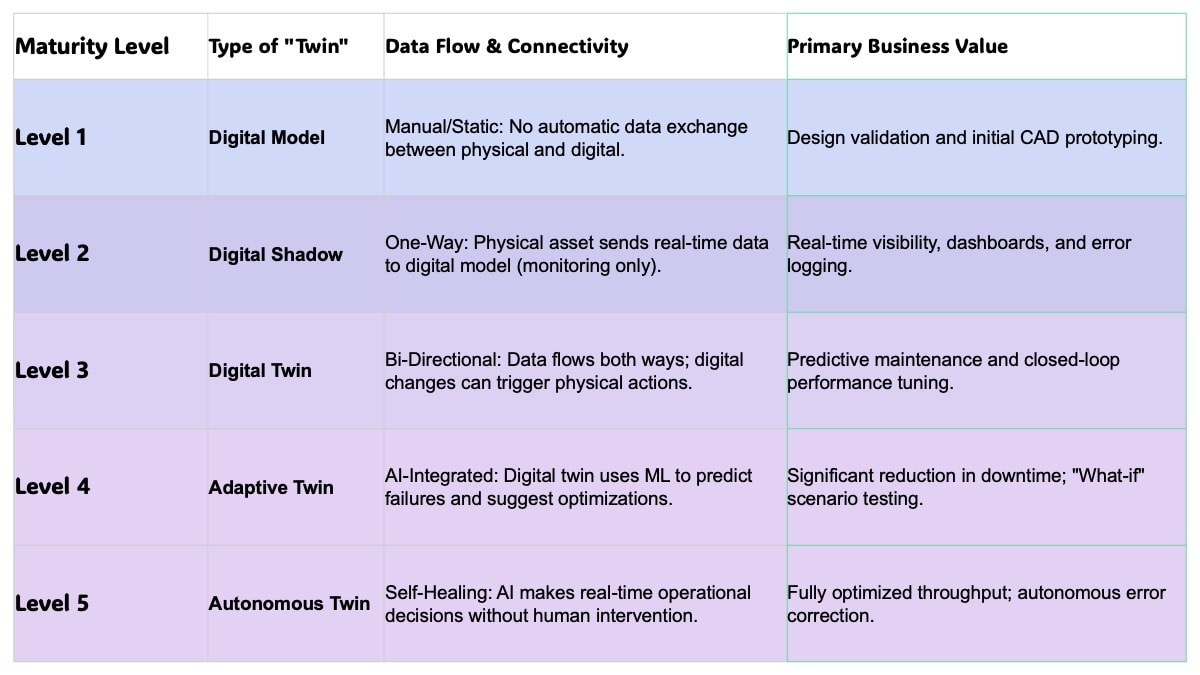
The digital thread for a company’s data creates a unified, authoritative record that links all lifecycle artifacts.
- A digital twin is a virtual replica of a physical asset, synchronized via IoT sensors for real-time simulation and monitoring. PLM systems manage these twins by integrating data from design, production, and performance. They feed lifecycle analytics by enabling predictive insights, performance forecasting, and optimization.
- As the World Economic Forum highlights, leveraging twin technology can increase operational efficiency by 10% and support process optimization and sustainability.
- Siemens emphasizes virtual replicas as key to connecting real and digital worlds, enabling real-time intelligence and reduced environmental footprints through transparency in Material Flow Management.
Collaborative Tools and Change Management
Collaborative tools within PLM are built on workspaces that support commenting, real-time co-editing, and notifications, enabling cross-team collaboration.
Here’s why and how:
- Document change governance workflows: submit requests, assess impacts, approve via structured reviews, and implement with notifications.
- Management functions within PLM play a key role in tracking and controlling product design changes, managing approval workflows, and maintaining audit trails for compliance and traceability.
- Change processes are essential for managing modifications to product designs throughout the product lifecycle.
- Formally, we speak, for instance, of ECRs/ECOs (Engineering Change Requests & Orders, respectively).
- ECO/ECR track and control revisions in PLM, ensuring that design changes are communicated to procurement, manufacturing, and engineering. Require audit trails for every change to maintain traceability and compliance.
Benefits of PLM Software in Manufacturing Business
Product Lifecycle Management software delivers measurable business value in the manufacturing industry, as follows:
- PLM systems reduce manual data-handling errors and cycle times.
- PLM helps break down silos. Time-to-market is accelerated by ensuring that all departments work with up-to-date, accurate data.
- PLM ensures consistent data and streamlines product development throughout the execution process, from design to production.
- PLM software can provide real-time insights into product performance, customer feedback, and market trends.
- For example, PLM software such as Siemens Teamcenter, when integrated with IoT and CRM platforms, helps manufacturers link product performance and customer feedback to engineering data, enhancing design and service decisions.
Operational Efficiency and Cost Reduction
PLM minimizes costs and rework by ensuring all teams use the same, accurate data. Early error detection plays a central role here, minimizing rework and scrap while enabling optimized resource allocation and lower warranty claims.
Examples of PLM achievements include a 20–25% reduction in development costs by catching design errors early; early fixes cost around $1,000, while late fixes can exceed $100,000.
- BOM management synchronizes component lists across engineering and manufacturing, ensuring teams have the most up-to-date data. In complex assemblies such as automotive platforms with over 10,000 parts, outdated BOMs lead to errors, line stops, and costly retrofits.
- PLM minimizes this risk and improves handoffs, potentially reducing ECO cycle time by up to 40% in complex projects.
Accelerated Innovation, Quality, and Time-to-Market
This is how Product Lifecycle Management (PLM) improves product development performance by integrating structured product data, controlled workflows, and improved collaboration:
- Innovation Acceleration: PLM enhances innovation by automating routine tasks such as change management, approvals, and documentation, allowing engineers to focus on design. Through integrated, bidirectional access to requirements, design data like CAD, and validation results, all stakeholders work on a controlled, versioned product definition. This reduces rework and accelerates high-quality innovation.
- Faster Time-to-Market: PLM enables parallel workflows across engineering, manufacturing, and sourcing with a shared product structure. It reduces version confusion and streamlines changes, cutting development cycles by 15–30% and enabling quicker launches to meet market needs.
- Structured and Coordinated Product Launch; PLM ensures that production, testing, and marketing operate from the same released product configuration. Controlled BOMs, specifications, and documentation guarantee that marketing campaigns, certifications, and manufacturing execution align with the validated product definition. This reduces launch risk and supports sales goals.
- Enhanced Product Quality and Compliance: Consistent data sharing, traceable requirements, and controlled revisions reduce defects and prevent unauthorized changes. Automated documentation, audit trails, and version control simplify regulatory compliance and strengthen quality control.
- Global Collaboration and Supply Chain Integration: Secure, cloud-based PLM platforms offer role-based access to accurate data for distributed teams and suppliers. Real-time visibility into changes reduces errors, shortens response times, and ensures consistent product quality worldwide.
Metrics, Risks, and Best Practices
Success metrics include
- time-to-market reduction (20-50%)
- faster change cycles in engineering (30-70%)
- defect reduction (20-40%)
- cost savings (15-30%).
Common risks are:
- resistance to change
- Poor data migration
- scope creep
- inadequate training.
Recommend governance:
- establish data ownership
- standardization rules
- regular audits
- cross-functional steering committees.
Evolution of PLM
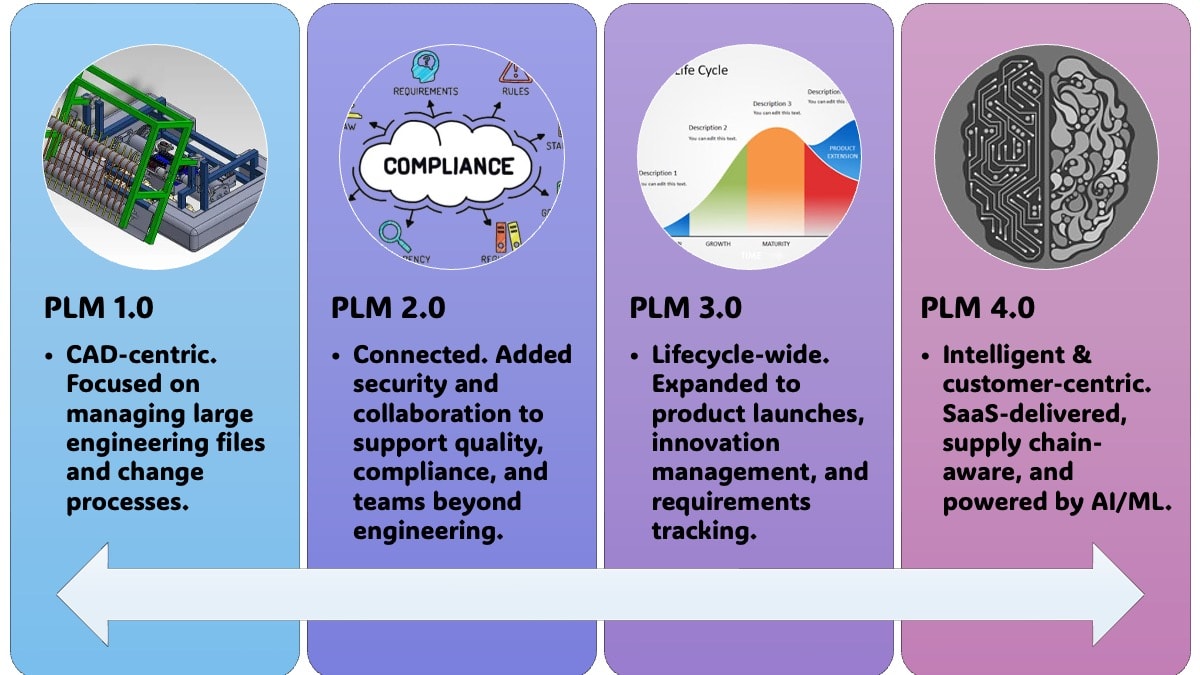
The evolution of product lifecycle management (PLM) began in the 1980s with American Motors Corporation (AMC), which sought to improve its product development processes to compete with larger automotive companies.
- PLM 1.0 was focused on PDM and was primarily CAD-centric, addressing the management of large CAD files and engineering change processes.
- In the 1990s, PLM evolved to PLM 2.0, which included security and collaboration features to support functions beyond core product development, such as quality planning and product compliance.
- The transition to PLM 3.0 after 2000 focused on product launches and incorporated broader lifecycle capabilities, including innovation and requirements management.
- Modern PLM software, often referred to as PLM 4.0 in parallel with Industry 4.0 (see [2]), is characterized by a supply chain- and customer-centric approach, leveraging a software-as-a-service (SaaS) model to enhance accessibility and integration.
- PLM 4.0 enables the creation of a digital thread that connects diverse data sources, including IoT data, virtual replicas, and customer insights, thereby facilitating better decision-making and innovation.
- AI and ML technologies integrated into PLM systems can improve predictive maintenance and quality control throughout the product lifecycle.
Where Engineering AI Fits in PLM
Engineering faces mounting pressures:
- intensified global competition,
- blurred hardware-software boundaries,
- evolving skill demands,
- fragmented teams/tools that stifle creativity and lead to costly delays or suboptimal designs.
Traditional PLM provides a solid digital foundation for the lifecycle, but its structural limitation is that it follows rules rather than generating insight. In the upstream phases, where concept and design decisions have the highest downstream impact, engineers get a governed data environment but no intelligence acting on that data.
Engineering AI
We stated in the introduction that AI is turning engineers into “super-engineers”, high-level operators guiding and refining smart systems by providing design data.
Instead of dealing with repetitive tasks, design engineers or project managers can focus on creativity, intuition, trade-offs, and insights. The goal is for AI-augmented super-engineers to collaborate to develop complex products faster and more effectively.
Neural Concept offers a platform to foster human-AI collaboration, accelerating hardware innovation and empowering humans to engineer the future.
Engineering AI as the Intelligence Layer in PLM Workflows
PLM systems already integrate IoT, digital twins, and cloud capabilities to provide real-time visibility. Engineering AI extends this by adding a proactive, predictive intelligence layer, particularly during the design and engineering stages, leveraging 3D deep learning, generative AI, and physics-aware predictions.
Generative Design and Ideation
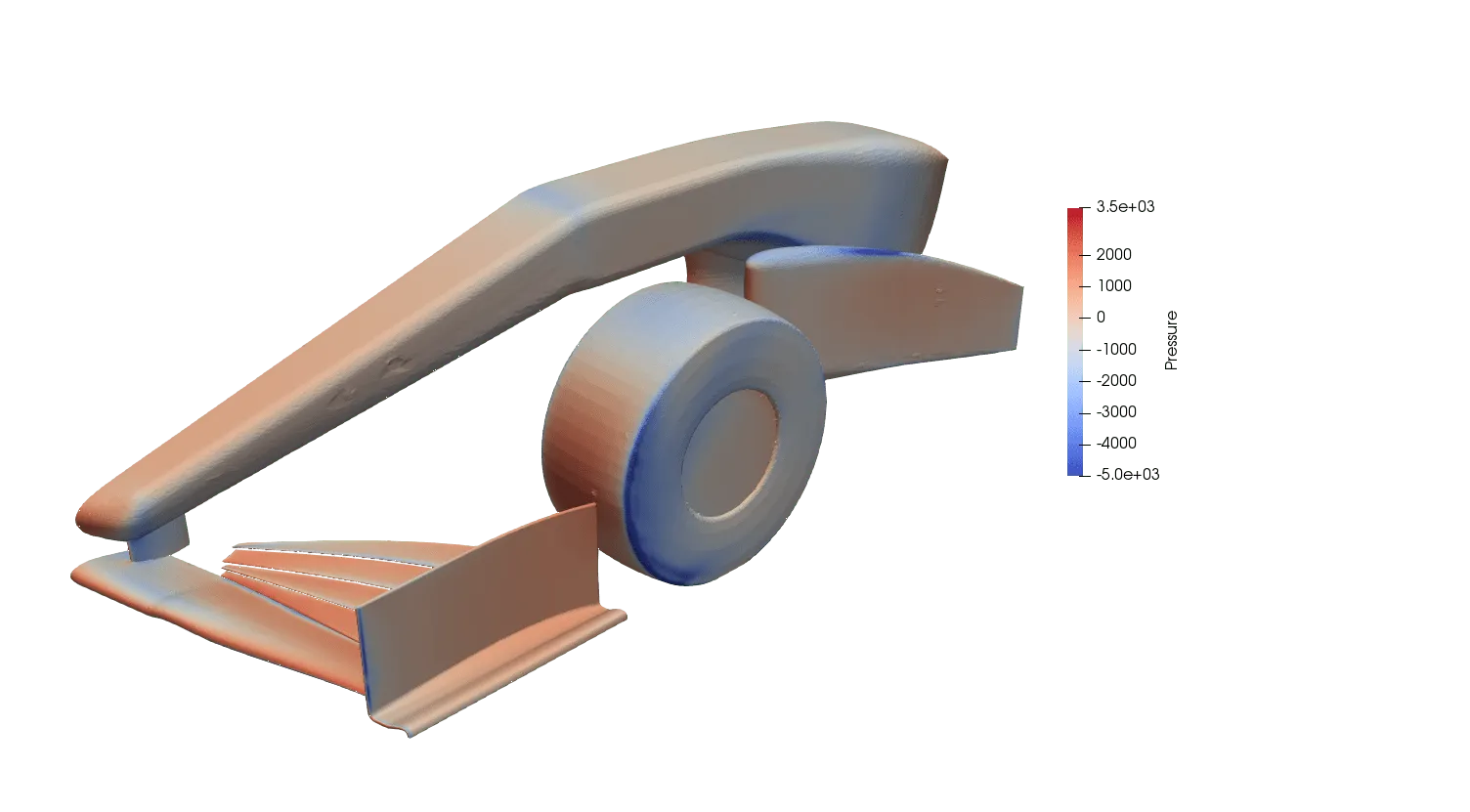
Engineers provide high-level intent (constraints, performance goals), and AI generates thousands of optimized 3D geometry variants in minutes, all of which are CAD-ready and manufacturable. AI compresses exploration from months to days, uncovering innovative solutions beyond what human intuition alone can achieve, also thanks to geometry-aware AI design co-pilots for engineering.
Accelerated Simulation and Validation
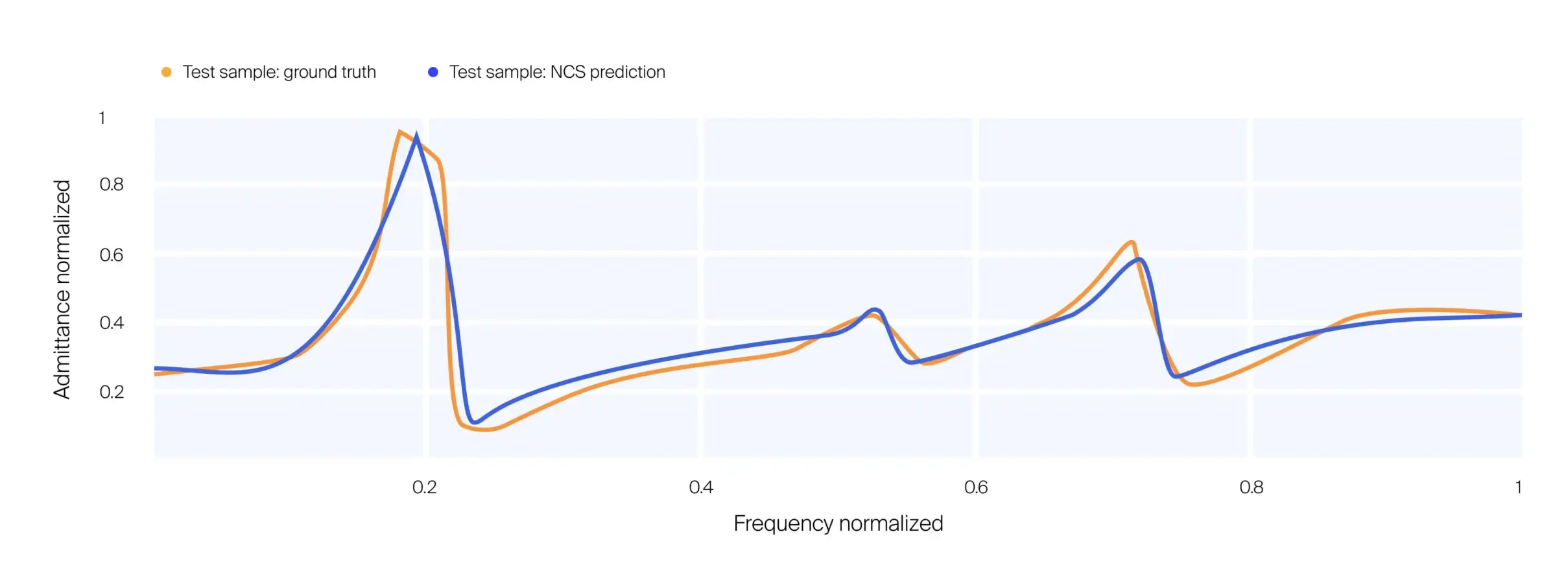
AI surrogates predict outcomes from CAD and simulation data at near-instant speeds, enabling instantaeous data-driven scenario analysis without full recomputation. Surrogate predictions catch issues early, reduce the need for physical prototyping, and feed directly into PLM software modules.
Optimization Across the Lifecycle
AI analyzes product and operational data to surface patterns that are not visible to an individual engineer working within a single programme.
Consider, for instance, that a geometry that performed well in one product family is failing earlier than expected in the field when used in a different thermal environment. The engineer receives that finding as a prompt, evaluates it against the current design context, and decides whether to act.
AI manages the scale of that search across thousands of prior designs; the engineer provides the judgment.
Real-World Impact
- The Swiss SP80 team used Neural Concept’s AI to optimize ventilated hydrofoils, achieving over 20% performance improvement and increased speed through AI variants and pilot feedback.
- A turbine manufacturer cut R&D from years to months by using AI co-pilots (see Note [3]) to improve aerodynamics and thermodynamics, resulting in higher efficiency and lower emissions.
- Automotive and aerospace sectors employ similar AI methods to accelerate development, enhance safety, extend EV range, and reduce costs.
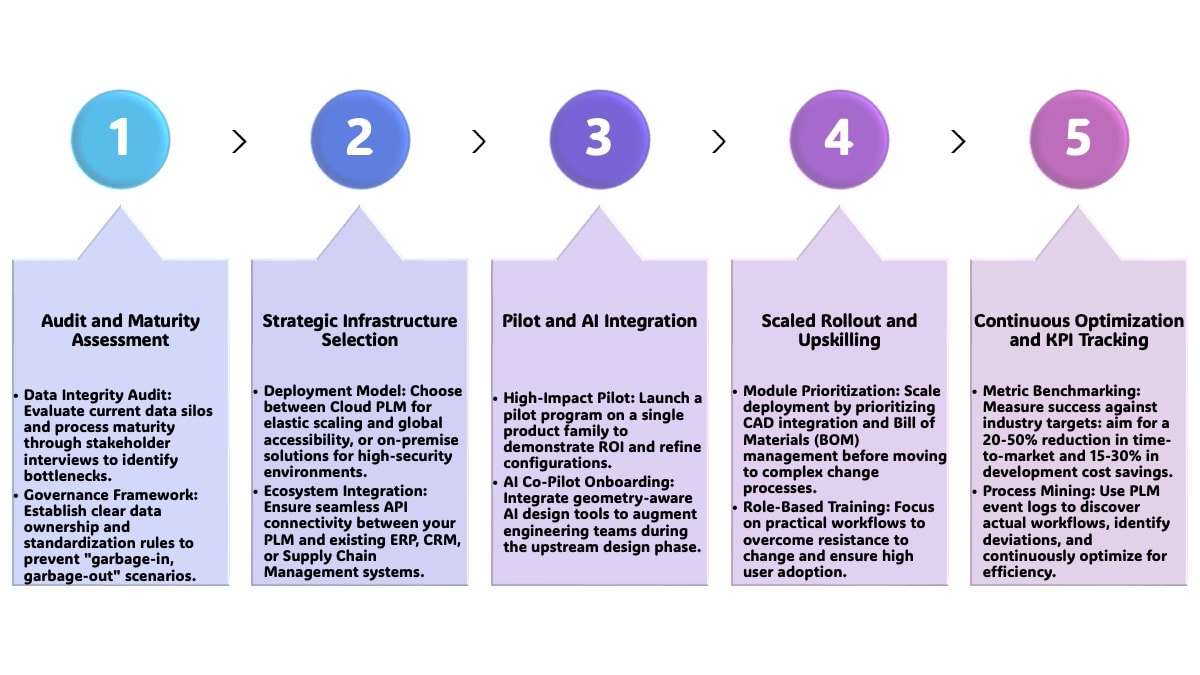
Challenges, Path Forward, Implementation Roadmap
Introducing AI into today’s PLM software modifies how engineering information is interpreted and acted upon. The main constraints are structural. We will list 4 challenges and 4 paths forward with a “→”.
- Challenge: AI systems depend on data consistency. In many PLM environments, data, such as design data, accumulates through heterogeneous processes and legacy migrations. Under these conditions, model outputs become unstable. → Improving performance requires prior work on data governance to ensure lifecycle coherence.
- Challenge: Integration must occur at the transactional level. An AI layer that sits outside the PLM system can analyse data, but cannot influence how changes propagate or how traceability is maintained in a controlled manner. → That requires architectural system integration, not a reporting connector.
- Challenge: Workflow implications must be addressed explicitly. AI-assisted reasoning, for instance, through design co-pilots, alters how engineers search for, compare, validate, and approve information. This demands → workflow redesign.
- Challenge: Algorithm quality is also a factor. Inadequate model selection, poor validation, or misaligned training objectives can degrade performance regardless of the quality of the infrastructure. Robust algorithms cannot compensate for failures in model validation or structural inconsistencies. → This requires disciplined model validation and objective alignment.
Read more on how to leverage engineering data for product design.
Conclusions on Modern PLM Software
PLM tools provide the backbone for managing the manufacturing lifecycle and drive efficiency across product stages from concept to retirement.
PLM tools and systems connect teams that would otherwise work with different versions of the same product data and integrate technologies such as AI and virtual replicas.
Engineering AI in PLM compresses the time between running a simulation and making a design decision, which is where most engineering cycles lose days
AI is enabling manufacturing companies to create better products faster while addressing complexity in globalized supply chains.
Manufacturers that connect AI to their PLM backbone reduce the lag between design decisions and production outcomes, and that gap is where cost and time are lost
FAQs
Do I need to be a PLM specialist to use PLM?
No. PLM is not like CAD or CAE, where effective use requires strong technical skills in geometric modeling, meshing, numerical methods, or simulation setup. PLM is primarily a backbone system, a process-orchestration environment, and a data-governance layer.
Is PLM a data vault for CAD?
Much more! Activities are generated and assigned based on actions and dependencies. It provides information and guidance, not just data storage: it pushes information rather than pulling it. It helps companies track available product versions, their states, and dependencies.
What’s the difference between PLM and ERP?
PLM governs the product itself and how it is changed over its lifetime. ERP governs the business processes that surround it: procurement, finance, production scheduling, and logistics. The two systems are complementary; they operate on different objects and answer different questions.
How does PLM compare to Excel in manufacturing workflows?
PLM eliminates errors, ensures version control and traceability; Excel risks siloing a company’s product data, leading to inconsistencies and limited collaboration.
What is the difference between PLM and RFID in manufacturing?
PLM governs data and processes; RFID tracks physical items in real-time for inventory and logistics.
What are the 5 stages of PLM?
The 5 stages are: concept, design and development, production and launch, service and support, and end-of-life management.
What are the most common PLM applications in automotive manufacturing?
The most common applications of PLM tools in automotive are: BOM management, CAD integration, change control, requirements traceability, and supplier collaboration for vehicle development.
What is the ROI of PLM implementation in manufacturing?
Typically 2-4x over 3 years, with payback in 12-18 months.
Where does the ROI of PLM come from?
PLM pays back primarily through engineering cost reduction and faster development cycles, both driven by the same underlying mechanism: teams stop duplicating work because validated design and product information is reused rather than recreated from scratch.
What is PLM Process Mapping in manufacturing, and why does it matter?
Process mapping visualises how work actually flows through the product lifecycle, rather than how it is assumed to flow. The value is diagnostic: it makes bottlenecks visible and creates the baseline needed to standardise and improve processes systematically rather than by intuition.
What is the difference between PLM and CRM in manufacturing?
PLM focuses on product creation and lifecycle; CRM manages customer relationships, sales, and post-sale interactions.
How does PLM compare to a traditional database in manufacturing?
PLM enforces process state and maintains traceability across the product lifecycle. A traditional database stores records; it doesn’t know a product’s stage or who is authorized to change it.
What is the difference between Industry 4.0 and Industry 5.0?
Industry 4.0 connects machines, captures their data, and uses that data to automate decisions that previously required human judgment. Industry 5.0, a concept stage, goes further by placing human collaboration, resilience, and sustainability at the center.
Why is PLM important in Industry 4.0?
In Industry 4.0, PLM is the digital backbone that connects the entire product lifecycle with real-time data.
Notes
[1] Industry 5.0. What this approach is focused on, how it will be achieved, and how it is already being implemented: https://research-and-innovation.ec.europa.eu/research-area/industrial-research-and-innovation/industry-50_en
[2] What are Industry 4.0, the Fourth Industrial Revolution, and 4IR?https://www.mckinsey.com/featured-insights/mckinsey-explainers/what-are-industry-4-0-the-fourth-industrial-revolution-and-4ir
[3] Introductory video to Engineering Co-Pilots unveiled at CES 2026 https://youtu.be/knHEgSNancI