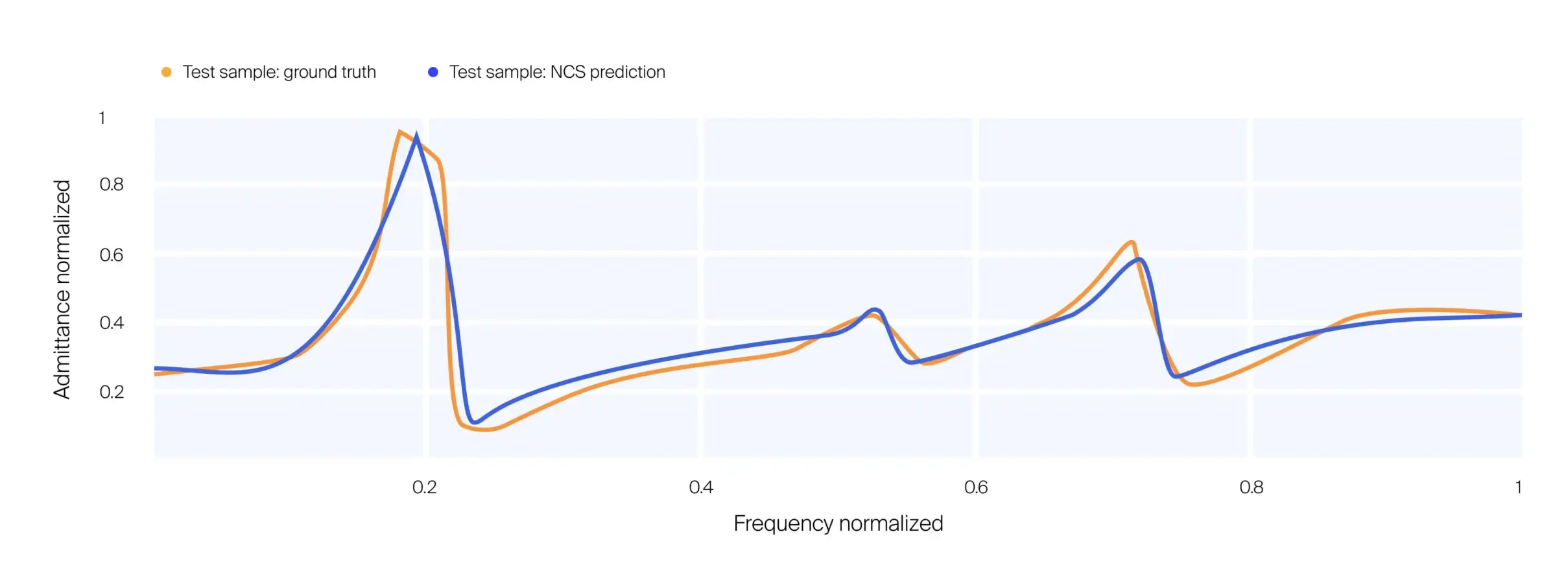
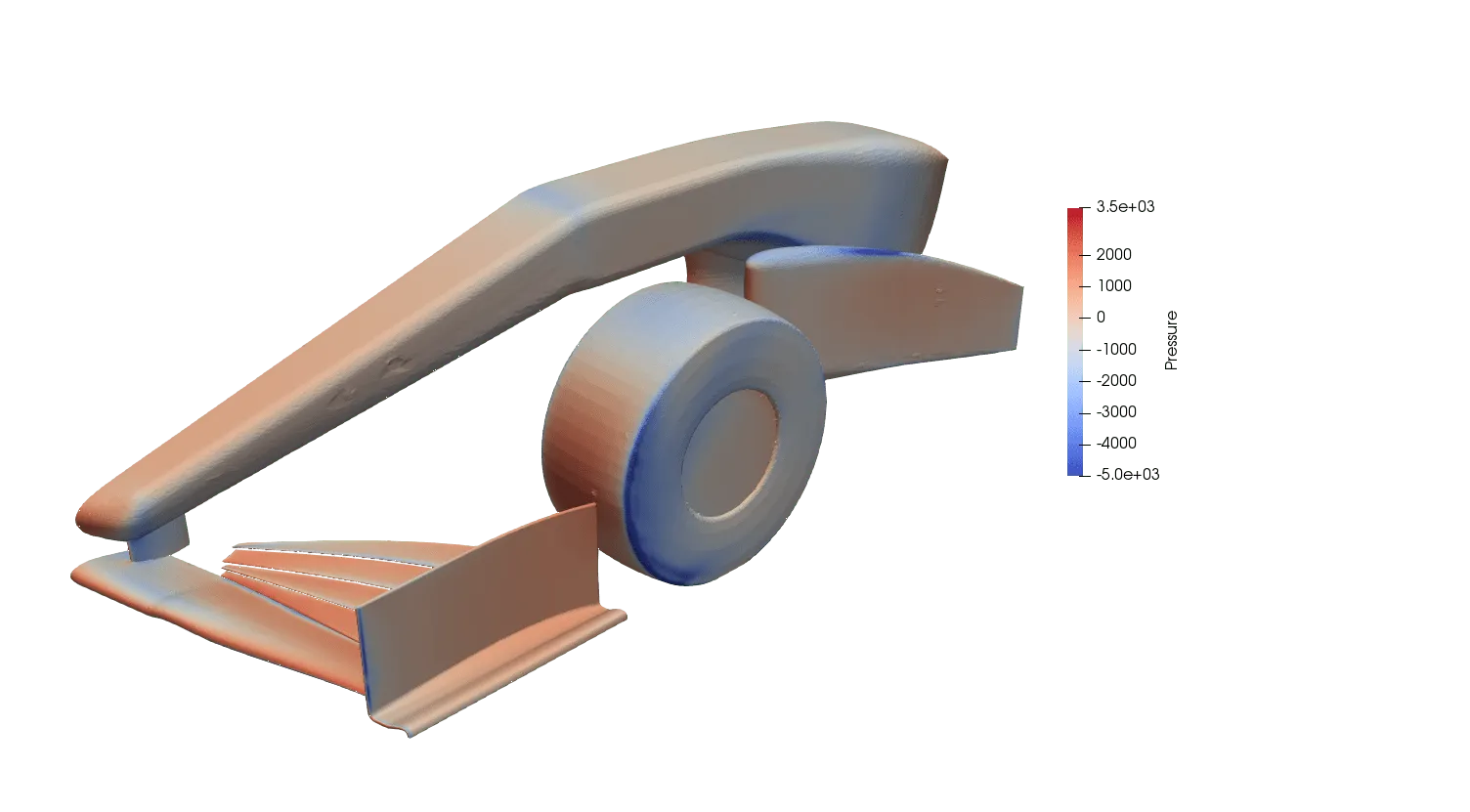
AI for CAE - Best Practices for Enhanced Simulation
Artificial intelligence is being increasingly utilized in computer-aided engineering to accelerate and enhance workflows in virtual engineering. This article shares best practices in AI for engineers using computer-aided engineering (CAE). It focuses on data-driven approaches to help design complex systems in the automotive, aerospace, and other industries. By combining physical models with neural networks (NNs), engineers can enhance the impact of design through computational fluid dynamics, structural, and electromagnetics simulations.
Unlock the Future of Simulation through innovations and discover how Artificial Intelligence (AI) in CAE is helping the design process by merging physics data and deep learning:
- Introduction to CAE and Artificial Intelligence
- Expanding AI Capabilities into Engineering Simulation Workflows
- Benefits and Case Study
- Data Preprocessing and Model Training
- Machine Learning in CAE
- Summary: Best Practices for AI-Driven Simulation
- Deep Learning Training
- Training on Datasets
- 3D CNNs
- Optimizing Training and Reducing Bias
- Outcome
- Deployment and Inference
Introduction to CAE and Artificial Intelligence
CAE software tools have long been essential in different fields and various industries, including automotive, aerospace, energy, and electronics.
These robust software tools demonstrated their ability to verify the performance and safety of engineering products. Designers can perform virtual testing and refinement of complex systems as a key step in product development, before creating any physical prototypes. Also, services companies can be outsourced for simulations by major corporations and their providers.
This virtual testing process can identify and solve potential issues early in the design phase. For example, it significantly reduces development time and costs in the automotive industry, making it an indispensable part of modern automotive design workflows. System simulation plays a crucial role in achieving these efficiencies, streamlining processes, and enabling faster innovation.
The different fields of technology are:
- Computational Fluid Dynamics (CFD) and Heat Transfer
- Solid Mechanics, Crashworthiness: Finite Element Analysis (FEA)
- Electromagnetic Analysis
Expanding AI Capabilities into Engineering Simulation Workflows
The integration of machine learning and AI is allowing engineers to:
- enhance their expertise
- accelerate workflows across the product lifecycle
- improve predictive accuracy
- automate design optimization.
Rather than replacing traditional methods, traditional software is complemented by tools that combine data-driven learning with physical principles to deliver faster, more consistent results.
- Physics-informed neural networks (NNs) approximate solutions to partial differential equations, thereby maintaining physical laws. Physics-informed neural networks (PINNs) integrate physical laws directly into the training process, to adhere to fundamental principles. They ensure physical consistency and enhance existing models, rather than replacing them. Google frameworks support AI-driven simulation and design. PINNs are not purely data-driven like classical supervised learning; they rely on physics constraints, with data as a secondary guide.
- Geometric Deep Learning has emerged as the key enabler for rapid design exploration and digital twin creation, accurately mirroring system behavior in real-time. It extends machine intelligence to complex shapes, such as computational meshes and 3D CAD geometries. It bridges the “CAD-to-result” workflow by learning relationships between shape, boundary conditions, and physical responses.
Benefits and Case Study
This collaboration between numerical analysis and machine intelligence is a key factor in the design process for complex systems, enhancing designers’ capacity to explore broader design spaces, gain insights earlier, and reduce dependency on costly computing resources. AI surrogate models enable faster simulations by predicting in seconds or minutes compared to traditional methods, which can take hours or weeks.
Engineers can predict and optimize designs, accelerating the design process and improving the accuracy of decisions. Real-time simulations also enhance collaboration among automakers, suppliers, and software vendors, fostering a more integrated and efficient development ecosystem.
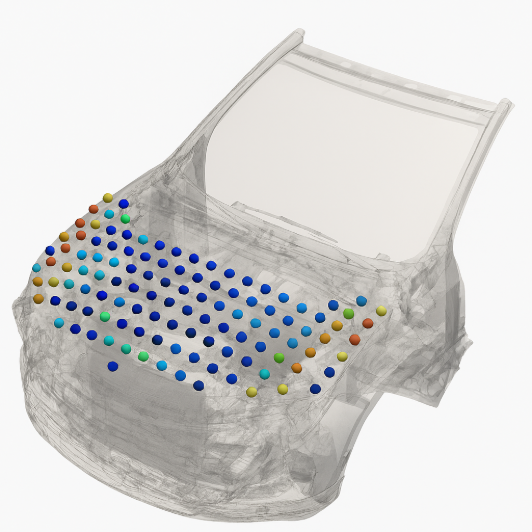
Generated pedestrian impact zones on vehicle hoods enable earlier design choices without the need for full simulations.
After developing a trained co-pilot with results from past programs, GM empowered its designers with a tool that assesses safety, style, and aerodynamics. This approach to pedestrian safety enhances crash simulations, reduces handovers, shortens iterations, and keeps design insights accessible.
Data Preprocessing and Model Training
Effective model learning from 3D simulations relies on high-quality datasets, as highlighted in recent research. Outputs (including geometries, boundary conditions, mesh resolutions, and field variables) must be reformatted for use with various frameworks, including machine learning methods.
The latest GPU-accelerated technology, such as NVIDIA PhysicsNeMo, has become instrumental in enabling large-scale model development and parallelized preprocessing. These capabilities allow engineers to process terabytes of numerical outputs and tune networks within hours rather than days. PhysicsNeMo is an open-source framework that facilitates the building and training of AI models for physics-based simulations, further enhancing the efficiency of engineering workflows.
Embedding physics knowledge into model development ensures results remain credible; for example, it helps to maintain accuracy and reliability.
- In crash analyses, certain elements, such as energy absorption and deformation patterns, must obey conservation laws.
- In CFD, mass and momentum continuity are conserved
Architectures that integrate these physical constraints deliver more reliable and interpretable predictions.
Machine Learning in CAE
Machine learning addresses complex CAE problems by optimizing systems and enhancing simulation accuracy. While unlikely to replace CAE jobs soon, it will change roles, requiring engineers to adapt to new tools. Its adoption now spans various areas, including generative design and real-time checks.
The table below outlines how ML applications are reshaping processes in various contexts.
| CAE Domain | Application | Results | Example Use Case in the article |
|---|---|---|---|
| CFD (Fluid Mechanics) | Surrogate modeling of flow fields | Predicts lift and drag without a full CFD run | Rapid assessment of aerodynamic shapes |
| FEA (Structural Mechanics) | Neural stress field estimation | Instant prediction of local stresses | Crashworthiness |
| Thermal Analysis | Heat diffusion | Maintains physical consistency with less meshing | Cooling system design |
| Electromagnetics | Neural field solvers | Accelerated field mapping | Motor and antenna design |
| Generative Design | Topology optimization | Manufacturable lightweight structures | Aerospace and automotive components |
| Real-Time Digital Twins | Hybrid models | Continuous monitoring & feedback | Predictive maintenance of turbines |
Summary: Best Practices for AI-Driven Simulation
Discover how AI transforms CAE with practical strategies to boost simulation accuracy. You will learn how to optimize your workflows for the automotive industry, aerospace, and more.
- Embed Physical Experience in Geometric Learning: Incorporate physical results (high-fidelity CAE or laboratory testing) into deep learning models to accurately capture geometric relationships (e.g., flow patterns in CFD), ensuring simulations reflect real-world behavior.
- Curate High-Quality Data: Preprocess simulation datasets (geometries, boundary conditions) to reduce bias, as seen in automotive crash simulations. Models need large volumes of high-quality datasets for effective training; poor dataset quality can create potential issues
- Validation Against Physical Prototypes: Compare predictions with experimental results to achieve high R² values (e.g., 0.95 in crashworthiness).
- Leverage GPU-Accelerated Pipelines: Accelerate large-scale simulations with tools like NVIDIA platforms for faster and more accurate iterations.
Deep Learning Training
The application of deep learning in Computer-Aided Engineering changes how we design and simulate complex systems.
Artificial Neural Networks can learn from past design history, capturing the geometric features that determine physical behavior. This approach enables CAE engineers to obtain results in a matter of seconds, i.e., almost in real-time, while maintaining consistency with CAE results.
Learning from Datasets
The learning process begins with records derived from previous projects.
In FEA, for instance, the computation of the stress concentration factor or stress maps is usually recorded.
Such records become a valuable foundation for learning correlations between geometry, boundary conditions, and results.
More details:
- 3D CNN Technology
- Among recent advancements, 3D Convolutional Neural Networks (3D CNNs) play a crucial role. Initially developed for image recognition, these architectures are now closely linked to CAE because they can process volumetric grids produced by computational fluid dynamics (CFD) or FEA.
- Training Resources
- The significant acceleration often attributed to geometric deep learning is realized after the training phase: once the surrogate model is trained, predictions can be produced in minutes instead of hours. Large datasets generated from CFD or FEA may be required. The more extensive and diverse these datasets are, the more reliable the learned correlations become.
Optimizing Training and Reducing Bias
Bias control remains a key concern: NNs exposed to limited geometries may fail on unseen ones. Combining CAE and CAD data from multiple configurations broadens generalization and stabilizes performance.
Outcome
The integration of deep learning into design workflows is transforming how expertise, decision-making, and innovation are applied across all industrial sectors.
- Enhanced expertise
- Deep learning enhances the expertise of designers by adding a new layer to their competencies. AI suggests design directions in real-time, transforming workflows into a continuous adaptive loop rather than a separate stage.
- Continuous learning
- As domain-specific AI assistants integrate into enterprise workflows, analysis specialists oversee systems that learn from past projects and build a consolidated knowledge base. Human engineers remain essential for validating results and ensuring the feasibility of these results in real-world applications.
- Extension to all industrial sectors
- The application of this technology extends to other sectors.
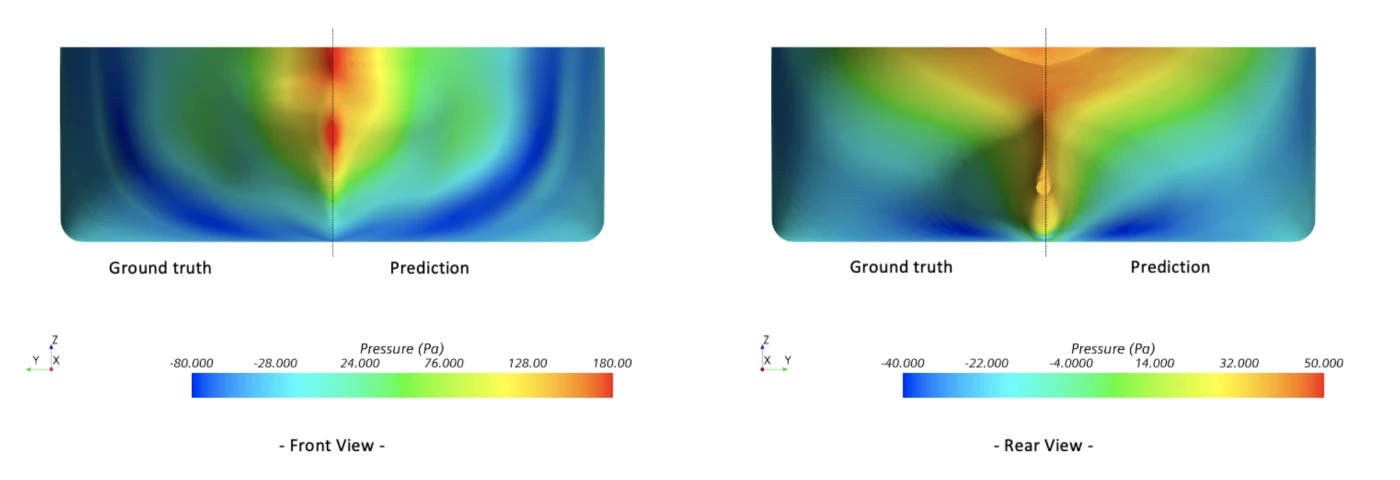
- For instance (above), naval designers can now predict a ship hull’s hydrodynamic performance in milliseconds instead of hours.
- In the life sciences (below), Neural Concept enables patient-specific eye surgery planning 100 times faster, reducing hours to minutes.

Deployment and Inference
Tools must be efficiently deployed for inference (prediction) in design environments.
AI-powered surrogate models can be integrated with solvers, preprocessors, or CAD tools, enabling prediction of flow, stress, or field distributions. Technologies like NVIDIA NIM facilitate its deployment from cloud to edge systems.
This flexibility enables designers to evaluate new designs in real-time, receiving near-instant response during iterative design sessions.
Conclusions & Future Outlook
Deep learning combined with CAE can contribute to transforming computational fluid dynamics (CFD), FEA, electromagnetics, and manufacturing by integrating physical principles with NNs. This approach enables CAE engineers to utilize machine intelligence to enhance accuracy in system design while minimizing computational demands.
Neural architectures produce reliable surrogates of physics-informed results. Generative design tools facilitate the interactive exploration of design options, enabling a shift from static checks to active, real-time design aids. Rapid evaluation and design space exploration, previously limited by the need for large-scale simulations, is now affordable.
The advancements in integration of real-time digital twins, GPU-accelerated pipelines, and adaptive platforms with traditional solvers will reshape CAE. The combination of numerical methods and AI will redefine simulation processes across various industries, supporting new design possibilities and faster results.
FAQs
What are the main applications of AI in computer-aided engineering (CAE)?
AI services play a crucial role in accelerating simulations in CFD, FEA, heat transfer, molding, and electromagnetism, optimizing designs, and building real-time digital twins.
How do AI-driven predictions compare to traditional CAE simulations?
Predictions are faster and more accessible, emphasizing democratization and early deployment. Designers quickly explore and refine ideas through high-fidelity simulations, screening thousands of concepts in minutes, spotting trends, and guiding users to promising regions before costly calculations for quicker results.
What are some case studies of AI & CAE?
Examples include aerodynamic optimization, crash simulation acceleration, and injection molding prediction, all of which demonstrate significant time savings and enhanced design exploration.
What are the benefits of using AI with CAE?
AI enhances efficiency by incorporating key elements that reduce computation time, enabling rapid evaluation of design options, and supports continuous learning from data. It reduces CFD and Finite Elements Analysis times from hours to seconds, delivering statistically accurate predictions. However, integrating AI tools with existing systems, such as CAD, CAE, and PLM, can be complex and resource-intensive, necessitating careful planning.
What are the future trends in AI+CAE?
We will adopt geometric deep learning on 3D meshes and CAD geometries, enabling faster design exploration and generative workflows. This will enable designers and CAE engineers to evaluate thousands of options early, thereby accelerating the traditional simulation process.
What is the relevance of physics-informed neural networks for CAE?
Physics-Informed Neural Networks (PINNs) embed physical laws and PDEs into surrogate models, integrate into simulation libraries, and improve R&D workflows. They embed equations of motion or heat transfer into NNs for faster solutions, making models more useful in simulations.