AI Product Innovation for Faster Development Cycles
Leveraging AI provides a clear path forward for organizations seeking to adapt their innovation strategies and stay ahead in rapidly evolving markets. By adopting AI-driven approaches, companies can strategically position themselves to respond to change and maintain long-term competitiveness.
Without new ideas, businesses risk falling into:
- Commodization: all offer similar products
- Financialization: prioritize quick profits over long-term success with R&D investment
Thus, innovation in product development is not optional: products that are not improved or adapted lose relevance and margin over time, as we have seen in the examples above.
How Is Artificial Intelligence Changing the Game?
The good news is that artificial intelligence and machine learning are boosting product development by accelerating innovation and improving outcomes.
Here’s why Artificial Intelligence is changing the game:
- AI can process information thousands of times faster than humans, spot patterns in massive datasets that would take years to analyze manually, and test thousands of variations simultaneously.
- A human designer might, for instance, sketch 10 shoe designs in a week. AI models can generate and evaluate 10,000 variations in hours, each optimized for different criteria such as weight, durability, or manufacturing cost. This example demonstrates that AI can generate ideas and design candidates at a scale and diversity beyond human capability. AI's ability to generate novel ideas and solutions that humans might not conceive of expands the scope and speed of innovation, enabling breakthroughs that were previously out of reach.
- But AI is about more than just speed. It helps organizations make more informed decisions by identifying effective strategies rather than relying solely on intuition or limited insights. AI can also generate design ideas for physical products faster than humans alone, giving companies an advantage in competitive, fast-changing markets.
- A McKinsey analysis (2025) finds that in industries producing complex manufactured products, AI could meaningfully shorten research and development timelines, with acceleration varying widely across industries and development stages.
- In some sectors, the effect is on the lower end of the scale; in others, it is much larger. Overall estimates suggest that Artificial Intelligence can accelerate R&D processes by 20 to 80 percent, depending on the industry.
- Notably, about three-quarters of the potential economic benefits of Artificial Intelligence in product innovation come from generating new product candidates, underscoring the significant impact of AI-driven concept development and idea generation.
Product Innovation With Faster Development Cycles - Deep Learning Cases
Innovation helps create new products faster and more creatively.
Spanning industries from aerospace to automotive, Deep Learning tools can produce thousands of design alternatives, accelerating design cycles. Engineers incorporate human expertise in the final refinement phase. The ongoing collaboration between machines and engineers fosters smarter, quicker, and more effective design choices.
Cross-Industry Preliminary Considerations:
- Learn about the role of AI in product design.
- Explore the role of AI in CAD Design.
Aerospace Industry Overview:
- Explore the role of Deep Learning for product innovation in the aerospace industry.
Automotive Industry Examples: For insights into the key differences and applications of Machine Learning (ML) and Large Language Models (LLMs) in modern engineering fields, including the automotive sector, read this comprehensive article.
- MAHLE used Neural Concept’s AI platform to design a radial blower inspired by nature for car air-conditioning systems, testing over 30 million designs, which helped improve efficiency by 15%, reduce noise by 4 decibels, and make the blower smaller, which is especially useful for electric vehicles.
- OPmobility has integrated AI technology into the car’s exterior design, accelerating testing of various physics factors for hybrid, hydrogen, and full-vehicle models. At CES 2025, ideas such as a quieter hybrid fuel tank and tests that now take seconds rather than hours were presented.
- Eaton was able to rapidly predict thermal performance and optimise cooling plates, yielding a 30% reduction in pressure drop and 10% lighter components. The case demonstrates how deep learning accelerates engineering efficiency and drives innovative product designs.
- For in-depth technical detail, see also:
- Lombardi, A., Zampieri, L., Agrawal, M., Singhal, M. et al., “Optimization of Power Module Cooling Plate: An Application of Deep Learning for Thermal Management Devices,” SAE Technical Paper 2024-01-2583, 2024, https://doi.org/10.4271/2024-01-2583.
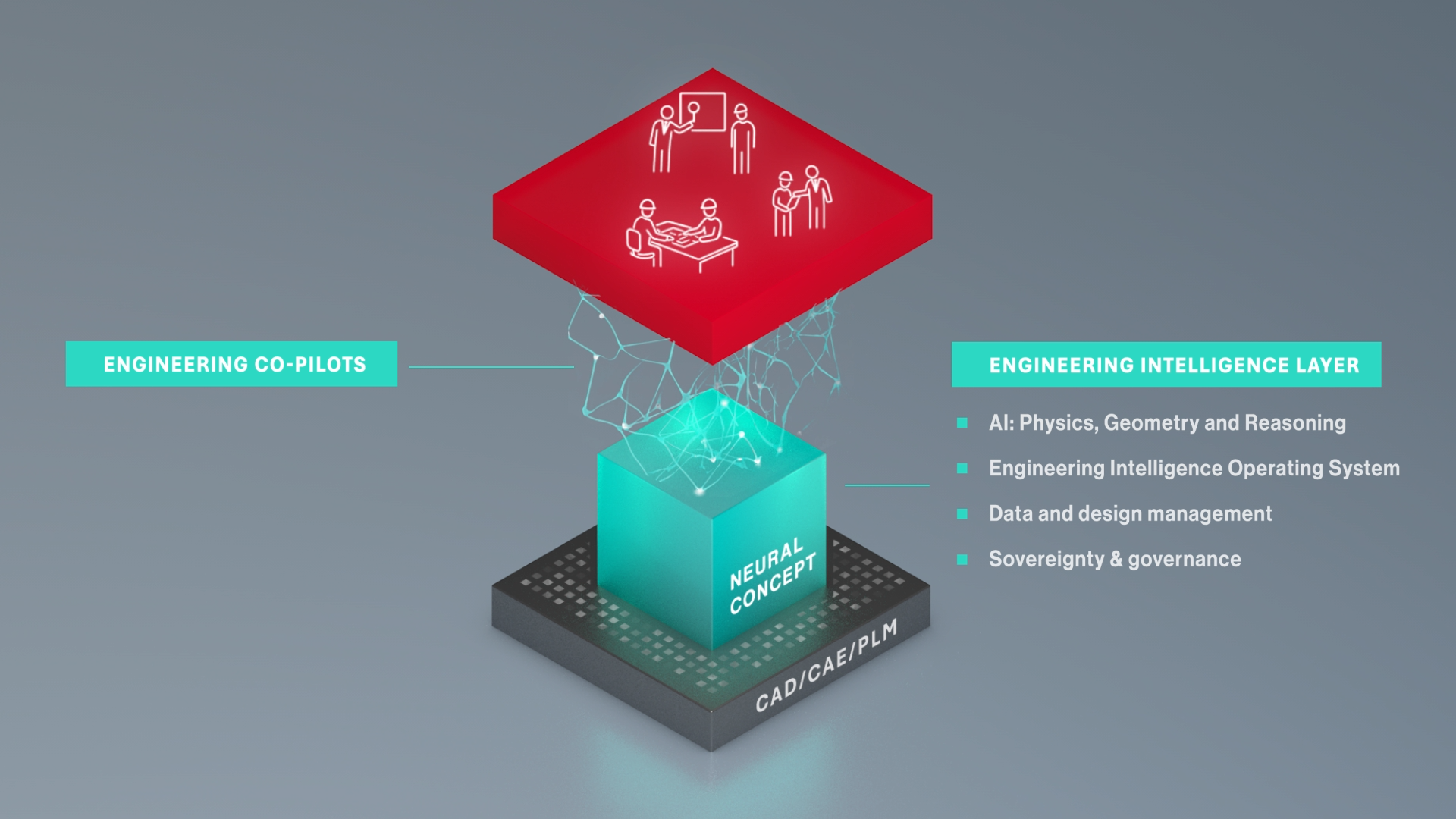
2026 Update - Co-pilots
- Explore how generative design and human collaboration are accelerating development cycles.
The Product Development Process
To understand the impact of Artificial Intelligence on product innovation, we first need to review the concepts underlying new product development.
The traditional product development life cycle consists of distinct stages that companies follow to bring innovative products from concept to market.
Each stage requires time, resources, and coordination across multiple teams.
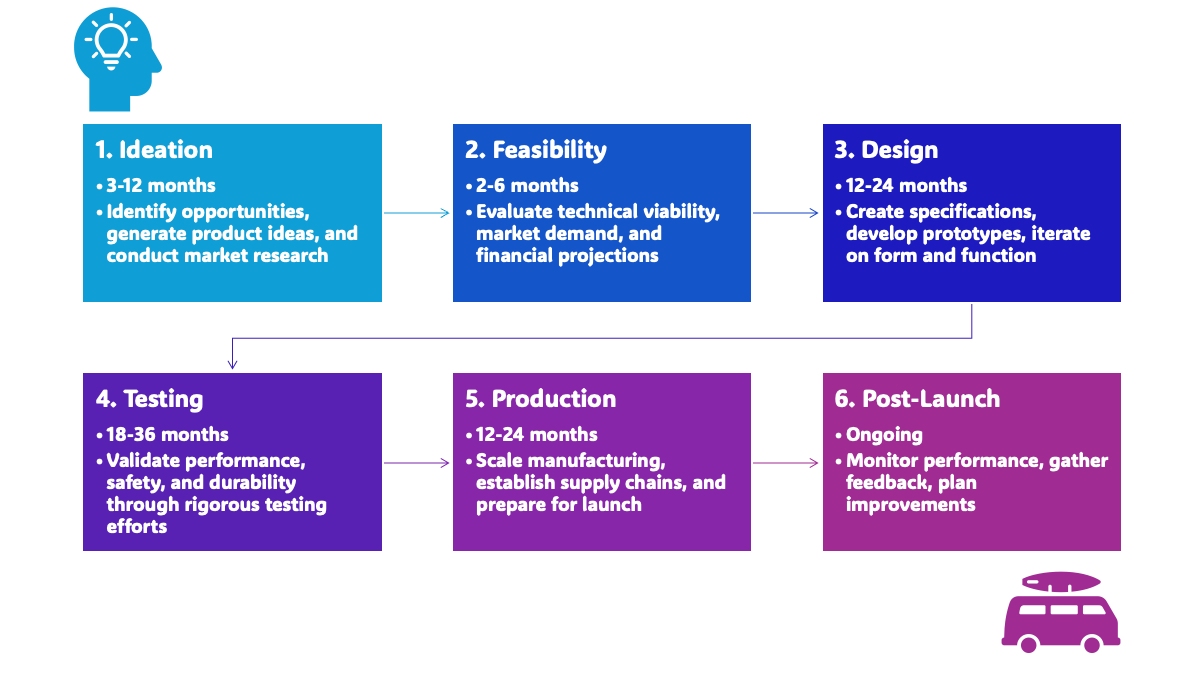
The Stages of Traditional Product Development
Traditional product development follows a linear or iterative process through six key stages. Each stage creates bottlenecks that slow innovation and limit exploration of alternatives. In the biopharmaceutical industry, the traditional method for developing new drugs is lengthy and complex, posing significant challenges to R&D productivity and innovation.
| Stage | What Happens | Example (Drug Discovery) | Timeline |
|---|---|---|---|
| 1. Ideation | Identify opportunities, generate product ideas, and conduct market research. | Screen thousands of compounds manually to find molecules that interact with disease targets | 3-12 months |
| 2. Feasibility | Evaluate technical viability, market demand, and financial projections | Assess if compounds can be synthesized and manufactured at scale | 2-6 months |
| 3. Design | Create specifications, develop prototypes, iterate on form and function | Optimize molecular structure at the molecular level for effectiveness and stability | 12-24 months |
| 4. Testing | Validate performance, safety, and durability through rigorous testing efforts | Conduct laboratory tests, animal trials, assess toxicity and efficacy | 18-36 months |
| 5. Production | Scale manufacturing, establish supply chains, and prepare for launch | Set up pharmaceutical production, obtain regulatory approval for new drugs | 12-24 months |
| 6. Post-Launch | Monitor performance, gather feedback, plan improvements | Track patient outcomes, report adverse events, and refine formulations | Ongoing |
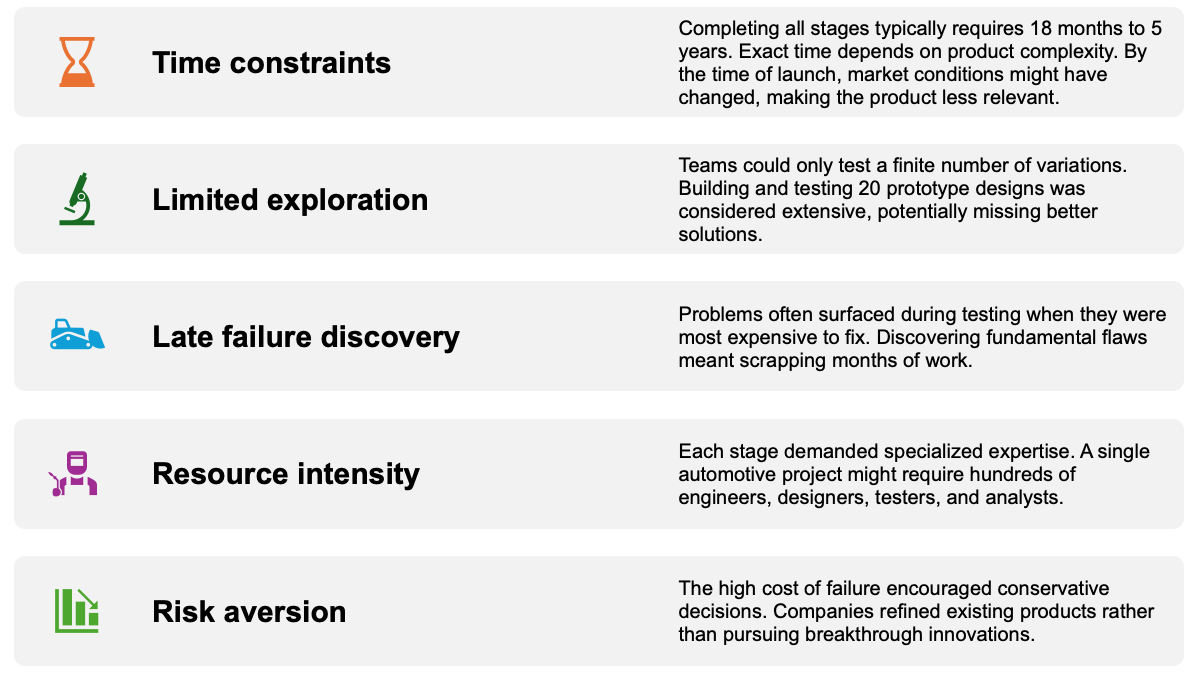
Does the Traditional Process Create Bottlenecks?
The traditional process does create significant bottlenecks throughout the value chain, as illustrated.
How and Where Does AI Change Everything?
Artificial transforms the traditional process by introducing speed, automation, and predictive capabilities at every stage. Rather than moving sequentially with limited iterations, Artificial Intelligence enables parallel exploration of thousands of options simultaneously.
AI-powered generative design systems significantly enhance engineering processes by optimizing structural dynamics, aerodynamics, and performance prediction, enabling multidisciplinary engineering teams to rapidly iterate and improve complex product designs.
Explore how neural networks can affect aerodynamic design.
| Stage | Impact of AI | Example: Human Health (Drug Discovery) | Speed Improvement |
|---|---|---|---|
| 1. Ideation | Analyzes customer behavior, market trends, and unstructured data to identify opportunities | Screen millions of molecular structures in silico before laboratory work | Weeks vs. years |
| 2. Feasibility | Predicts technical feasibility, market fit, and manufacturing constraints instantly | Simulate molecular properties, predict synthesis routes, and estimate production costs. | Days vs. months |
| 3. Design | Generates thousands of design variations optimized for multiple criteria | Create novel molecular structures that meet efficacy, safety, and manufacturability requirements | Hours vs. months |
| 4. Testing | Simulates performance, predicts failures, and identifies issues before physical testing | Model drug interactions, predict side effects, and simulate clinical trial outcomes | Days vs. years |
| 5. Production | Optimizes manufacturing processes, reduces carbon emissions, and ensures quality control | Optimize synthesis pathways, predict batch failures, automate quality inspection | Real-time optimization |
| 6. Post-Launch | Analyzes customer experience data, predicts maintenance needs, and identifies improvements | Monitor patient outcomes across populations, identify new applications for existing drugs | Continuous insights |
The results include shorter timelines, lower costs across the value chain, better alignment with market needs, and innovative products that more accurately meet customer demands.
In summary, companies gain a competitive advantage by exploring many more product options than before.
AI doesn’t replace human experts but helps them do their jobs better, in symbiotic collaboration:
- AI handles large amounts of data
- Human experts focus on creative problem-solving and strategic decisions about which new products to develop.
Basic Concepts of AI and Gen AI
Artificial intelligence (AI) is a type of software that learns from experience. Traditional software follows strict, pre-set rules. AI improves its performance by analyzing data and recognizing patterns.
Think about how you learned to identify spam emails. You didn’t memorize a list of forbidden words; instead, you saw hundreds of examples over time and developed an instinct for what seems suspicious. AI works similarly, but it processes thousands or even millions of examples to establish that instinct almost instantly.
For example, a typical spam filter might block emails with the phrase “FREE MONEY.” Spammers can bypass this by using code or misspelled words, like “FR33 M0NEY.” An AI-based spam filter learns what spam looks like from many examples. It detects patterns in word choice, sender behavior, and email structure. AI automatically identifies new types of spam by detecting underlying patterns, not just specific phrases.
The Learning Revolution: From Rules to Data
The key distinction that makes modern Artificial Intelligence powerful is its ability to learn.
Learning means the system improves its performance through experience rather than requiring humans to explicitly program every rule. When an AI system encounters new data, it adjusts its internal parameters to better handle similar situations in the future.
This capability represents a fundamental change from earlier approaches to artificial intelligence.
How AI Learns: Three Main Approaches
AI systems learn in different ways depending on what type of problem they’re solving.
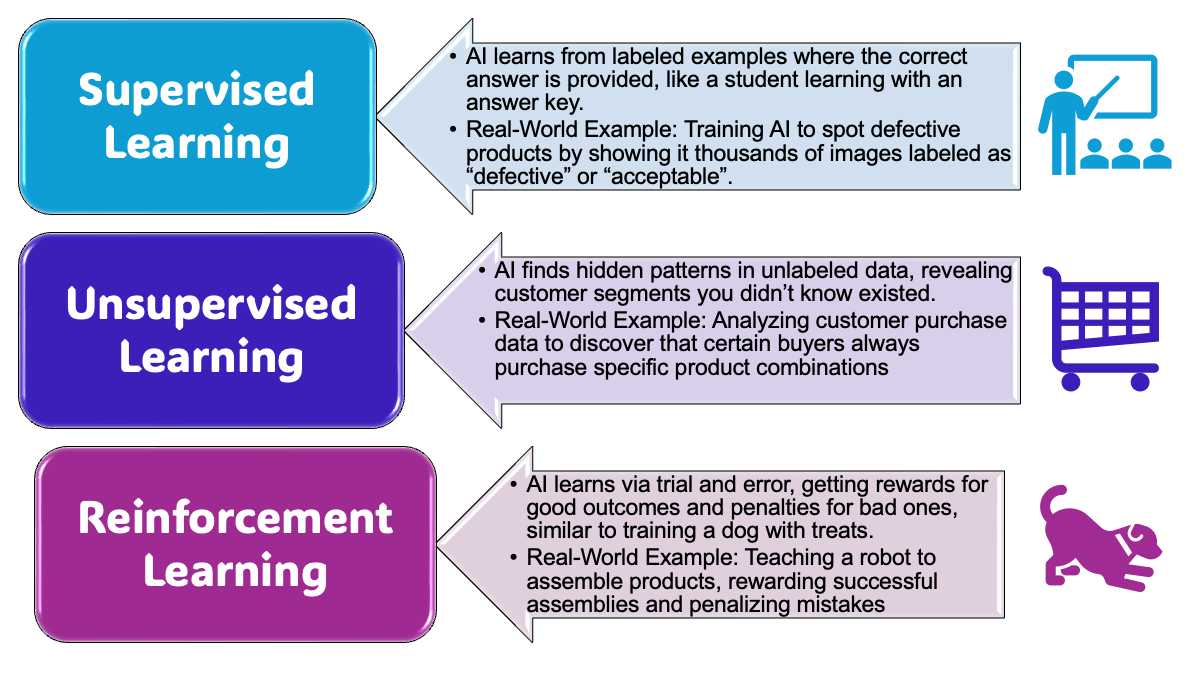
Here are the three fundamental approaches of Machine Learning:
- Supervised learning excels when you have historical data with known outcomes.
- Unsupervised learning reveals insights hidden in complex datasets.
- Reinforcement learning solves optimization problems where the best approach isn’t obvious upfront.
Each approach serves different purposes in product development.
From Symbolic Rules to Learning Systems
Modern AI works because it learns from large amounts of data instead of following strict rules. That’s why artificial intelligence can now solve complicated product development problems that seemed impossible ten years ago.
In the beginning, early AI systems relied on explicit rules created by humans, such as “IF patient has fever AND rash THEN consider measles.” These systems couldn’t learn from experience or adjust to new situations. When this approach failed to meet expectations in the 1970s and 1980s, funding dried up, and the field was called the AI Winter.
The significant change happened when researchers started using learning-based systems called artificial neural networks. Instead of being programmed with fixed rules, these networks learn patterns directly from data.
This evolution was recognized in October 2024 when the Nobel Prize in Physics was awarded to John Hopfield and Geoffrey Hinton. Their groundbreaking research in the 1980s on networks that could store and learn patterns laid the foundation for today’s AI systems.

The Foundation: Data
AI technology runs on data, used in a straightforward process:
- Collection
- Gather relevant information from various sources (sensors, databases, user interactions, documents, previous engineering simulations)
- Preparation
- Clean and organize the data, removing errors and standardizing formats so the AI can process it effectively
- Training
- Feed the prepared data to the Artificial Intelligence model, so it learns patterns, relationships, and rules.
- Application
- Use the trained model to make predictions, generate content, or automate decisions on new data it hasn’t seen before
More quality data (text, images, numbers, or any digitized content) means better performance.
A good example: teaching Artificial Intelligence to recognize skin cancer. Feed it 100,000 labeled skin images, and it will learn to identify suspicious moles with accuracy rivaling that of dermatologists. ù
However, poor data leads to poor AI. Biased training data results in biased outputs. If the skin cancer training data only includes lighter skin tones, the AI will perform badly on darker skin tones, which could affect people’s health. Diverse, representative data is crucial for AI systems that influence people’s lives, whether in healthcare or in other domains where AI is used for innovation, such as drone aerodynamics design optimization.
Large Language Models (LLMs)
Large Language Models (LLMs) are all around us, and many of us use them daily.
In short, LLMs are AI systems trained on vast amounts of text data from sources such as websites and programming code. They recognize patterns in language, helping them understand and generate human-like text across many topics.
Models like GPT or Claude have billions of parameters, allowing them to adapt their complexity to different audiences. For example, they can explain quantum physics to a child or provide detailed explanations to a graduate student.
LLMs are used in chatbots, coding assistance, email drafting, and language translation. They analyze unstructured data such as customer reviews, research papers, and social media posts, providing insights that would be difficult for humans to process quickly.
Generative AI: Creating New Content
Generative AI refers to AI systems that generate original content by learning underlying patterns in data, rather than only making predictions.
It produces new content, including text, images, music, and design outputs. By learning statistical structures from large datasets, generative AI can create original ideas without directly copying existing material. Typical applications include marketing content, product visuals, and customer communications, where these systems automate and scale content creation across industries.
Traditional AI and generative AI differ in scope and output.
- Traditional AI focuses on prediction (inference) or classification based on historical data.
- Generative AI produces multiple novel and viable outputs from user-defined constraints, expanding human exploration while introducing risks, such as misinformation, if not properly supervised.
AI Agents: Systems That Act
AI agents autonomously achieve goals through multi-step planning. Unlike chatbots that just respond, agents use tools and adapt their approach. The emerging field of agentic AI represents systems that can plan, execute tasks independently, and adjust strategies based on results.
Example: given “I want to go hiking this weekend,” an agent checks the weather, searches for trails, assesses your fitness based on past data, and suggests specific hikes with timing, all without further input.
AI Strategy and New Insights
Decision-makers need an AI plan that answers key questions. For instance, understanding innovations such as the impact of digital twin technology on the automotive industry can inform strategic decisions.
- Where can AI be helpful?
- How can it be used responsibly?
- What data is required?
Technology is changing quickly. For example, GPT-3 seemed groundbreaking in 2020, but by 2023, it was outdated.
AI’s ability to analyze vast amounts of data helps find new insights that humans can’t discover on their own. Medical researchers use AI to identify disease markers in millions of genetic samples. Drug developers use AI to generate new ideas for existing medicines by analyzing thousands of compounds at once.
These skills give organizations several benefits:
- understand market trends faster,
- predict customer actions more accurately,
- Find innovation opportunities that are hard to see via traditional methods.
The combination of speed and pattern recognition is changing how companies decide which new products to create.
Having a clear plan is crucial for organizations that want to use AI to boost innovation and develop better products. With a strategic direction, companies can ensure their AI efforts deliver real value and guide their decisions toward successful outcomes.
Business Impact of AI on Product Innovation
AI can handle large amounts of data from different sources, helping companies develop products more efficiently. Using AI in product development offers three main advantages:
- Faster time-to-market: What took 18 months now takes 6. You can launch products while demand is still high, rather than waiting until competitors have saturated the market. Thus, AI can streamline and accelerate key processes and workflows in product development, improving time-to-market.
- Lower costs: Digital testing is cheaper than building physical prototypes. AI catches design flaws early, before you’ve manufactured 10,000 defective units. Automation reduces the need for large teams doing repetitive analysis.
- Better products: AI helps you make data-driven decisions. Instead of guessing what customers want, you analyze what millions of actual users are doing. Products that better match real needs lead to higher sales and fewer returns, improving the overall customer experience. AI tools can help companies identify unmet needs tailored to specific consumer segments at a granular level.
AI can help companies save thousands of hours and millions of dollars in product development by generating new ideas and optimizing processes.
The potential annual economic value unlocked by using AI to accelerate R&D innovation is estimated at $360 billion to $560 billion (McKinsey & Company, 2025).
Deep Learning Models: The Heavy Lifters
Deep learning models are neural networks with many layers that excel at spotting complex patterns in large datasets. In product development, this pattern recognition supports several practical applications:
- Predicting success: By training on data from past products (features, pricing, marketing spend, and sales), the model learns which characteristics correlate with success and can evaluate new product concepts before launch.
- Generating variations: Generative models, once trained on existing designs (e.g., 10,000 chairs), can produce novel, structurally sound, and visually appealing alternatives.
- Continuous improvement: Models can be retrained with new data from product launches, customer reviews, and returns, improving the accuracy of future predictions and designs.
Making Sense of Data
Modern companies collect vast amounts of data. Examples include:
- website clicks,
- purchase records,
- customer service calls,
- sensor data from the Internet of Things (IoT) devices,
- social media mentions.
A human team alone cannot analyze all this information effectively.
AI systems combine customer behavior with market trends, competitor launches, and changing regulations.
A fitness tracker company might analyze when users stop using their devices and public complaints on forums to identify needed improvements, such as better battery life, rather than adding more sensors.
This data analysis detects problems and uncovers opportunities. AI observes that users in cold climates use the product differently, indicating a need for a weatherproof version for a new market segment.
The Real Impact
AI enhances human creativity and expertise. Designers still need to understand what makes a product attractive or functional.
Engineers still have to solve new technical problems.
However, AI excels at handling repetitive tasks:
- analyzing data,
- running simulations,
- testing different options,
- identifying issues.
This allows humans to focus on aspects that require human judgment and creativity.
One example is the use of AI-powered generative design tools. Design tools can automatically generate and evaluate thousands of product design options against specific goals and constraints. This technology helps teams find innovative solutions that would be hard or time-consuming to discover on their own.
In industries where things move quickly, this is a competitive advantage
Case Studies, Revolutionizing Product Development
The following examples demonstrate how organizations across different sectors have successfully implemented AI to transform their product development initiatives. While specific metrics and timelines vary by source, these cases illustrate the practical applications of AI in creating innovative products.

- AI has been applied in the food industry to generate thousands of new product ideas, helping companies save time and resources in product development.
- Mondelez International uses machine learning tools to accelerate recipe development significantly for new products. Machine-learning tools in R&D generate and evaluate many possible snack formulations based on desired flavor, texture, cost, nutrition, and other constraints, enabling them to bring products to pilot or production stages 4–5 times faster than traditional trial-and-error testing. More info available here: pws.io.
- AI has enabled Kraft Heinz to develop plant-based products that mimic the flavor, color, smell, and functionality of animal products. Leveraging AI at the molecular level, Kraft Heinz and NotCo could better understand and replicate the properties of animal-based foods, resulting in more accurate and innovative plant-based product formulations.
- Coca-Cola used AI to create a new limited-edition product, Y3000 Zero Sugar, with a tutti-frutti flavor. According to a managing director at a leading food innovation consultancy, “AI-driven product development, as seen with Coca-Cola’s Y3000 Zero Sugar, demonstrates how strategic use of data and machine learning can unlock entirely new flavor experiences and accelerate time to market.”
- AI tools have been used to analyze millions of social posts, recipes, and menus to identify trends and inform product development, as seen with PepsiCo’s new hydration options that responded to changing consumer preferences.
- AI tools help Danone analyze data and predict trends for optimizing yogurt formulations. Danone leveraged AI and data-driven predictive tools to analyze massive datasets on consumer preferences, market trends, and ingredient interactions, enabling faster optimization of product formulations and reducing trial-and-error in R&D by predicting what combinations will meet sensory, nutritional, and stability targets.
- AI has been used by companies like Ocean Spray to explore the healthful effects of cranberries, leading to new product ideas.
- AI has been applied in the personal care and life sciences industry with several notable implementations.
- AI has enabled companies to generate new product ideas and gain insights into existing products, as demonstrated by The Estée Lauder Companies’ interactive AI trend-spotter tool.
- Avon implemented AI alongside augmented reality technology for virtual try-ons, resulting in a reported 320% increase in conversion rates.
- AI has been utilized to create digital twins that optimize material designs and simulate product performance, particularly for complex products, such as diapers and sanitary pads. See, for instance, Procter & Gamble partnering with Microsoft.
- Unilever has more than 500 AI projects globally, using in silico testing to optimize products before the lab and scale-up stages, boosting efficiency and cutting time-to-market. AI has helped Unilever design products to suit regional taste preferences by running virtual tests and scenarios to optimize products before the lab stage.
- Google DeepMind’s AlphaFold predicts protein structures, accelerating drug discovery for diseases such as Alzheimer’s and enabling breakthroughs in medical research.
- Other industries:
- General Electric uses AI to monitor equipment health and predict failures, significantly reducing factory downtime and carbon emissions through more efficient operations.
- Generative design enables engineers to specify constraints and generate thousands of design variations, as demonstrated by Boeing.
- Apple optimized its A-series chip designs with machine learning, resulting in improved performance and lower power consumption.
- Nike and UPS have leveraged AI tools to optimize supply chains, improving efficiency, reducing costs, and enhancing responsiveness to market changes.
Note: These examples are based on publicly available information. For the most current and detailed case studies, readers should consult company reports or industry publications directly.
Integrating AI into Product Development Workflows
Successful implementation requires thoughtful integration at each stage of development.
Successful AI implementation depends heavily on the consolidation of clean, structured data pipelines.
- This foundation enables AI to automate documentation tasks in product development processes, particularly in regulated industries such as pharmaceuticals, medical devices, aerospace, automotive manufacturing, food processing, financial services, and healthcare technology. In these sectors, thorough documentation is not optional but legally required, making automation especially valuable.
- AI goes beyond documentation by improving human creativity and technical accuracy at different stages of product development. It serves as a team partner, helping other departments work better together. AI can also make product development processes more efficient and analyze large data sets to provide valuable insights that guide decision-making.
- AI automates manufacturing tasks, ensuring quality control by detecting defects in real-time production and simulating production scenarios before committing to expensive tooling. AI leverages real-time computer vision with anomaly detection on production-line sensor streams, coupled with digital twins and physics-informed simulation to predict defect rates and optimize tooling parameters before physical manufacturing.
- Artificial intelligence helps create new products by personalizing options for each customer, predicting what customers might need in the future, and automating the design process. Specifically, automation quickly generates many design options, while testing automation runs thousands of simulated performance tests under various conditions, materials, and uses.
- AI analyzes user data to tailor product features and interfaces, a classic case of personalization via recommender systems, exemplified by Spotify’s Discover Weekly.
Automotive Industry
AI accelerates the innovation cycle from conceptualization to market launch by up to 30% in automotive applications.
- Eaton Corporation reduced design time for an automated lighting fixture by 87% using AI for simulations.
- Google’s AutoML helps developers build AI features without extensive coding knowledge by leveraging neural architecture search and Bayesian optimization.
- Tesla uses AI to design hardware components and test self-driving software through simulations that model millions of driving scenarios.
Various Industries
AI enables companies to optimize supply chains, as evidenced by Nike’s demand forecasting systems. UPS’s ORION system employs AI to automate routes and predict demand, saving millions. ORION solves a Vehicle Routing Problem, which is a generalization of the famous Travelling Salesman Problem.
In other industries, AI applications continue expanding.
- Pharmaceutical companies use AI for drug discovery, analyzing molecular interactions to identify promising compounds faster.
- Aerospace manufacturers employ generative design to create lighter components that reduce fuel consumption.
- Consumer electronics firms use AI to predict which features will resonate with target demographics, informing decisions about where to invest development resources.
New Product Development Strategies
Product development is no longer a linear path from idea to launch. Today, competitive advantage comes from how effectively companies use data, AI, and simulation tools across the entire product development lifecycle, from opportunity discovery to design, testing, and market fit.
Below are the core strategy pillars reshaping modern product development.
AI-Driven Opportunity Discovery and Idea Generation
Artificial intelligence is increasingly used at the very start of the product development process. AI systems help identify unmet needs and emerging opportunities earlier and more systematically than traditional methods. This is possible because AI can analyze large volumes of internal data, customer behavior, market signals, and unstructured information.
Instead of relying solely on workshops or intuition, teams can use AI agents to scan trends, detect weak signals, and surface product ideas that would otherwise remain hidden. This improves both the speed and the breadth of idea generation while reducing bias.
Concept Development and Design Optimization with Digital Twins
Simulation and virtual testing are transforming concept development. AI-powered design tools and digital twins allow teams to explore multiple design alternatives, stress-test concepts, and optimize performance before committing to physical prototypes.
Digital twins (virtual replicas of products or systems) enable rapid iteration in a controlled environment. This reduces development time, lowers prototyping costs, and improves reliability by identifying design flaws early in the process.
Faster Testing Cycles and Reduced Time to Market
AI models can automate and accelerate testing activities that were traditionally slow and resource-intensive. Virtual testing, predictive failure analysis, and automated validation allow teams to move from concept to production with fewer iterations and less rework.
As a result, companies can shorten development cycles while maintaining or improving product quality, which is essential in fast-moving markets.
Data-Driven Market Fit and Customer Alignment
AI is used to align products with real customer needs. By analyzing usage data, feedback, and behavioral patterns, companies can refine their products’ features, pricing, and positioning.
This data-driven approach has several advantages: it
- improves product market fit,
- reduces the risk of misaligned launches,
- supports continuous improvement after release.
Generative AI for Engineering and Operational Efficiency
Generative AI is increasingly used to automate routine tasks without replacing engineering judgment. It frees teams to focus on higher-value activities such as architecture decisions, trade-off analysis, and strategic planning.
Used correctly, generative AI becomes a productivity multiplier rather than a creative crutch.
Industry Applications Across Sectors
In pharmaceuticals, AI is used to analyze molecular structures, biological data, and scientific literature to identify promising compounds and new uses for existing drugs. This cuts down discovery timelines and development risk.
In manufacturing and engineering, digital twins and AI-based simulations are used to model physical behavior, reduce prototyping, and optimize performance. These approaches improve quality, lower costs, and reduce environmental impact by minimizing waste and unnecessary testing.
AI-Enabled Supply Chain and Lifecycle Integration
Beyond design and development, AI supports demand forecasting, inventory optimization, and lifecycle management. Real-time data analysis enables companies to anticipate demand, adapt production, and deliver more responsive customer experiences.
This tight integration between product development and operations strengthens resilience and scalability.
Strategic Takeaway
Integrating AI into product development is no longer experimental. It is becoming a baseline capability. Companies that use AI to systematically generate ideas, optimize design, validate concepts, and align with customer needs gain structural advantages in speed, cost, and quality.
As AI technologies mature, the differentiator will not be access to tools, but how deeply they are embedded into product development strategy and decision-making.
Conclusion - From Customer Behavior to Optimized Products
AI is transforming how organizations approach product development by increasing speed while reducing costs throughout the value chain. AI tools provide insights that help companies understand customer behavior, identify market trends, and achieve better market fit.
As a vice president of product development might recognize, integrating AI isn’t about replacing human expertise but amplifying it. Organizations that strategically deploy AI to handle data-intensive tasks, freeing their teams to focus on creative problem-solving and strategic decision-making, gain a competitive edge.
The continued evolution of agentic AI promises even greater autonomy in managing complex product development initiatives.
FAQ
How can AI actually speed up product development compared to traditional methods?
AI can analyze vast amounts of data very quickly, run thousands of simulations simultaneously, and find patterns that humans might overlook, thereby avoiding lengthy manual analysis and shortening physical prototyping. Design problems are detected before costly manufacturing begins.
What’s the difference between generative AI and traditional AI?
Traditional AI analyzes existing data to make predictions or classifications. Generative AI creates entirely new content, such as design variations, material combinations, or product concepts. Both serve different purposes: one evaluates options, the other generates them.
Do companies need massive datasets to benefit from AI in product development?
Transfer learning enables models trained on large datasets to be fine-tuned with smaller, company-specific data, which can still provide valuable insights when properly structured, even if more data improves performance.
How does AI streamline internal knowledge management?
AI can streamline internal knowledge management by codifying tacit knowledge and synthesizing insights from various sources.
How do small companies compete with large corporations that have more AI resources?
Small companies can leverage cloud-based AI services, pre-trained models, and specialized consultants without building infrastructure from scratch. Their advantage often lies in faster decision-making and more focused implementation of specific high-value applications.
What are the most significant risks of relying on AI for product decisions?
Key risks include biased training data leading to flawed recommendations, over-optimization for past patterns that miss emerging trends, and over-reliance on AI without human judgment. Successful implementations maintain human oversight at critical decision points.
How does AI help with understanding customer needs better than traditional market research?
AI analyzes behavior across millions of interactions instead of relying on survey responses. It detects subtle patterns in purchase history, product usage, and sentiment to reveal unstated preferences.
Can AI handle creative aspects of product design or just analytical tasks?
AI is good at creating new ideas and variations based on what it has learned. While it can generate original combinations, human designers are still needed to judge what looks good, is culturally appropriate, and matches the brand. The best results happen when humans and AI work together.
What skills do product development teams need to work effectively with AI?
Teams need data literacy to understand AI outputs, critical thinking to evaluate recommendations, and domain expertise to set appropriate constraints. Technical AI skills can reside with specialists, while others learn to use AI tools effectively.
How long does it typically take to see ROI from implementing AI in product development?
ROI timelines vary widely by application. Quick wins, such as automating data analysis, can show value within months. More complex implementations, such as predictive modeling or generative design, often require 12-18 months before measurable impact.
Will AI eventually replace human product developers?
AI supports human developers by handling data tasks, generating options, and running simulations, but humans provide strategic direction, creative vision, user empathy, and judgment about trade-offs.