AI in Manufacturing Quality Control Explained
Traditional quality control methods rely on manual inspection, sampling, and reactive strategies, which are likely to fall short of manufacturing needs by 2026.
- By 2026, AI will have become a mission-critical foundation for quality control in manufacturing. AI integration has matured across factories worldwide, moving from pilots to vital infrastructure for reliable, high-volume production.
- AI is revolutionizing manufacturing quality control through computer vision and predictive analytics. AI-powered quality control (QC) systems can analyze thousands of images per second, quickly flagging anomalies that human inspectors might miss. These AI systems are particularly effective at detecting, classifying, and locating product defects during visual inspections, thereby improving product quality. Computer vision systems provide accurate visual inspections at production speeds.
- There is a tangible shift among human high-level operators who guide intelligent systems rather than perform repetitive inspections, accelerating hardware innovation cycles that once took months and now take days.
- AI-driven processes can lead to 20-30% improvements in operational efficiency by 2026. Let us define operational efficiency as ≈ useful output / total input. Efficiency gains come from faster inspections, reduced downtime through predictive alerts, optimized parameter adjustments, and streamlined workflows that eliminate bottlenecks. AI also minimizes waste and lowers labor costs through automation, helping manufacturers ensure product excellence.
- Manufacturers report operational cost reductions of 25-40% using AI for quality control. Savings arise primarily from dramatic cuts in scrap, rework, warranty claims, and returns, often paying back implementation costs within 12-24 months. AI identifies opportunities to optimize parameters such as temperature and material flow during the manufacturing process, thereby further enhancing efficiency.
- AI analyzes supply chain data to assess supplier reliability and predict disruptions. In inventory management and predictive maintenance, AI enables real-time monitoring and early detection of equipment issues. By monitoring incoming material quality, delivery patterns, and external risk signals, AI helps prevent quality variances before they impact the production line.
Follow us on the journey on quality control processes and the impact of Artificial Intelligence:
- Introduction to Quality Control
- Defect Detection and Prevention
- Manufacturing Processes and Artificial Intelligence
- Benefits of AI-Powered Quality
- Introduction to AI Quality Control: Basic Tools
- Computer Vision Technology
- Machine Learning Algorithms
- The Role of ML
- Data Quality Considerations for AI Systems
- Implementing AI-Driven Quality Control
- Manufacturing Processes Optimization
- Real-World Applications
- Challenges
- Hard Metrics for AI in Quality
Accelerating AI adoption is important. Below is a quick guideline to AI in Manufacturing Quality Control, outlining the benefits of each aspect and listing the core technologies.
| Aspect | Key Benefit (Consideration) | Impact | Technologies |
|---|---|---|---|
| Defect Detection | Instant, accurate flaw identification | 30–60% fewer defects | CV, ML |
| Operational Efficiency | Faster processes, less downtime | 20–30% productivity gains | Predictive analytics, industrial sensors |
| Cost Savings | Reduced waste, rework, returns | 25–40% cost reduction | AI-driven line optimization |
| Supply Chain Oversight | Early risk and anomaly detection | Higher reliability | End-to-end data analytics |
| Implementation | (Requires quality data & initial investment) | High ROI if executed well | MES / ERP integration |
Quick Guideline: AI in Manufacturing QC
Introduction to Quality Control
Quality control (QC) in manufacturing is a structured set of activities that ensures products conform to defined specifications, safety requirements, and customer expectations.
- QC operates at multiple levels: verifying materials before production, checking critical dimensions during processing, inspecting finished products for performance and compliance, and documenting deviations along with corrective actions to maintain process stability.
- A well-implemented quality control system creates predictability. Products consistently meet technical requirements, and regulatory standards are satisfied with traceable evidence. Early detection of deviations reduces scrap and rework, lowering losses.
- Traditional QC methods rely on statistical sampling, manual checks, and post-production audits. These methods may overlook subtle issues, particularly at high volumes or speeds.
- Today, we focus on prevention by using data and AI in quality to tightly control variables (such as temperature, pressure, and material properties).
Defect Detection and Prevention
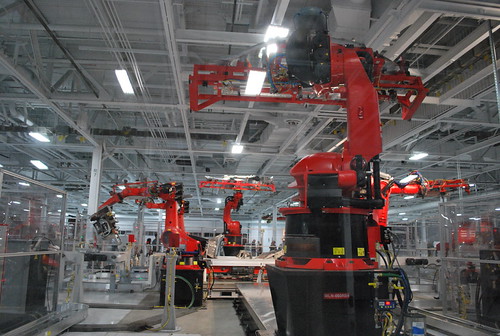
Identify flaws such as surface imperfections, inaccuracies, or weaknesses through visual, dimensional, or functional testing during or after production. AI and visual inspection tech help detect, classify, and locate defects, enhancing QC and reducing rework or scrap. Prevention aims to stop defects at the source by controlling processes, training operators, qualifying materials, and refining designs.
See more on groundbreaking tools for designing, manufacturing, and assembling components.
Manufacturing Processes and Artificial Intelligence
Artificial intelligence now permeates manufacturing, turning data into actionable intelligence across the factory floor.
Companies are always seeking ways to improve competitiveness and reduce costs. By integrating AI into their manufacturing processes, they can achieve this ever-moving target. The cumulative effect of AI is a more responsive and cost-effective operation:
- AI can be applied to various manufacturing processes, including production planning, QC, and supply chain management. It enables dynamic scheduling, resource balancing, and holistic oversight.
- AI systems can interpret sensor data to optimize production processes and improve quality. Real-time insights allow fine-tuning of parameters for peak performance.
- AI can also be used to predict maintenance needs, reducing downtime and improving overall efficiency. By forecasting failure days or weeks in advance, unplanned stops drop dramatically.
Defect Detection with AI
With AI deployed for defect detection and prevention, fewer defects reach customers, strengthening loyalty and reducing liability risks for companies.
AI systems can analyze data from various sources to identify potential defects and prevent them. Multi-sensor fusion reveals hidden correlations and early warnings. AI-driven computer vision (CV) systems enable real-time product inspections that accurately identify defects and anomalies. They achieve near-perfect consistency even at line speeds exceeding human capability.
What are the Three Main Benefits of AI-Powered Quality?
AI-powered QC offers numerous benefits that scale across entire facilities, including
(1) improved defect detection
(2) reduced waste (see next section)
(3) increased efficiency in operations
This is possible because AI systems can process data in real-time, enabling manufacturers to identify and address quality issues quickly. Immediate corrections prevent small problems from becoming large ones.
AI-powered QC can also help manufacturers improve their supply chain management, reducing the risk of quality issues and improving overall quality. Upstream monitoring ensures incoming materials meet specs.
AI-powered quality control can deliver measurable, compounding advantages. By adopting AI-powered QC, manufacturers can improve their brand reputation and increase customer satisfaction. Consistent excellence translates to repeat business and positive reviews.
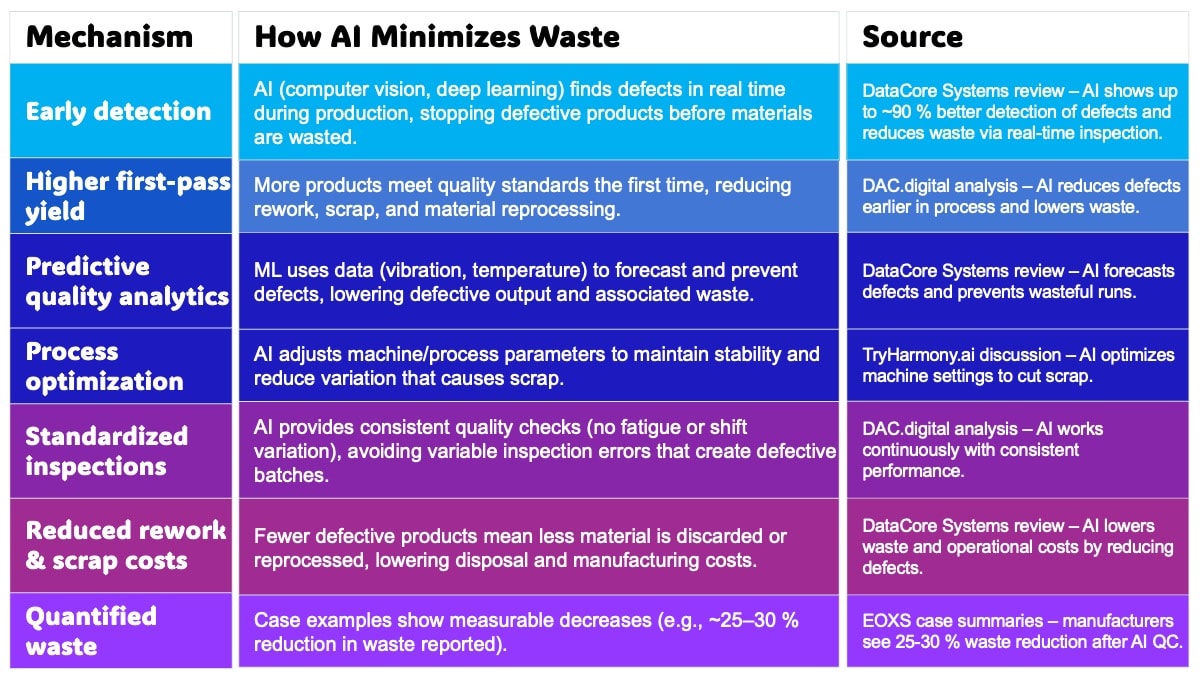
How Does AI Reduce Waste?
Here’s a fact-based table showing how AI in manufacturing quality control minimizes waste.
Introduction to AI Quality Control: Basic Tools
AI QC systems are transforming the manufacturing industry by improving precision and efficiency.
Traditional Quality Control and AI-Powered Systems
Traditional QC methods often fell short in meeting modern production needs, making AI a game-changer for QC. Manual limits and sampling can’t keep pace with today’s complexity and speed.
AI-powered systems use machine learning (ML) and CV to improve defect detection and reduce human error in production lines. Automation removes fatigue and variability from inspections. Read on to learn how AI is shaping the future of product development through automation.
Precision-critical or high-volume sectors see the most dramatic gains. Thus, the food and beverage industry, automotive manufacturing, and semiconductor manufacturing are among the sectors that can benefit from AI-driven quality control processes.
Computer Vision Models
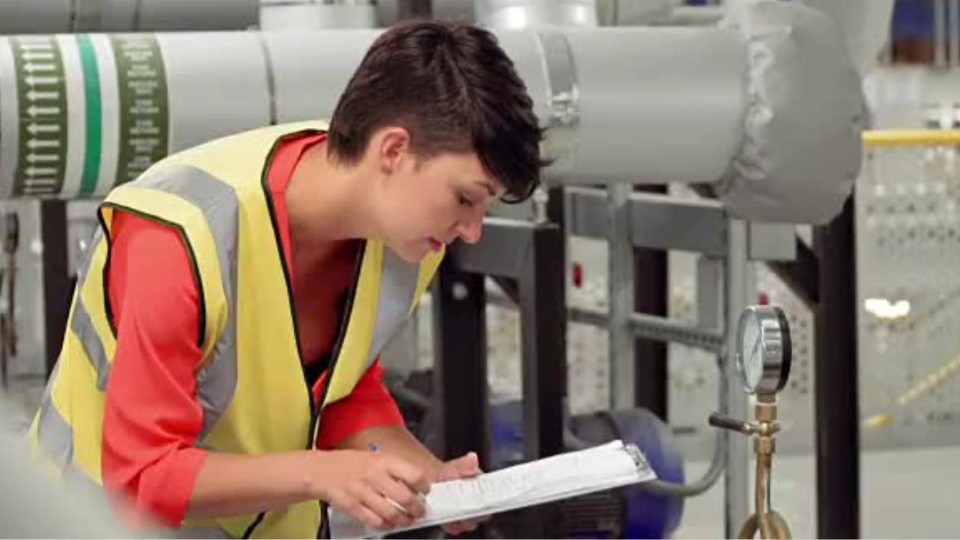
Computer vision (CV) is among the most exciting applications of AI. CV technology can be used across industries such as automotive, food and beverage, and pharmaceuticals to improve QC. Its flexibility supports a wide range of product types and defect classes.
- CV technology is a key component of AI quality control systems. With vision, AI inspects products and detects defects, exploiting data from advanced cameras that capture details invisible to the naked eye.
- CV models can be trained on data to recognize patterns and anomalies, allowing them to identify defects with high accuracy. Robust training datasets enable generalization to real variations.
- AI-powered CV systems can inspect products at high speeds, reducing the need for manual inspections and improving overall efficiency. Full 100% inspection becomes feasible without bottlenecks.
Machine Learning Algorithms
ML consists of algorithms that learn patterns from data to make decisions automatically. Instead of explicit programming, the model parameters are optimized from data by adjusting internal weights to minimize the error between predictions and outcomes. No fixed rules are hard-coded; they emerge from data.
There has been a major boost in ML adoption due to:
- Cheaper sensors and massive data availability
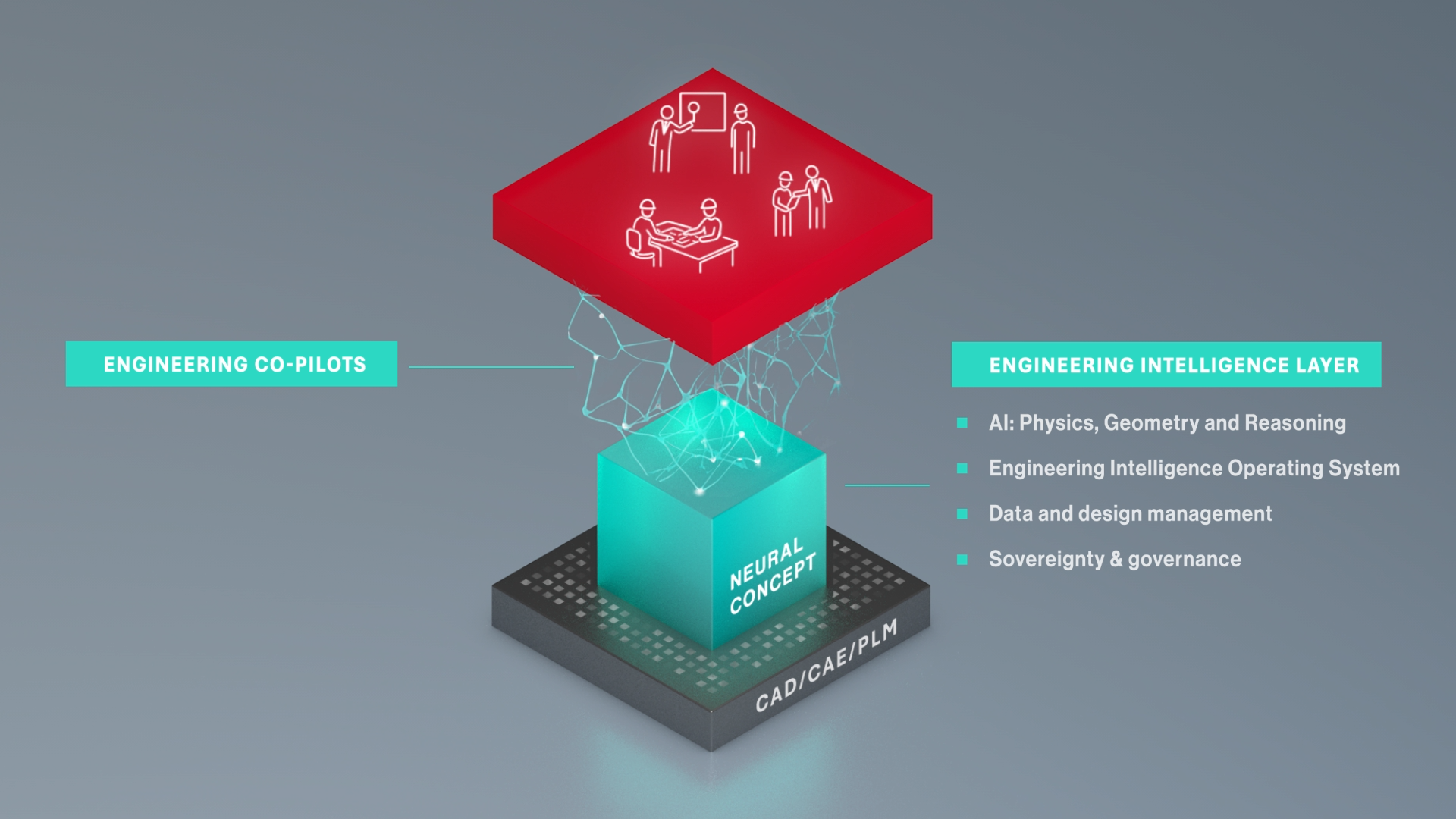
- Higher computing power (GPUs, edge devices) - see how Neural Concept accelerates product development on Nvidia GPUs.
- Better training methods and open-source frameworks
What does ML learn from?
- Sensor signals (temperature, vibration, pressure)
- Vision data (camera images)
- Quality logs (pass/fail, defect type)
- Process parameters (speed, feed, torque)
What Does ML Do in Quality Control?
ML powers the decision-making core of AI quality control. It can:
- Classify defects (scratch, crack, OK part)
- Predict failures (tool wear, drift)
- Recommend parameter changes (adjust speed, reduce heat)
Machine Learning models learn from data and improve over time, assessing data from various sources to identify patterns and detect defects in real time.
ML enables AI to adapt to changing production environments and process parameters, ensuring consistent product quality. It handles new materials, tool wear, or environmental shifts.
Also, the system gets smarter with each cycle by leveraging advanced algorithms, driving long-term gains for companies that adopt this approach. For instance, manufacturers can reduce waste and improve efficiency in their production processes.
Data Quality Considerations for AI Systems
Prioritizing data quality enables manufacturers to unlock the full potential of AI-powered quality control.
- For AI quality control systems to deliver accurate results, manufacturers must ensure the data feeding them is both relevant and reliable. data from a variety of sources and ensuring it. This means collecting comprehensive data to ensure proper labeling, formatting, and data integration.
- In industries like food and beverage, AI-powered quality control relies on high-quality data on materials, production parameters, and process conditions to detect anomalies and maintain consistent product quality.
- Generative AI is used to create synthetic datasets for training quality models. Learn how to revolutionize products with generative AI.
- Continuous improvement is another critical aspect of quality data. As manufacturing environments and parameters evolve, so too must the data that AI models learn from. Regularly updating datasets and retraining models, for instance, by efficiently training models in the cloud, ensures that quality control systems remain effective, even as new products, materials, or regulatory compliance requirements are introduced. This is especially important in sectors like automotive manufacturing, where production lines and quality standards are frequently updated.
- Human error and bias in data collection can weaken the effectiveness of AI quality control. If the data used to train AI models is incomplete, inaccurate, or biased, the AI may fail to detect defects or generate false positives. To address this, manufacturers should establish strong data validation and verification processes, ensuring high-quality, unbiased data is used to train and operate models. See the “Hard Metrics” section in this article.
- Integration with existing quality control systems and manufacturing technology is also essential. By connecting AI with enterprise resource planning (ERP) platforms, supply chain management tools, and other quality control systems, manufacturers can create a seamless flow of information. This integration of AI provides insights that support both manual and automated processes throughout the entire supply chain.
Implementing AI-Driven Quality Control
AI-based quality control requires upfront investment in hardware, software, and training. Costs include cameras, edge computers, and skilled engineers. Learn more about the top applications of AI in engineering.
AI needs clean, labeled data and a solid IT infrastructure. Poor data produces unreliable models.
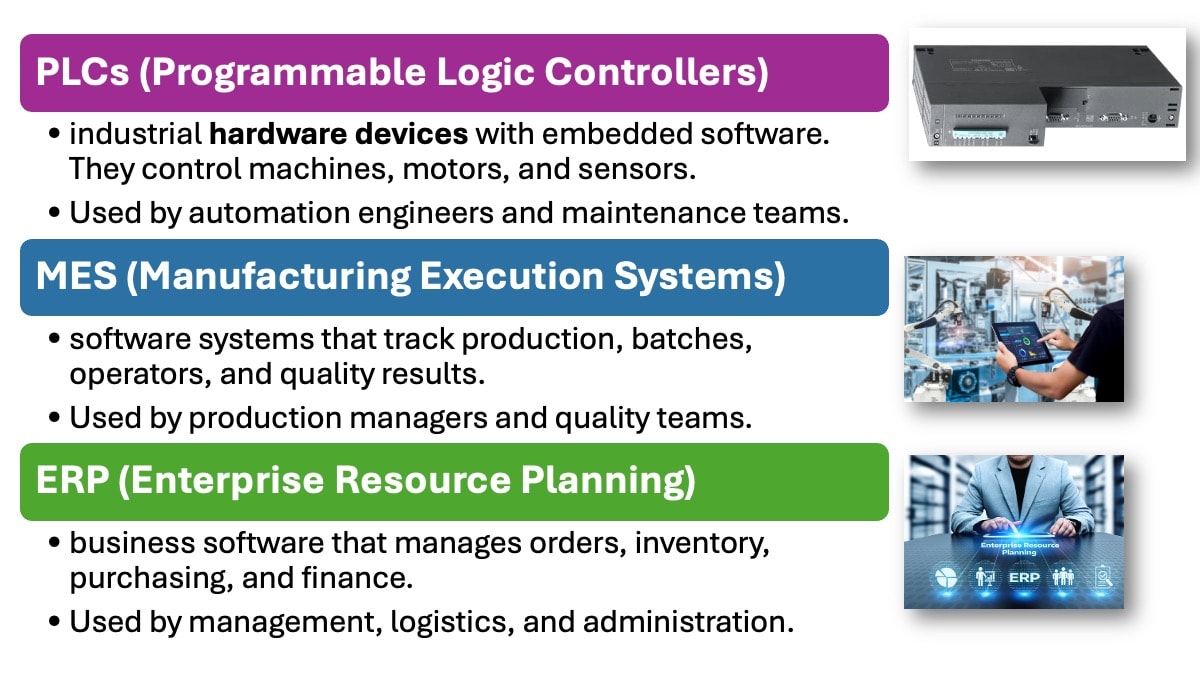
Factories use three main systems: PLCs, MES, and ERP.
Manufacturing Processes Optimization
Optimizing manufacturing processes is key for companies aiming to achieve efficient, high-quality production in today’s competitive landscape. AI is enhancing quality control processes and driving continuous improvement across production lines.
- AI (more specifically, Machine learning algorithms) excels at analyzing data generated throughout the production process and identifying real-time patterns and anomalies. Data comes from sensors, machines, and vision systems.
- Thus, AI systems empower manufacturers to make data-driven decisions that improve product quality and operational efficiency.
- Quality issues can be predicted before they escalate. This proactive approach not only prevents defects but also minimizes the risk of costly recalls and rework.
- In automotive manufacturing, for example, AI-powered quality control systems continuously monitor production lines, using computer vision and advanced analytics to spot inconsistencies and maintain consistent product quality.
- In the food and beverage industry, AI-driven quality control systems detect defects early, reducing waste and ensuring that only products that meet strict standards reach consumers.
Advantages of Manufacturing Processes Optimization
AI-powered quality control reduces human error by automating inspections using computer vision, improving reliability, and freeing operators to focus on higher-level tasks. It also enhances supply chain management by analyzing data to identify bottlenecks, optimize inventory levels, and ensure raw material quality, thereby creating a resilient, adaptable supply chain.
Using advanced algorithms, machine learning, and computer vision, manufacturers can reduce waste, improve product quality, and meet industry standards. Overall, AI-driven systems are transforming manufacturing, enabling companies to produce better products and stay competitive.
Real-World Applications
AI has proven its value in diverse high-stakes manufacturing environments, delivering consistent, superhuman performance where human limitations once constrained quality.
- AI systems maintain consistent vigilance 24 hours a day, 7 days a week, unlike human inspectors who experience fatigue and distraction. This tireless monitoring ensures no lapse in attention during long shifts or high-volume runs.
- AI systems can reduce the number of defective products that reach the final stage of production, minimizing waste and rework. By catching issues early, factories avoid costly downstream corrections and material loss.
- AI-driven quality control systems help ensure compliance with regulatory standards in the pharmaceutical industry, reducing the risk of defective products.
- Human-AI collaboration lets engineers focus on creative problem-solving while AI handles analysis, enabling teams to gain a competitive edge through smarter, faster processes.
- BMW reduced defect rates by 30% within a year of implementing AI vision systems in its production facilities. Such an implementation demonstrates how manufacturers can compress development and validation cycles.
- Samsung Electronics reduced customer return rates by 31% within 18 months of implementing AI-powered quality control in semiconductor manufacturing. AI-enhanced inspection and yield management in wafer production have reduced microscopic defects, boosting the reliability of chips for electronics and automotive applications.
- Medtronic implemented a machine learning system to inspect critical components in implantable cardiac devices, achieving high detection rates on critical defects. In this highly regulated medical field, AI ensures precision on life-saving implants, catching anomalies that could impact patient safety and regulatory approval.
- AI-powered quality control systems in the food and beverage industry ensure product consistency by inspecting items for color, size, and shape. Automated checks maintain uniformity in packaging, ingredients, and final products, reducing the risk of recalls and upholding brand standards.
These real-world successes highlight AI’s ability to elevate quality across automotive precision, semiconductor complexity, medical reliability, and consumer goods consistency.
Challenges
While rewards are substantial, adopting AI for quality control entails hurdles like investing in talent, data governance, phased adoption, and security. Successful companies see these challenges as manageable steps toward long-term gains.
- AI requires high-quality training data to be effective; poor datasets can lead to inaccurate detections. Garbage-in, garbage-out applies strongly! Biased or incomplete data undermines model reliability.
- There is a shortage of AI specialists to program and maintain quality control systems. Demand for data scientists, ML engineers, and domain experts outpaces supply in many regions.
- Automated systems can inspect up to 10,000 parts per hour, improving production throughput. High-speed capability unlocks massive efficiency, but requires robust integration to avoid bottlenecks elsewhere.
- Manufacturers often lack the clean, structured, and application-specific data needed for reliable AI insights. Legacy systems and siloed information make data preparation one of the biggest early obstacles.
- Resistance to change is a common barrier to AI implementation in manufacturing environments. Shop-floor teams may fear job displacement or distrust “black-box” decisions without proper change management.
- Successful adoption requires rethinking workflows to position AI as an enhancement to human capabilities, promoting reorganization that builds competitive advantages through smarter processes.
- Financial requirements and data quality limitations pose additional hurdles for AI implementation. Capex for sensors, computing, and training can strain budgets, especially for SMEs.
- Implementation costs can be a barrier, especially for smaller companies looking to adopt AI technologies. Scaling from pilot to full deployment demands careful ROI planning.
- Cybersecurity concerns increase as AI systems are integrated into manufacturing processes. Connected OT/IT environments introduce new attack surfaces that require layered defenses.
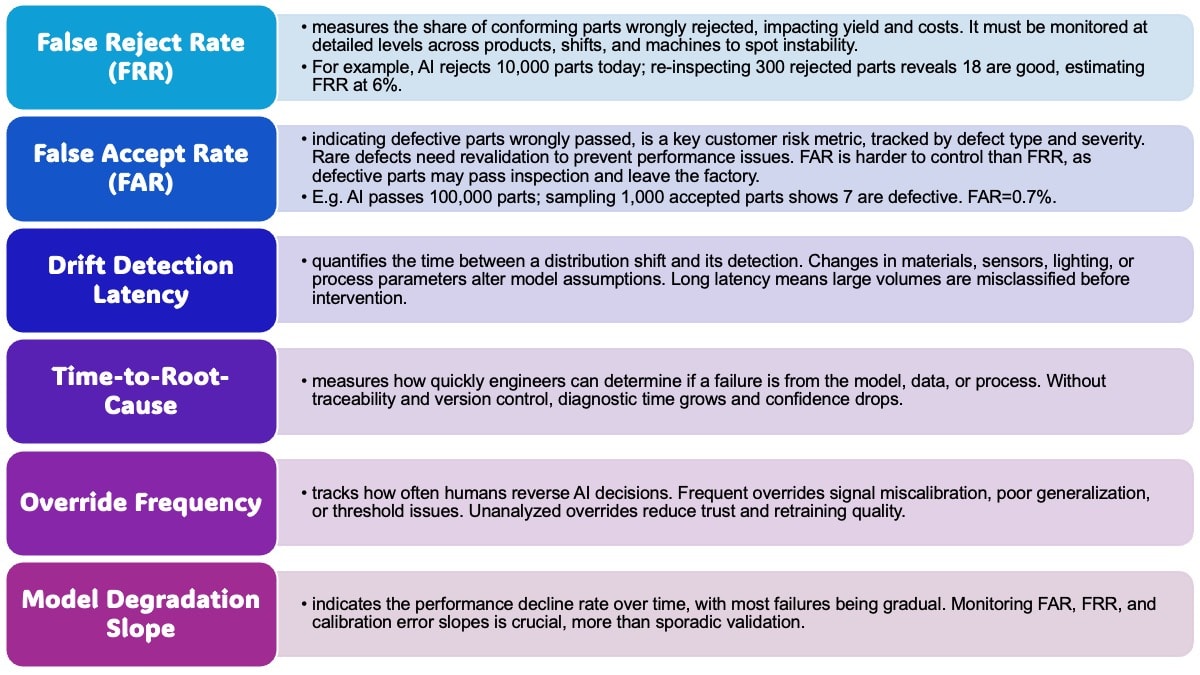
Hard Metrics for AI in Quality
Speed and automation alone do not establish control: AI in QC is superior only if its performance is continuously measured and governed. If the below metrics are not continuously tracked, AI is not superior; it is just faster. So these metrics are not just an option.
Conclusion - Benefits and Future Outlook
- The integration of CV systems with advanced neural networks has revolutionized defect detection in manufacturing. What once relied on human judgment now leverages pattern recognition at scales and speeds that are impossible to achieve manually.
- AI-driven systems can analyze data in real time, detect defects that might elude human inspectors, and continuously refine their detection capabilities. This closed-loop learning turns every production cycle into an opportunity for improvement.
- AI-powered quality control systems offer unprecedented speed, accuracy, and scalability. From microchip fabrication to vehicle assembly, AI handles complexity without compromise.
- AI systems maintain consistent vigilance 24 hours a day, 7 days a week. Reliability never fatigues, ensuring uniform quality around the clock.
AI is transforming the manufacturing industry by enhancing precision and efficiency in quality control processes. As AI technologies continue to evolve, we can expect even more innovative applications in quality control. The future of quality control will be shaped by AI, with a focus on predictive maintenance, integrated systems, and industrial automation. By embracing AI and other emerging technologies, manufacturers can improve their competitiveness, reduce costs, and increase customer satisfaction.
FAQ
What is the benefit of Machine Learning models in quality assurance?
ML models use data from across the supply chain to predict and optimize manufacturing processes. They help ensure product quality, comply with standards, and minimize waste.
What role do raw materials play in AI quality systems?
Raw materials establish the foundation for final product quality. AI systems process sensor and supply chain data to evaluate supplier performance, forecast potential disruptions, and enable manufacturers to ensure product excellence through proactive quality assurance.
How does AI’s predictive capability support continuous improvement in manufacturing?
AI algorithms and ML models analyze production data to enable predictive maintenance. In modern manufacturing, this is essential for reducing waste, adapting dynamically, and maintaining high-quality standards through continuous refinement.
Can AI help the automotive industry with regulatory compliance?
Absolutely. In the automotive industry, AI quality systems deploy ML models to track process and sensor data across manufacturing companies and the entire supply chain, ensuring compliance with quality standards and enabling manufacturers to deliver product excellence while reducing waste.
How do AI algorithms reduce material waste?
AI reduces material waste through early defect detection, process setpoint optimization (where models learn parameters such as speed, feed, curing time, and mix ratio to fine-tune setpoints and reduce defects), and predictive maintenance.