Engineering intelligence embeds AI-powered prediction into the design loop, opening simulation knowledge to everyone who shapes a product rather than only to simulation specialists. The scale of the change is the point: roughly 0.01 seconds of AI prediction per design variant against hours for a traditional solver run.
Key takeaways
The guide is aimed at leaders in product development, design and simulation who are evaluating these systems.
Prediction per design variant drops to around 0.01 seconds, against hours for a traditional solver.
Opening simulation to non-specialists is the structural change, not the raw speed alone.
Adoption depends on personas and workflow integration as much as on the underlying model quality.
Table of contents
This guide is dedicated to leaders in product development, design, and simulation who want to understand what engineering intelligence can deliver. The guide covers how those AI systems are changing engineering prediction and product design, what to look for when evaluating solutions, and how to connect AI to improvement across the product lifecycle.
Engineering intelligence embeds AI-powered prediction into the design loop, opening simulation knowledge to everyone who shapes a product.
0.01s
AI prediction per design variant vs. hours for a traditional solver
75%
Reduction in end-to-end development time (OPmobility)
10x
Faster simulation throughput across product lines
What is Engineering Intelligence?
Engineering intelligence is the practice of embedding AI-powered prediction directly into product design workflows. Performance findings, locked within simulation databases and specialist knowledge, become accessible to everyone involved in a design decision while the decision is still open.
Engineering intelligence (EI) removes the bottleneck between simulation results and the designer who needs them. EI integrates Artificial Intelligence, machine learning, and advanced data analytics into engineering practices.
Why Engineering Intelligence systems matter
Engineering intelligence is becoming increasingly necessary for modern product development. Development timelines shrink as product complexity grows. There is a disconnect between what disciplines can simulate and what they can explore in the available time. Also, fragmented information from legacy systems can be a primary barrier to progress.
The deeper problem is that most engineering tools have historically served specialists:
A CAE simulation specialist runs and interprets a Computational Fluid Dynamics (CFD) or Finite Element (FEA) campaign.
Designers making geometry decisions rarely have direct access to those findings. They must rely on intuition, accumulated experience, or slow feedback loops from simulation.
💡 The core shift: Engineering intelligence embeds AI-driven predictions into the product lifecycle at the point when decisions are still open — not after the geometry is frozen.
Product designers use machine learning to analyze large datasets from CAD and CAE. The catch is that AI has to connect cleanly to the systems a team already runs, and that is hard to get right.
Using the Neural Concept AI-first design platform, disciplines can easily query performance predictions across thousands of configurations in seconds, exploring a solution space that sequential simulation campaigns could not reach within program timescales. Designers and researchers gain direct access to performance targets, thermal behavior, and manufacturing feasibility data without needing simulation expertise to run each query.
This closes the loop between R&D, manufacturing, and the program office, all from the same design environment.
From a broader perspective, Jensen Huang's keynote at CES 2026 introduced the idea that "the ChatGPT moment for Physical AI is almost here." In the article, we focus on engineering/product teams. Still, Physical AI is an even broader context in which EI becomes the core infrastructure required to bring Physical AI products into existence.
What does Engineering Intelligence deliver?
Engineering intelligence delivers validated performance prediction to designers while decisions are still open. It helps engineering leaders who aim to:
Shorten the time from design to performance results
Give all designers access to simulation
Recognize risks hidden in how design variables interact
AI-powered tooling trained on datasets (for instance, CAD and CAE) produce predictions in milliseconds rather than the hours a conventional solver requires. Check here for a guide for engineers on 3D Deep Learning.
The real value of those platforms comes from turning what they learn into real improvements.
Prediction speed
0.01 – 1 second per design variant
vs. traditional solver
Hours to days per simulation run
Design space explored
Thousands of configurations per session
Who can access it
Every designer — no CAE expertise required
How do teams drive change in engineering with AI?
Teams deliver when they deploy Engineering Intelligence, i.e. AI integrated into the actual design flow. This approach goes beyond the siloed analyses that run after the design geometry is frozen. Recognizing a problem through metrics is only the first step; companies need a way to act on it preemptively.
The right team structure connects simulation expertise with model building while giving product developers direct access to the results:
⚙️
Simulation specialists and data scientists
Build and validate physics-aware AI models that encode the physics of their domain.
✏️
Designers
Use those prediction models to explore and scale design alternatives interactively, querying performance predictions without waiting for full simulation runs.
📊
Management
Uses delivery metrics and design cycle data to track what bottlenecks are subtracting the time available for exploration.
Personas and adoption
A successful rollout should be designed for at least three roles:
The CAE or simulation specialist is the platform builder. Some engineers on this team handle data, train models, and validate predictions. They do this before the AI system is delivered.
The product designer relies on a prebuilt, data-driven tool. It delivers AI predictions on demand. Designers need quick access to performance insights, whether through dedicated apps or inside their familiar CAD environment.
Engineering leaders need program-level visibility. They track design coverage, simulation throughput, and dependencies that could put schedules at risk.
AI tools fail when they make people work in a way they don't recognize. Designers are the clearest example. Most tools are built for specialists.
Platforms that put the user experience first are the ones teams actually adopt. They fit the way engineers already work inside familiar workflows, and they deliver better results faster.
From engineering metrics to action
Choose metrics that reflect the actual pace and depth of design exploration and drive change. The key questions have shifted from "What should we measure?" to "How do we act on these measurements?" and "Who in our organization should own this process?":
design variants evaluated per program phase,
simulation throughput by domain,
code review cycle time for simulation model updates,
deployment frequency of validated prediction models,
lead time from geometry change to performance prediction.
Map each metric to the specific groups and service owners responsible for the relevant step in the design chain, because even the most beautiful DORA dashboard in the world is useless if it just hangs on a monitor that nobody looks at.
AI tools and AI-powered capabilities
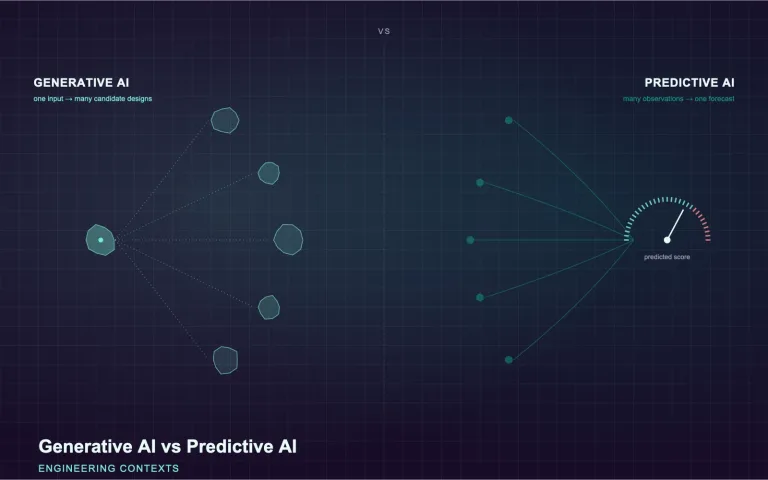
Engineering intelligence platforms accelerate design exploration. Their primary mechanism is physics-aware AI prediction.
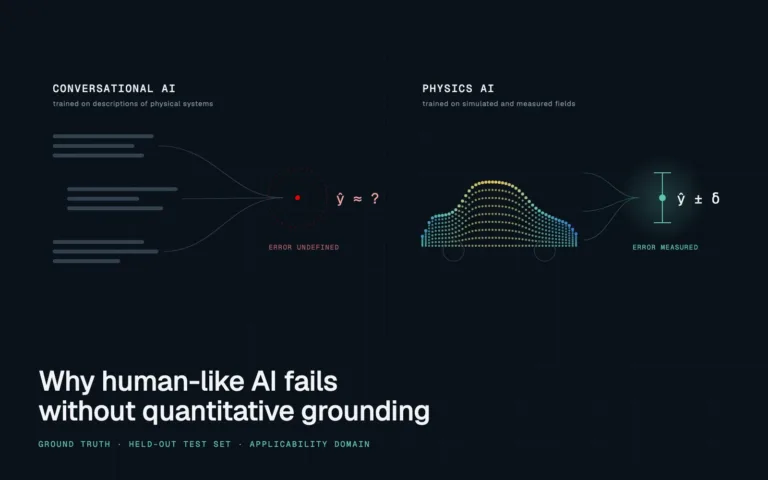
To create physics-aware AI prediction models, teams train AI models on historical simulation datasets.
The model can predict performance across thousands of design configurations. A response time of 0.01 to 1 second per design enables designers to run campaigns that would otherwise be out of reach.
Deep learning models applied to 3D geometry can instead capture complex, non-parametric complex shape dependencies.
Furthermore:
AI agents can monitor design campaigns and surface configurations approaching constraint boundaries.
AI automates repetitive tasks, allowing humans to concentrate on higher-level innovation.
Integrating into workflows
The most effective workflows use AI to generate and rank a broad set of design options. Designers can analyze trade-offs across many objectives. Designers can connect performance predictions to manufacturing constraints and product lifecycle requirements.
AI-powered prediction works best when paired with interactive exploration tools. Together, they deliver better outcomes by embedding design experiences straight into the workflow.
A prediction that does not align with where work actually happens has a limited impact on the product lifecycle.
A good AI Design Copilot is aware of both physics and geometry. It keeps human judgment central to design decisions.
At the same time, it expands the design space available for exploration.
Application examples
Real deployments show where the performance gains actually occur:
MAHLE
Automotive HVAC — nature-inspired fan blade
The goal was to develop a nature-inspired fan blade. The fan geometry was modeled after penguin fins. A copilot explored over 30 million virtual design iterations within the packaging constraints of electric vehicles.
−4 dB sound output +15% efficiency
Subaru
Stamping / forming — metal die-face analysis
Subaru used deep learning to speed up a key step in its metal stamping process. Accuracy remained comparable with traditional CAE.
3 hours → 2 minutes Comparable accuracy
General Motors
Pedestrian safety — AI copilots across 11 vehicle programs
AI copilots trained across 11 vehicle programs provided designers with real-time predictive safety feedback during the styling stage.
Weeks → seconds 11 vehicle programs
Eaton
Power electronics cooling — geometric deep learning
Geometric deep learning applied to CFD simulation data produced cooling plate designs with significant improvements. See more on enhancing engineering innovation.
>30% pressure drop improvement >10% weight reduction
OPmobility
Vehicle body & tank design — generative AI across product lines
AI-driven generative design embedded across multiple product lines cut end-to-end development times and accelerated simulation throughput.
−75% development time 10x simulation throughput
Antolin
Automotive interiors — AI-native lighting development
AI-native design pipelines compressed interior lighting development cycles, enabling designers to iterate over a broader range of solutions while meeting OEM safety and performance standards.
Weeks → days Broader design space
🔍 Want to know more about Neural Concept’s engineering intelligence platform?
As product complexity grows, the lag between what can be simulated and what can be acted on becomes the real constraint. Many organizations lack the pipeline automation and connectivity needed to turn CAE results into faster, better design decisions and explore only a few sparse designs.
Key topics for engineering organizations
Key topics for engineering organizations include:
What are the key questions about which metrics truly reflect our effectiveness and impact?
How can we use data to identify gaps in our workflows, including the reality of how work is actually done rather than just documented, and automate repetitive tasks?
Are we leveraging AI-powered predictions to inform every stage of the product lifecycle, from design to deployment?
Basic access is now table stakes across the industry, while advanced engineering intelligence creates advantage. In a market where product cycles keep compressing, this holds for large enterprises and smaller teams alike.
The early days of fragmented tools and disconnected data are fading. Integrated systems are taking their place as the foundation for future engineering work. These systems connect simulation specialists, designers, AI platform teams, engineering leaders, and relevant stakeholders in implementation and decision reviews. Everyone gets the predictive power they need to make better decisions, faster.
Implementing AI in engineering can require a substantial upfront investment. Still, the rewards are significant. The application examples above show this. Successful engineering organizations focus on turning key metrics into concrete improvements.
Conclusion: choosing the right approach
The organizations that extract the most value from engineering intelligence share three practices; they:
Embed an AI-powered prediction where design decisions are still open,
Give users direct access to simulation findings without requiring them to become CAE specialists, thanks to engineering copilots.
Treat the platform as the infrastructure they run on.
The key question is, therefore, which platform closes the lag between a change in geometry and a validated performance prediction at the pace product developers actually demand.
That is where competitive advantage is built or lost.
FAQ
Why do companies need engineering intelligence (EI)?
Without EI, simulation knowledge stays concentrated in specialist positions and rarely reaches designers in time to influence decisions. Consistent AI-powered measurement and prediction build feedback loops that enable improved predictability of product performance.
How does engineering intelligence improve product development speed?
It gives designers direct access to AI-powered performance predictions without waiting for full simulation campaigns, enabling faster iteration across a broader range of designs. Tools that connect surrogate models to design tools reduce the lead time from a meaningful change in geometry to the availability of validated performance data.
How can an engineering manager use data for productivity measurement & improvement?
By tracking simulation throughput, design cycle time, and surrogate model deployment frequency for each program, managers can identify specific bottlenecks, act on those measurements, assign ownership to the right part of the engineering organization, and measure whether changes meaningfully improve the speed at which teams access performance insights.
Where is the real value of EI?
It lies in using measurement to drive movement and improvement. For instance, tracking cycle time at each process step exposes hidden bottlenecks, enabling targeted interventions that increase throughput.
Can AI models be biased?
AI can inherit biases from training data, necessitating careful monitoring to avoid flawed decisions.
Is data quality important?
Yes. The effectiveness of engineering metrics is often hindered by data issues, leading to mistrust in the metrics used for decision-making. Sources must be validated.
Why do engineering teams resist AI?
Cultural resistance, fears of job loss, and trust issues can slow the adoption of intelligent engineering, especially when AI is introduced without clear organizational context. Data issues often undermine engineering metrics, leading to mistrust. The main barrier is fragmented or low-quality data from legacy systems, overwhelming many engineering leaders with the volume of data they collect
Why is it hard to find engineers who can own an engineering intelligence transformation?
A significant skills gap exists for managing the intersection of engineering and data science, requiring extensive upskilling.