Understanding the Engineering Product Development Life Cycle
The product development lifecycle in product engineering is a process that transforms initial ideas into fully realized products. It can begin with a creative product idea, but it also needs an understanding of customer needs and market context. Early in the cycle, engineers focus on problem definition and idea generation, turning inspiration into a workable product concept.
- The pursuit of innovation is central to gaining a competitive edge and is a key outcome of a robust engineering product development life cycle.
- As the work moves forward, the product engineering life cycle is dedicated to rigorous exploration of potential solutions, including generative AI in product design.
- Real or simulated prototypes are built and tested, and designs evolve in response to feedback from the real world or simulations. The iterative testing process allows engineers to collect feedback and refine both the technical design and the overall development strategy. In this critical stage, AI-supported design copilots become essential.
- Modern prototyping methods have also revolutionized the iterative approach. Rapid prototyping uses technologies such as 3D printing to produce quick physical iterations and accelerate design refinement.
- The development team (including product managers, designers, and engineers) collaborates closely within agile engineering frameworks, leveraging their combined expertise to ensure quality, timely delivery, and ongoing support throughout the product lifecycle.
- Later stages of the life cycle focus on execution and market preparation. Engineering teams translate refined concepts into tangible solutions. They embed quality, compliance, and manufacturability into the design. Design for Manufacturability (DFM) ensures the product can be manufactured efficiently, cost-effectively, and at scale.
- Even after launch, the product engineering life cycle continues! Ongoing testing, user feedback, and updates ensure the product remains relevant until its retirement. It is essential to have an expert team in place, and evaluating developers’ domain and technical knowledge is crucial for building effective products and solutions. Conducting a detailed background check on potential partners is also necessary to verify their experience and customer feedback.
- Thus, the product engineering life cycle involves several stages, each serving a unique purpose in bringing a product to market. Through these phases, the product development lifecycle forms a robust framework for engineering, guiding teams toward reliable, safe, and competitive solutions. Product engineering services help companies create superior-quality products at a rapid pace, supporting both innovation and speed to market.
The sections below will walk you through this path:
- Introduction to the Product Development Process
- Key Factors in the Product Development Process
- Product Development Strategies
- Collaboration and Partnerships
- Measuring Success - Best Practices
- Product Development Process - Best Practices
- Streamlining the Product Life Cycle
- Which Tools Are Used for Managing the Lifecycle?
- Product Development Challenges and Opportunities
- Regulatory Compliance Considerations
- The Importance of Product Development Planning
Introduction to the Product Development Process
The product development life cycle starts with identifying customer needs and collecting feedback to turn insights into a concept. Engineering then shapes the idea into a tangible form, guided by strategy and design thinking. By the time the product hits the market, it combines creativity with technical precision.
As a structured framework, the product development cycle includes several phases, ranging from idea generation and technical validation to the production of finished products that meet market and customer requirements.
A structured approach to product development balances several critical factors:
- Strategic foundations: analyses of market and competition, regulatory requirements, and alignment with the business goals.
- Engineering and design factors: engineering precision, creative innovation, and cross-functional collaboration.
- Technical enablement: tools such as CAD/CAE software and advanced AI simulations that improve design accuracy and manufacturing efficiency.
- Feedback-driven iteration: customer feedback and testing for usability, supported by agile development methodologies.
These factors work together to ensure reliable and scalable outcomes throughout the product engineering life cycle. Continuous validation and adherence to industry standards (e.g., ISO, FDA) mitigate risks while also sustaining quality.
Key Factors in the Product Development Process
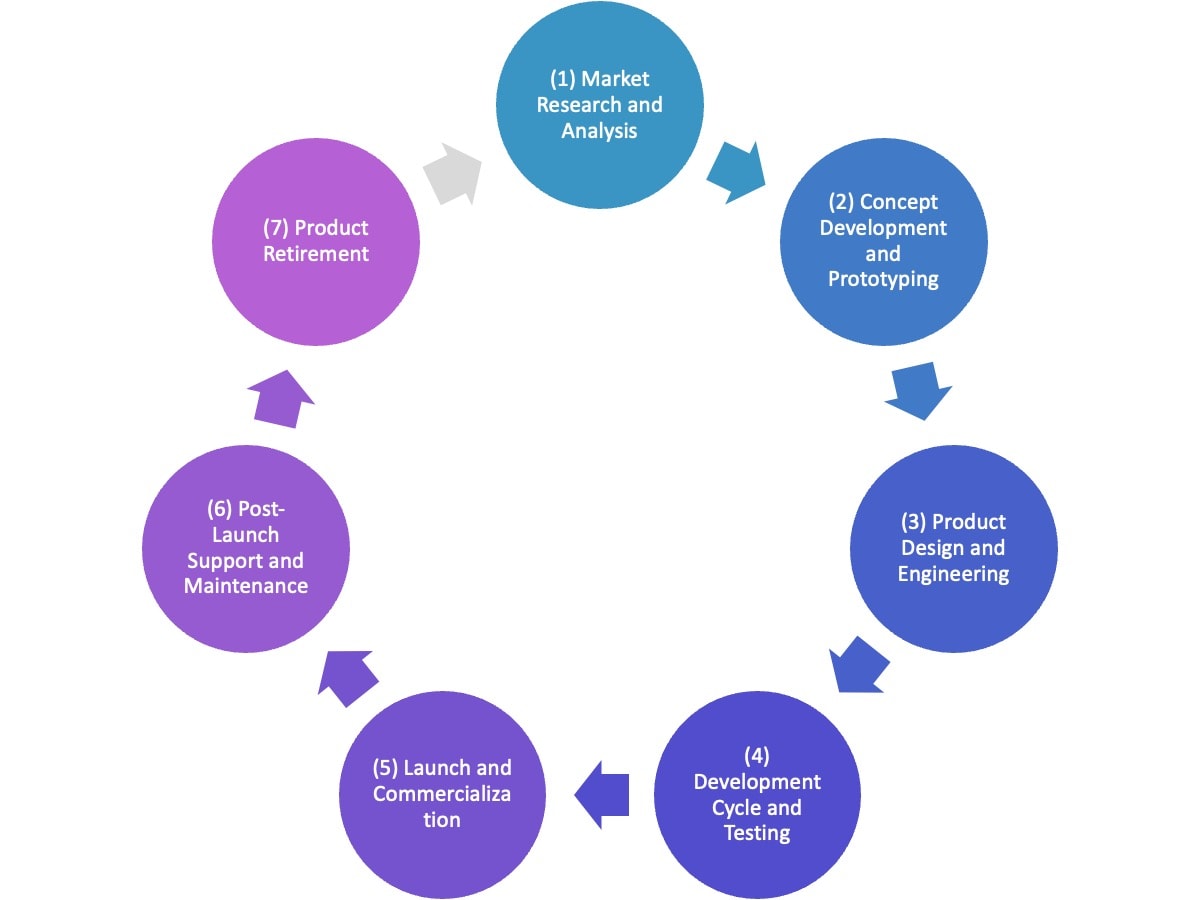
The key stages of the product lifecycle form a continuous cycle in which information generated later must be reintegrated into earlier stages.
The lifecycle functions effectively only when data flows across stages. Each phase produces information that reduces uncertainty in subsequent iterations. The efficiency of this feedback integration determines long-term competitive advantage.
Today, these stages are being accelerated and enriched by software development in the field of Artificial Intelligence. Discover how generative AI is reshaping the engineering product development life cycle, transforming concepts into market-ready solutions.
1. Market Research and Analysis
This initial stage focuses on understanding the target market and customer feedback to inform the new product development process. Examples of this first stage illustrate how thorough research lays a strong foundation.
- Market Research: Collecting data on customer preferences and behaviors informs product direction. Dyson’s bagless vacuum design stemmed from identifying user frustrations with traditional models.
- Competitive Analysis: Examining competitors identifies market gaps and opportunities. Amazon’s Echo leveraged superior AI-driven voice recognition to differentiate itself in the smart home sector.
- User Research and Focus Groups: User research identifies target audience pain points and defines personas to ensure a human-centered design. Instant Pot’s multi-function cooker was developed based on feedback about kitchen inefficiencies to streamline meal preparation. User Acceptance Testing (UAT) confirms that the product meets the user's needs and expectations.
- Regulatory Requirements: Compliance considerations ensure legal and safety standards are met. Medical devices, such as Electronic Health Record (EHR) systems, incorporate HIPAA (Health Insurance Portability and Accountability Act) requirements early to avoid costly revisions.
2. Concept Development and Prototyping
Once marketing research is complete, the next stage refines the product concept by incorporating new features and ideas into tangible concepts and prototypes.
Examples from leading firms show how this stage bridges creativity and practicality.
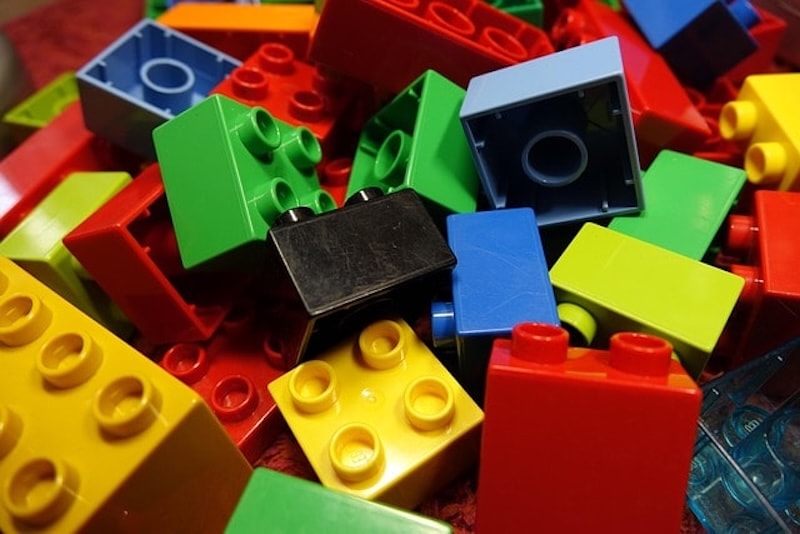
- Concept Development: Ideas are generated and refined through collaboration. LEGO’s innovation team gathered insights from designers and consumers to address challenges in creativity and assembly. They created a platform for users to propose concepts that align with the brand’s and target market’s needs.
- Prototyping: Minimum viable products (MVPs) test feasibility. Tesla’s early EV prototypes focused on battery efficiency, enabling rapid iteration based on performance data.
- Testing and Usability: Feedback refines concepts. Apple’s iPhone camera features, such as Night Mode, underwent extensive testing to ensure seamless integration.

3. Product Design and Product Engineering
This stage translates concepts from the previous stage into detailed technical specifications and designs. Product Design and Product Engineering is the stage where product developers shape ideas into detailed, actionable realities. It is the bridge between concept and creation. This stage is crucial because it transforms an abstract vision into an actionable design ready for testing and scale-up.
The examples below, from well-known products, will highlight how product engineering, quality, and prototype testing converge.
Whether the product is a physical object, a software system, a service, or an entirely digital experience, the same underlying principles apply.
Product design and product engineering teams ensure that the product
- meets functional requirements,
- aligns with business goals,
- complies with regulations,
- is delivered at scale.
Explore the latest approaches driving innovative product design, from emerging trends to practical insights.
Detailed Design Step
This step answers the questions:
- How should the product work?
- What form should it take?
- How will users experience it?
Details:
- Detailed design defines the product’s structure, functionality, and user experience.
- Design hardware and interfaces for physical goods that meet performance goals and provide a positive user experience, like Apple’s iPhone, with seamless hardware-software integration.
Technical Specifications Step
This step answers the questions:
- What exactly must the product deliver?
- How will compliance, performance, and safety be verified?
Details:
- Technical specifications define the requirements for design, encompassing performance, safety, usability, materials, dimensions, tolerances, architecture, APIs, benchmarks, security, and compliance with relevant regulations.
- Dyson’s vacuum ball technology required detailed specifications for safety and usability, guiding engineering. Software specifications outline architecture, data flows, security, and standards (such as GDPR or HIPAA).
Manufacturing and Implementation Planning Step
The manufacturing and production stage involves setting up the production process and creating the final product in large quantities. This step answers the question:
- How will the product be built, deployed, and supported?
Details:
- This stage prepares the product for production or deployment. For physical products, it involves designing scalable manufacturing processes that ensure quality, such as the Instant Pot’s safety features, including lid locks. processes that ensure consistency.
- For software and services, it means planning deployment, infrastructure, and automating testing and delivery to enable reliable launches and scalable maintenance. Maintenance & support should establish systems for troubleshooting, bug fixes, and customer queries throughout the product’s usage cycle.
Agile Methodologies Step
This step answers the questions:
- How can we adapt the design to reality?
- How can we ensure the product evolves to meet the needs?
Details:
- Agile methods add flexibility to design and product engineering. They break work into short cycles (sprints) with frequent review and adaptation. This allows teams to respond to feedback and changing conditions.
- For instance, during HRMS (Human Resources Management Systems) development, agile sprints can identify which features were rarely used, enabling the team to focus on higher-value functions to build a leaner, more effective system.
4. Development and Testing
Development and Testing convert design specifications into a validated, production-ready product. This phase ensures technical functionality, performance compliance, risk control, and launch readiness.
- Engineering Validation Testing (EVT) verifies that the product functions according to technical specifications. It confirms subsystem integration, architecture stability, and core functionality. Question addressed: Does the product work as engineered?
- Design Validation Testing (DVT) evaluates performance, reliability, durability, and safety under realistic conditions. Question addressed: Does the product meet operational and regulatory requirements?
- Example: Tesla’s 2012 Model S introduced flush electronic door handles to improve aerodynamics. In emergency or power-loss scenarios, usability concerns emerged. This illustrates the importance of validating edge conditions, not only nominal performance.
- Design Iteration. Test results drive structured refinements across mechanical, electrical, and software components. Iteration reduces defect propagation into production.
- Testing Discipline and Risk Control. Adherence to validation protocols limits downstream correction costs. Compressed or skipped testing increases launch risk.
- Example: A 2021 product launch experienced public demo failures after test cycles were reduced, requiring additional engineering time and resources.
- Key Performance Indicators (KPIs). KPIs quantify readiness and ongoing performance.
- Example: Fitbit tracks engagement metrics to refine algorithms and improve retention.
- Team Coordination. Alignment with manufacturing, sales, marketing, and support ensures operational readiness.
- Example: Amazon’s Echo rollout required synchronization across hardware production, software deployment, distribution, and promotion.

5. Launch and Commercialization
The launch and commercialization phase brings a product to market, emphasizing strategic rollout and a scalable production process to achieve broad reach and impact. This stage integrates marketing, distribution, and compliance efforts to ensure a successful introduction.
See how industry leaders turn best practices into measurable results:
| Stage / Strategy | Example Company | What Happens | Results / Benefits |
|---|---|---|---|
| Product Launch | Medtronic | Introduced a new medical device with strategic partnerships and compliance planning | Ensuring trust, faster adoption, and regulatory approval |
| Production and Distribution Scaling | Tesla EVs | Efficient manufacturing and logistics | High quality output at scale, global availability |
| Regulatory Compliance | Financial applications (PCI standards) | Align with industry regulations | Trust, security, user confidence |
| Feedback Collection | Boeing | 787 Dreamliner cabin redesign | Adjusted after early passenger feedback on lighting and air quality |
| Market Positioning | Apple iPhone | Coordinated branding campaigns and global supply chains | Strong target market presence, maximized penetration |
6. Post-Launch Support and Maintenance
Post-launch efforts focus on sustaining product relevance through support and updates. Examples show how ongoing refinement increases customer satisfaction and maintains competitiveness.
- Performance Evaluation: Outcomes are assessed to identify areas for improvement. Example: Amazon’s recommendation system is monitored post-launch to enhance accuracy.
- Feedback Integration: User input shapes enhancements. Example: Fitbit’s sleep tracking features evolved from user data, maintaining device relevance.
- Lifecycle Monitoring: keep products competitive with adaptations. Example: Dyson’s cordless vacuum series incorporates ongoing innovations to stay ahead of the competition.
- Stakeholder Alignment: Collaboration ensures that business and customer goals are met. Example: Apple’s iterative camera updates.

7. Product Retirement
The final stage manages a product’s phase-out, ensuring a responsible and strategic transition.
Examples highlight effective retirement practices for the final product.
- Production Phase-Out: Output is gradually reduced. Apple manages the stock of older iPhone models to minimize waste during retirement.
- Limited Support: Ongoing service is provided for a period. Microsoft supports legacy software briefly post-retirement to ease transitions.
- Responsible Disposal: End-of-life processes adhere to stringent environmental standards, particularly for electronics.
- Replacement Planning: New products fill gaps. Apple’s iterative iPhone releases keep the lineup fresh.

Product Development Strategies
A product development strategy is a sequence of economic decisions.
(1) Verify that people currently spend money, time, or effort dealing with a specific problem. If there is no measurable cost, there is no business case.
(2) Estimate whether your solution can change that cost structure in a way that justifies switching. Switching is expensive: cognitively, operationally, and sometimes financially. If the improvement is marginal, adoption will be marginal.
(3) Identify the dominant uncertainty. It is usually one of three things:
- Can it be built reliably?
- Will people actually use it?
- Will the margins sustain the business?
Then design the next step of development to reduce that specific uncertainty, one at a time.
Throughout the process, every added feature increases complexity, coordination cost, and maintenance burden. So development is largely about controlling complexity while validating revenue logic.
Collaboration and Partnerships
Successful product development depends on clear communication and joint effort across teams. Engineering, sales, marketing, and operations work together to design, build, and deliver products that meet customer needs and business goals.
External partners (suppliers, manufacturers, and other stakeholders) play a critical role. They provide technical expertise, help manage production, and reduce risks that appear when moving from concept to launch. Regular updates and agile practices keep everyone informed and enable teams to respond quickly to market changes.
Strategic partnerships can also open access to new technologies, customer segments, or distribution channels. By combining internal teams’ capabilities with those of external partners, companies can innovate faster, improve product quality, and better satisfy customers.
Measuring Success - Best Practices
Success in product development is about tracking the right data at the right time.
At each stage, measure metrics that matter:
- Customer adoption and feedback: Are users able to use the product as intended? Are they willing to switch from alternatives?
- Product quality: Defects, performance against specs, reliability.
- Business outcomes: Revenue, margins, production cost, and time-to-market.
Use usability tests and real user feedback early to catch design flaws before they scale. Track metrics continuously to ensure compliance, control costs, and keep schedules realistic.
Analysis should inform decisions, not justify them. If a prototype fails a key test, act immediately: don’t wait for the next stage. If a KPI drifts in production, identify the bottleneck and fix it fast.
Product Development Process - Best Practices
Effective practices enhance the product development process by using KPIs, as demonstrated by industry leaders. These approaches ensure consistent, high-quality outcomes within a complex process.
Discover how industry leaders transform best practices into tangible results.
The table below highlights key approaches, real-world examples, and the benefits they deliver.
| Best Practice | Example | What Happens | Results / Benefits |
|---|---|---|---|
| Thorough planning and compliance | Tesla | Iterative updates to electric vehicles with careful testing | Reduced risks, higher reliability, smoother rollouts |
| Agile methodologies | Enterprise cloud migrations | Continuous integration and deployment with iterative feedback | Faster adaptation, fewer errors, efficient delivery |
| Customer driven design | Instant Pot | User testing and feedback incorporated into products | Better usability, higher adoption, fewer complaints |
| Technical expertise | Medical device development | Precision product engineering and rigorous validation | Compliance with standards, safer and more reliable products |
Streamlining the Product Life Cycle
The examples below illustrate success stories in optimizing the manufacturing process without compromising quality.
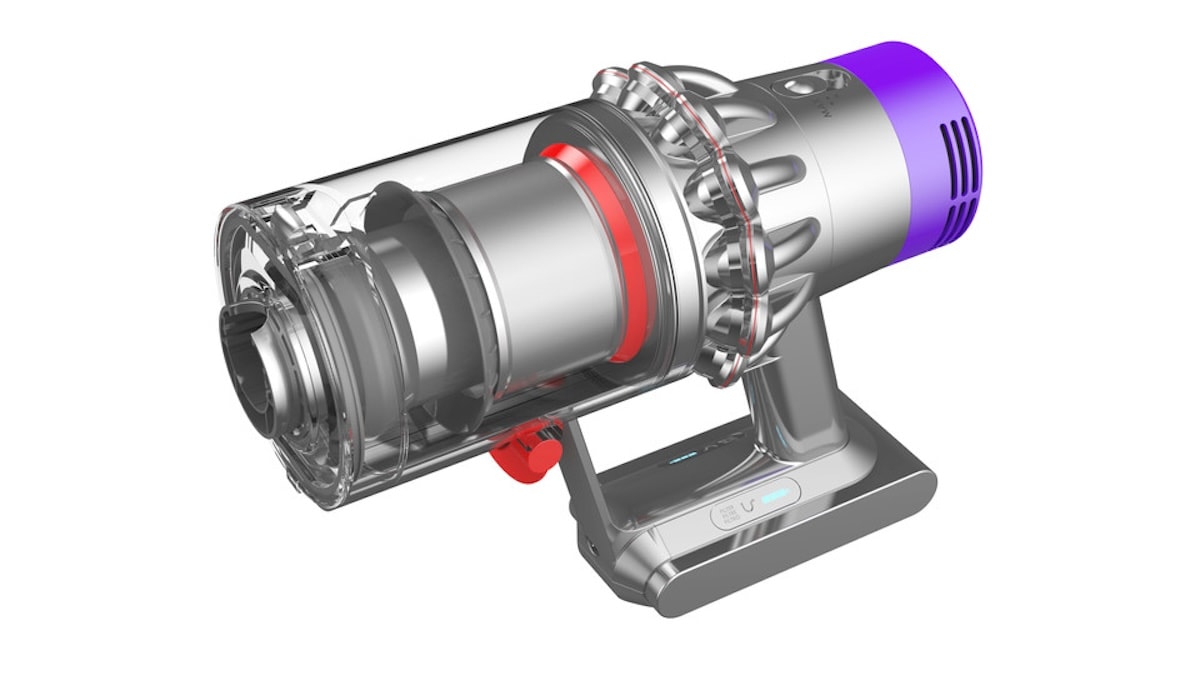
- CAD data supports precise manufacturing. At Dyson, engineers rely on detailed CAD models to define exact dimensions, tolerances, and component fit before mass production. This product engineering life cycle approach reduces assembly errors, accelerates prototyping, and ensures consistent product quality. Dyson minimizes material waste and shortens development iterations through virtual simulation of parts.
- Agile and iterative testing enhance efficiency. The product engineering life cycle iterative process shortens delivery time and reduces the risk of costly post-launch fixes. UiPath’s development teams use short sprints to continuously build, test, and refine automation tools. Immediate testing allows them to catch issues early, adjust features quickly, and better align products with customer needs.
- Developer-manager collaboration aligns hardware, software, and voice features to ensure seamless integration. During Amazon’s Echo development, engineers and managers coordinated on design, functionality, and user experience. Regular communication prevented misaligned features, simplified decision-making, and expedited market release.

- User panels provide valuable insights. Instant Pot’s designers engage real users to test prototypes and gather feedback on usability and features. Insights from these sessions inform design refinements, leading to products that better meet customer expectations. This approach reduces post-launch complaints and improves adoption rates, saving time and resources during development.

Instant Pot illustrates how a product development life cycle applies to a real-world consumer device, where user research, prototyping, and usability testing directly shaped the engineering, design, and feature set of successive models.
Which Tools are Used for Managing the Product Development Life Cycle?
Each product development stage generates data, decisions, and dependencies that must stay aligned across teams. This section examines the systems and platforms that keep the lifecycle connected and effective, from PLM environments to AI-driven design optimization.
What is PLM?
Product Lifecycle Management (PLM) platforms provide a centralized system for managing product data throughout the lifecycle. They ensure traceability, version control, compliance with standards, and team integration.
Popular PLM systems include
- Siemens Teamcenter
- PTC Windchill
- Dassault Enovia
PLM Platforms connect design, engineering, and manufacturing processes into a unified workflow.
What are the Project Management Tools?
Project management platforms, such as Jira, Asana, or Microsoft Project, support task coordination, resource allocation, scheduling, and progress tracking.
They complement PLM systems by offering visibility into project execution and aiding collaboration between technical and non-technical stakeholders.
CAD/CAE Integration Tools
CAD/CAE tools are fundamental to the product engineering life cycle, as they connect design with workflow, reduce handoff errors, maintain version control, and expedite validation. This link embeds models and simulations into the lifecycle.
What is the the Role of AI?
The latest approaches in product engineering life cycles incorporate AI and technical expertise to enhance prediction, optimization, and automation throughout the product development process.
Generative AI extends design space exploration, suggesting optimized geometries and configurations.
Machine learning supports predictive maintenance, quality checks, and process optimization.
To see a breakdown of applications and results, learn more about the real-world benefits of AI in engineering and how they impact efficiency, quality, and competitiveness.
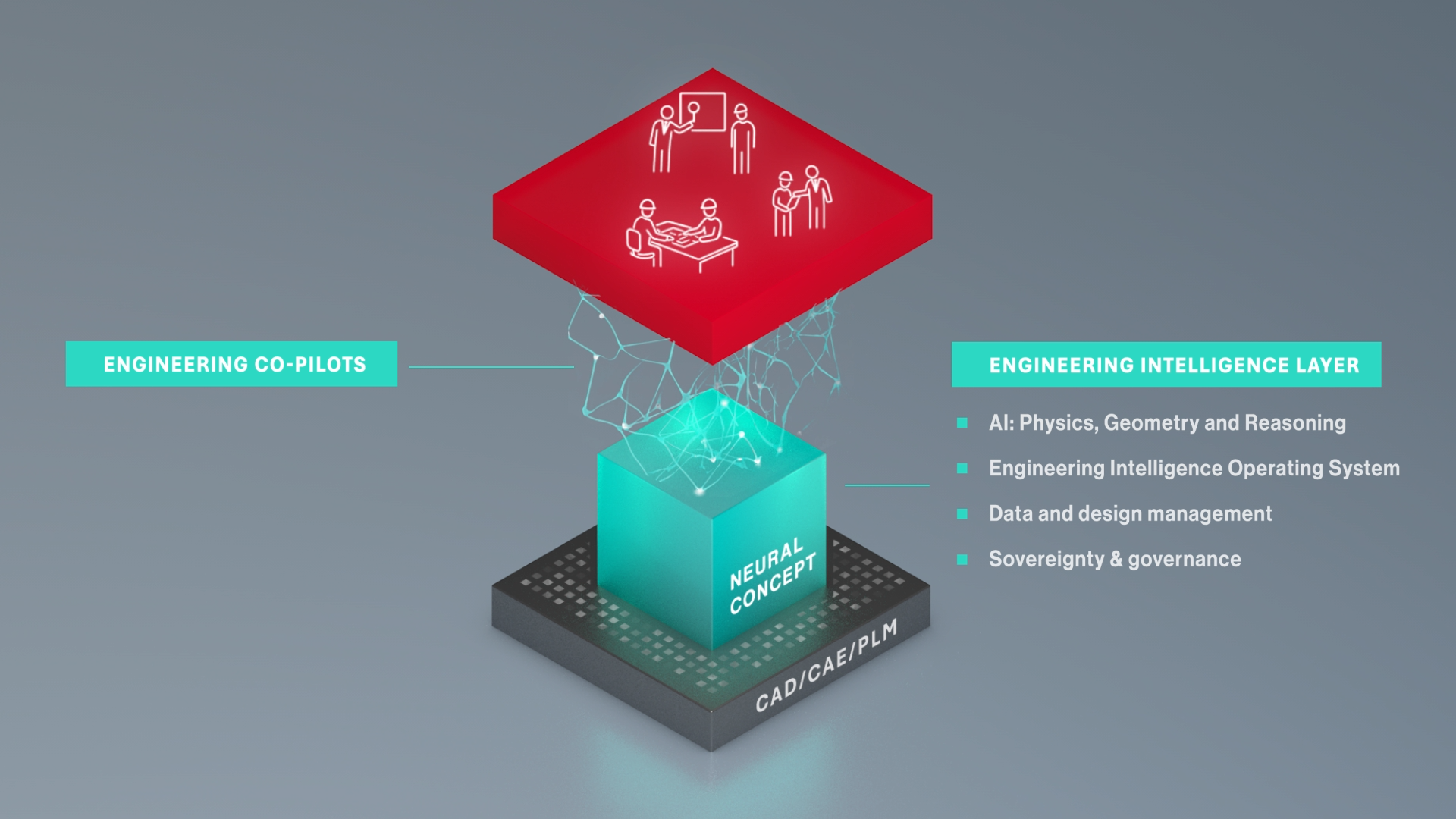
The Neural Concept user interface enables even sales teams to visualize and communicate complex engineering simulations in a clear, customer-oriented manner. This is a verification tool, but it is especially useful for generating ideas.
Product Development Challenges and Opportunities
The development process is complex, but also an opportunity for innovation. Examples demonstrate how challenges can be turned into advantages.
- Risk management is crucial, especially in regulated industries such as healthcare.
- Emerging technologies, such as AI, drive growth, as exemplified by Amazon’s advancements in personalized recommendations.
- Product updates maintain relevance, like Apple’s iPhone camera enhancements.
- New features expand portfolios, as evidenced by Fortnite’s seasonal updates, which demonstrate effective player engagement.
Regulatory Compliance Considerations
Regulatory requirements vary by industry and must be embedded early in the lifecycle. ISO 13485 governs quality management systems. Here are just a few industry-specific examples:
- Medical devices require FDA 510(k) clearance or PMA approval
- Automotive products follow ISO 26262 for functional safety
- Consumer electronics need CE marking for European markets
- Aerospace adheres to AS9100 standards.
Early compliance planning prevents costly redesigns and ensures market access.
The Importance of Product Development Planning
Strategic planning underpins a successful product lifecycle, aligning goals and mitigating risks.
Examples emphasize its critical role:
- Careful planning identifies risks early. For example, in Electronic Health Record (EHR) systems, compliance with U.S. HIPAA (Health Insurance Portability and Accountability Act) regulations must be addressed from the start. Early planning avoids costly redesigns and ensures patient data is secure.
- Alignment with business and customer goals ensures that products remain relevant and practical. Tesla demonstrates this through modular designs that enable faster upgrades and lower costs while meeting evolving customer needs.
- Stakeholder collaboration ensures compliance and quality. In regulated industries, engineers, designers, legal teams, and customers collaborate to meet both technical and regulatory requirements.
- A structured lifecycle cuts errors and improves efficiency. It provides teams with a roadmap, reduces rework, and ensures that each stage delivers measurable progress toward the final product.
Conclusion
The new product development process provides a structured framework that turns concepts into functional, market-ready products through defined stages and continuous iteration.
With market research, competitive analysis, concept development, and usability testing, organizations match technical design with customer needs and regulatory requirements.
Agile methodologies and cross-functional collaboration ensure that feedback collected at every stage is incorporated, improving product quality and time-to-market. A systematic approach also enables continuous improvement after launch.
Companies such as Apple, Dyson, Tesla, and Instant Pot Brands demonstrated how applying a disciplined product engineering life cycle delivers tangible results from innovative features to enhanced user satisfaction.
As a conclusion, the structured product engineering life cycle enables engineering teams to deliver solutions that meet key performance indicators, adapt to evolving markets, and maintain competitiveness.
FAQs
How can product development teams shorten the life cycle without sacrificing quality?
By integrating simulation-driven design, automation, and concurrent engineering practices, product development teams can identify issues early and iterate faster, reducing bottlenecks while maintaining rigorous testing and validation.
What should product managers prioritize during each stage?
They should ensure clarity of requirements during the first product development stage, track performance against objectives during prototyping, validate functionality in testing, and manage integration and production readiness for launch.
What challenges do startups face in managing product development, and how can they overcome them?
Limited resources, unclear requirements, and rapid pivots are common. Startups succeed by focusing on lean development, frequent testing, and using flexible tools that adapt to evolving product goals.
What metrics should R&D teams track to measure product success?
Key metrics include time-to-market, defect rates, iteration speed, cost variance, and alignment with performance targets. Monitoring these provides actionable insights to improve processes and outcomes.
How to improve cross-functional collaboration in product development?
Encouraging integrated workflows, shared documentation, and regular design reviews between engineering, manufacturing, and operations teams reduces miscommunication and accelerates decision-making.
When is it best to outsource parts of product development, and what are the risks involved?
Outsourcing works for specialized tasks or capacity issues, but risks quality, IP leaks, and slow feedback. Clear contracts and oversight reduce these risks.
How does “Agile” differ from “Waterfall”?
Agile emphasizes iterative progress, feedback, and adaptability. Waterfall follows a linear process.