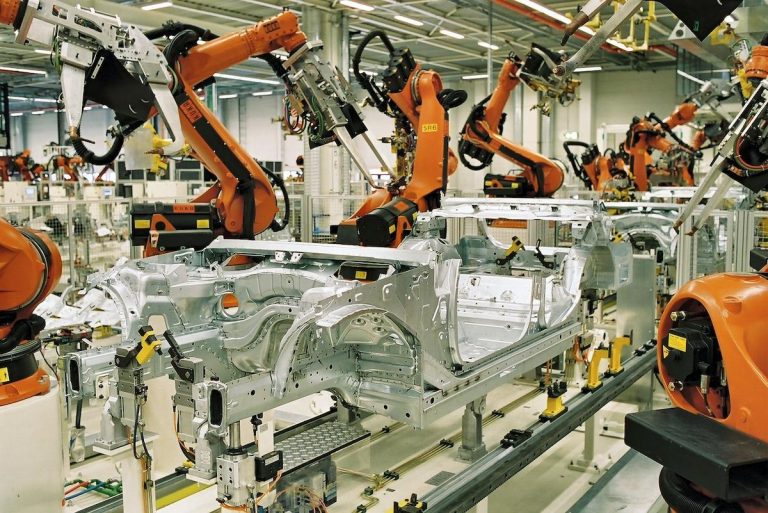
Manufacturing scalability is the ability of a company to raise production output efficiently without a proportional rise in cost, keeping process behaviour unchanged as volume grows. AI supports it by detecting the earliest signs of strain in sensor and operator data, well before defects accumulate, so the plant can correct course.
Key takeaways
Scalability means output rising faster than cost, with process behaviour holding steady.
Early strain detection in sensor and operator data is where AI intervenes, before defects appear.
The guide is written for engineering and operations leaders who need to test for scalability.
Total productive maintenance connects directly to scalability, since unplanned downtime caps output.
Table of contents
Manufacturing scalability refers to a company's ability to increase its production output efficiently without a proportional increase in costs.
AI helps manufacturing scalability by detecting the earliest signs of strain in sensor and operator data, well before defects accumulate, so the plant can correct course while the system is still predictable.
This article is a working guide for engineering and operations leaders: how to test for scalability, where it breaks under load, and how physics-aware AI keeps the process steady as production grows.
Scalability means raising output while keeping process behavior unchanged. The deeper indicators matter more than headline numbers: cycle time variance, rework volume, first-pass yield, and equipment drift. When these stay steady as volume rises, the plant is scalable; when they don't, it is simply overloaded.
AI detects the first signs of instability by recognizing patterns in vibration, temperature, flow timing, and operator interventions that humans usually notice only after problems have accumulated. Discover more about the major fields of AI and their applications.
Scalability has several dimensions that together determine whether growth holds:
Operational scalability allows processes to handle increased volume.
Strategic scalability includes a clear plan for growth, markets, and risks.
Financial scalability ensures capital and funding can support expansion.
Technical scalability involves software and systems that support growth.
Effective manufacturing scalability allows companies to fulfill sudden spikes in orders and enter new markets. It also prevents production failures and longer lead times associated with unplanned growth and manages costs by preventing over-investment in unused capacity and runaway costs during peak times.
What are the advantages of scalability for manufacturing operations?
AI-powered manufacturing scalability delivers measurable benefits across quality, efficiency, and responsiveness. The table summarizes the main advantages and their impact.
Benefit area
Key actions
Impact
Higher production volumes
Scalable processes and flexible systems
Handle more units without overloading equipment or staff
Improved quality control
AI monitors production steps and detects defects early
Maintains consistent product quality even at higher output
Scalable manufacturing enables companies to respond to changes in consumer preferences and market demands efficiently
Data-driven decisions
Real-time production and equipment data
Provides actionable insights for continuous process improvement
Workforce support
AI assists with repetitive or complex tasks
Frees human labor for higher-value work while maintaining efficiency
A scalable manufacturing operation can readily respond to fluctuations in demand and changing market conditions. Spreading fixed costs over a larger number of units lowers the cost per unit, which is how scalability reduces operational costs and supports overall operational efficiency.
How do we assess current production capabilities?
We assess production capability by measuring whether current operations can absorb higher output before committing to scaling. A comprehensive assessment of current operations and quality control measures clarifies existing capabilities and identifies opportunities for improvement. The core test is overall equipment effectiveness under load. Identifying common production bottlenecks early is crucial for addressing them proactively during scaling, and machine learning methods identify variation patterns while they are still small, well before they reach inspection.
What strategic planning steps ensure scalable manufacturing operations?
Strategic planning starts with matching projected demand against real capacity to find where the system would break first, a gap that manufacturing simulation can test against volume scenarios before resources are committed. Establishing clear, measurable objectives and metrics is essential for successful scaling in manufacturing.
Analyze demand variability and projected production volumes, then identify bottlenecks in equipment, labor, materials, or logistics to keep targets realistic.
Design flexible production lines, supply chains, and buffers to absorb fluctuations while maintaining quality. Flexible production lines are essential for scalable manufacturing because they can be quickly reconfigured to produce different products or accommodate varying volumes.
Coordinate production, inventory, and quality data through enterprise resource planning and embed automated quality control measures for early detection of deviations.
Test material flows and volume scenarios with AI-based simulation to optimize cost per unit and utilization before scaling up.
ERP and MES
Technology solutions like ERP systems provide real-time data and insights, enabling informed decisions about scaling operations. Investing in advanced technologies, such as ERP systems and automation tools, creates a flexible infrastructure that adapts to market fluctuations. Manufacturing ERP systems give real-time visibility into every part of the production operation, tracking raw materials and optimizing order fulfillment.
ERP and a Manufacturing Execution System (MES) play complementary roles. ERP plans and commits enterprise resources over weeks to months, while MES executes and tracks production on the shop floor in real time, capturing machine states, scrap, and quality at the unit level, with reaction times measured in seconds.
How can operational optimization improve production efficiency?
Operational optimization improves production efficiency by ensuring a stable, repeatable flow as output grows, which defines a scalable manufacturing operation.
Continuous improvement and lean manufacturing eliminate non-value-added activities and reduce excess inventory. Implementing lean manufacturing principles helps eliminate waste and optimize processes, making operations easier to scale.
Automated systems with statistical process control monitor critical parameters in real time. Statistical process control methods identify patterns of variation, enabling timely corrective actions before products move out of tolerance.
Supply chain and inventory coordination align material availability with production schedules. Effective supply chain management is critical for maintaining production efficiency during scaling, and building strong relationships with reliable, scalable suppliers ensures consistent material availability.
AI-driven tools analyze production data to identify patterns linked to performance losses and apply AI-driven process optimization to industrial workflows. Automation can enhance scalability in manufacturing by handling repetitive tasks with consistency and precision, allowing systems to handle increased volume without significant cost increases.
Is total productive maintenance related to manufacturing scalability?
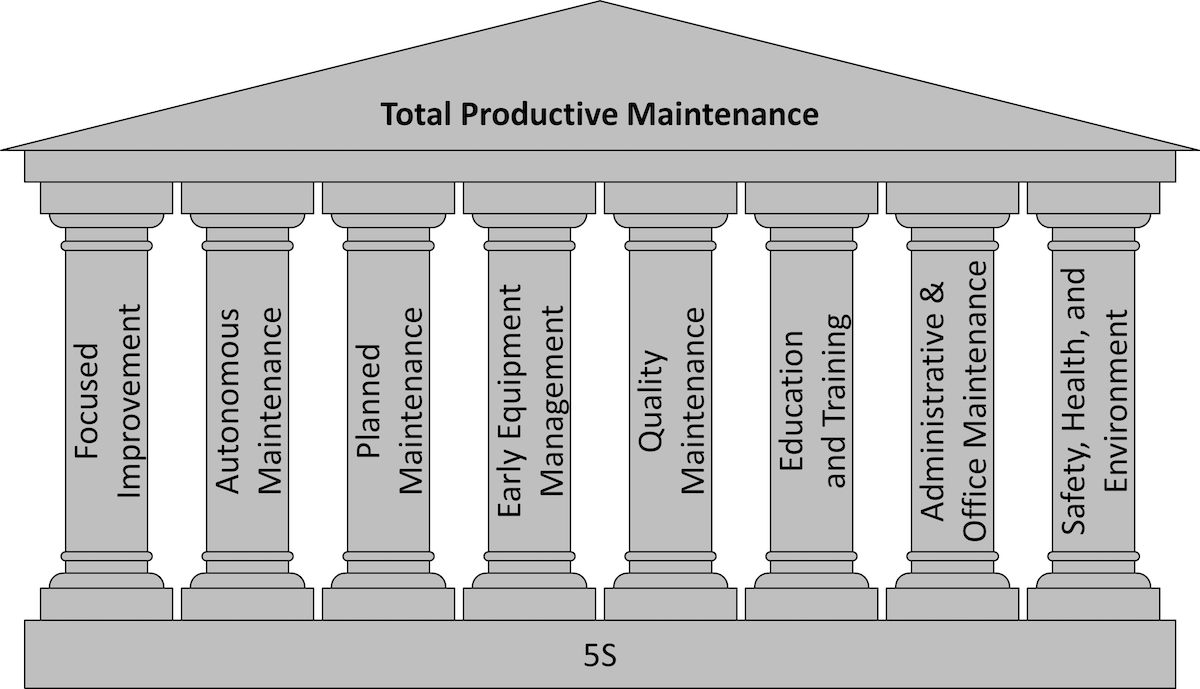
Total Productive Maintenance (TPM) is directly related to manufacturing scalability. Scaling requires output to rise without a disproportionate increase in downtime, defects, or maintenance load, and TPM targets exactly those failure modes.
As volume increases, equipment becomes the bottleneck. TPM reduces unplanned stops and minor failures that would otherwise scale nonlinearly with throughput and stabilize machines through preventive and autonomous maintenance. This keeps process capability intact as utilization rises.
Higher utilization amplifies latent faults. TPM shifts maintenance from reactive to predictive. This shift prevents small degradations from becoming system-wide interruptions and helps keep the cost per unit in check.
Eight pillars of a TPM program (source: AllAboutLean.com)
How does AI support quality and maintenance?
AI ensures consistent quality even during periods of increased production volumes, strengthening quality control systems while safeguarding product quality and cost efficiency. Ensuring quality control at higher output depends on detecting deviations early: automated quality control measures detect defects early in the production cycle, reducing waste and improving overall product quality. The mechanisms below show how AI continues to improve quality control as volume rises.
Quality control: computer-vision systems replace sampling-based inspection with full-field, full-rate inspection. Convolutional models detect deviations in geometry, texture, or assembly that correlate with downstream failures, often before defects exceed tolerance. The value comes from quantifying defect distributions to enable tighter process control, rather than relying on binary pass/fail logic.
Maintenance: predictive models learn degradation patterns in vibration, current draw, and temperature drift, scheduling action when the expected cost of failure exceeds the cost of intervention.
Supply chain and inputs: AI-driven comprehensive supplier assessments focus on risk propagation, correlating quality excursions with upstream material batches to identify which inputs amplify variability under load.
Which performance metrics are critical for scalable manufacturing?
The single most critical metric is overall equipment effectiveness, because it reveals whether higher throughput reflects real process improvement or assets being run into accelerated wear. Rather than tracking key performance indicators independently, AI models how changes in one part of the system propagate to others. Maintaining real-time visibility into quality metrics enables quick detection and correction of deviations during scaling.
Production and asset metrics: overall equipment effectiveness, cycle times, unit costs, and capacity utilization are analyzed together to separate real gains from accelerated wear.
Quality and supply chain signals: defect rates are correlated with material batches, suppliers, and process conditions, reducing the lag between root cause and corrective action.
Planning and inventory control: inventory turnover and production schedules are optimized using demand forecasts to achieve a stable flow with controlled buffers.
What is digital transformation in manufacturing?
Digital transformation links the physical and digital manufacturing worlds, helping companies maintain consistent product quality, manage flexible systems, and respond to changing market demands. Technology and automation streamline manufacturing processes, enhancing operational efficiency and quality management. Smart manufacturing combines real-time data analysis with automated systems to enhance the production process and capabilities. Its key elements include:
Artificial intelligence: algorithms analyze production processes, monitor equipment effectiveness, and support consistent product quality as production volumes increase, guiding decisions on production schedules, maintenance, and supply chain management.
Digital thread: a connected framework that tracks product data across the production lifecycle, from design to delivery, supporting efficient operations and reliable production outputs.
Digital twins: virtual models that simulate real-world operations. Digital twin technology provides a virtual environment for experimentation and optimization without disrupting active production, letting manufacturers forecast bottlenecks and plan scaling processes.
Computer-Aided Engineering (CAE): a set of integrated software systems, including Finite Element Analysis (FEA) and Computational Fluid Dynamics (CFD), that simulates expected behavior under defined assumptions. CAE results increasingly feed Deep Learning and AI systems, where high-fidelity outputs train fast data-driven approximations and anchor data-driven methods to physically consistent behavior.
The Industrial Internet of Things (IIoT) optimizes production schedules and provides real-time data for decision-making. IoT devices turn factories into intelligent, data-driven environments by connecting machines, sensors, and systems to collect and share real-time information. Investing in these advanced technologies lets enterprise resource planning and automated quality control measures ensure consistent quality, while a modular approach to production allows incremental scaling and reduces the risks associated with expansion. Continuous improvement initiatives then draw on data from digital systems to manage cost per unit as volumes increase. Explore the main CAE tools in the automotive industry.
Various drone designs generated by an AI algorithm (Neural Concept)
How should a workforce be developed for scalable manufacturing?
A skilled and adaptable workforce is essential for scaling manufacturing operations. Investing in training and upskilling prepares the workforce for increased production demands during scaling, while AI tools guide workers on repetitive tasks, enabling teams to handle larger production volumes without sacrificing consistency. Discover more on the best practices for sustainable manufacturing.
Cross-training employees enhances adaptability and reduces labor shortages during scaling, developing a versatile team capable of handling multiple responsibilities.
Standardized work instructions and documented standard operating procedures (SOPs) improve consistency, preserve institutional knowledge, and ensure best practices are maintained as operations scale.
Skills matrices and regular skill assessments track employee capabilities and identify gaps, guiding targeted training investments across all critical operations.
Technical certification programs develop specialized expertise in equipment operation, maintenance, and troubleshooting, while mentorship programs accelerate skill development by pairing experienced operators with newer team members.
Performance monitoring systems offer data-driven feedback for continuous improvement, and clear career development paths help maintain engagement and motivation during periods of expansion.
What industry trends affect manufacturing scalability?
The trend reshaping scalability most is the move of AI from isolated pilots into core production control, where models now tune processes in real time. AI systems can adjust manufacturing parameters in real time, ensuring consistent product quality and optimal output. Connected shifts reinforce it:
Accelerated AI adoption: per Deloitte's 2026 Manufacturing Industry Outlook (a 2025 survey of 600 executives), 80% plan to invest 20% or more of their improvement budgets in initiatives including AI and data analytics ⁽¹⁾. See the applications of Machine Learning to mechanical engineering.
Smart factory expansion: process automation transforms manual manufacturing operations into streamlined workflows. The global smart factory market is projected to grow from USD 156.6 billion in 2025 to USD 353 billion by 2034 ⁽²⁾. In a food processing plant, IoT-linked systems can calibrate temperatures automatically to reduce spoilage and increase production capacity without downtime.
Industry 4.0: PwC's 2025 Future of Industrials survey of 508 C-suite leaders found that 93% believe the world is on the brink of the next industrial revolution ⁽³⁾. Read more on
Digital twins and additive manufacturing: digital twins cut prototyping costs by 25 to 40% in aerospace and automotive ⁽⁴⁾, while the additive manufacturing market is expected to grow from USD 26 billion in 2025 to USD 132 billion by 2032 ⁽⁵⁾, enabling localized scaling.
Evolving ERP and cloud ecosystems: Gartner predicts that by 2027, 62% of ERP application spending will include AI capabilities ⁽⁷⁾, rebalancing inventory during growth phases while sustaining margins. McKinsey estimates that rekindling US productivity could add USD 10 trillion to cumulative GDP by 2030 ⁽⁸⁾.
Case studies of scalable manufacturing
Siemens: AI in electronics manufacturing
Siemens ⁽⁹⁾ embeds AI directly into factory operations rather than layering it on as analytics. Digital twins simulate production workflows to identify bottlenecks before changes reach the shop floor, while AI integrates with supply chain management to forecast demand and optimize inventory. Predictive maintenance anticipates component degradation, enabling higher output without a proportional increase in working capital.
Tesla: robotics and AI in automotive production
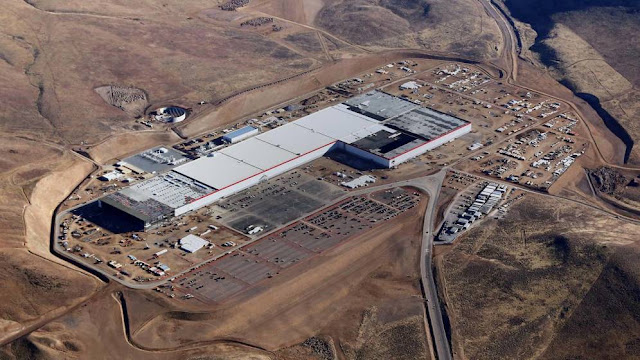
At Tesla ⁽¹⁰⁾, AI and robotics scale automotive production while controlling quality, cost, and throughput. Gigafactory lines integrate AI that monitors process parameters and adjusts conditions in near real time, so increasing output does not require proportional growth in labor. Machine-learning models detect early signs of quality drift before defects propagate, and robotics performs precision-critical tasks while operators focus on supervision.
Tesla Gigafactory under construction
Apple: lean manufacturing and scalable production
Apple combines lean manufacturing, inventory management, ERP, and AI-driven monitoring in electronics assembly. Automated inspection systems detect defects at scale and feed real-time data back into process control. Digital threads connect design, manufacturing processes, and the supply chain, while digital twins simulate process changes and volume ramp-ups before deployment, reducing yield loss during scaling ⁽¹¹⁾.
Conclusion and takeaway: How can manufacturing companies scale successfully?
Manufacturing scalability works like a recipe. Combine these elements, and a manufacturing business can scale without paying in defects or downtime:
Strategic planning that matches projected demand to real capacity before resources are committed.
Operational optimization that keeps flow stable so quality management holds as output rises.
Digital transformation that connects production data end to end for full visibility.
AI across the process to scale production, maintain consistent product quality, and improve cost efficiency.
Continuous process improvement initiatives that compound each gain rather than treat scaling as a one-off step.
The result is scalable solutions that expand production capabilities, respond to changing market demands, and deliver sustainable growth.
A process designed to increase production volumes without sacrificing quality or disproportionately growing production costs. Key characteristics of manufacturing scalability include efficient handling of increased production volumes, cost-effective maintenance of profitability margins, and consistent product quality regardless of volume.
What are the main steps to implement scalable manufacturing processes?
Assess capabilities, plan strategically, optimize operations, maintain quality, develop workforce, and integrate AI and scalable solutions. Maintaining quality control during scaling requires implementing robust systems and procedures and regularly reviewing operational performance to ensure optimal resource allocation.
What is the difference between manufacturing scalability and manufacturing flexibility?
Scalability focuses on increasing production capacity through effective performance monitoring systems, while flexibility adjusts manufacturing processes to different products or market conditions. Modular design enables easy upgrades or customizations during product development.
How do digital twins improve manufacturing scalability?
By simulating production processes, identifying bottlenecks, and planning production schedules without disrupting current operations. Leverage data analytics to track key performance indicators and optimize resource allocation in manufacturing.
Which metrics are used to evaluate manufacturing scalability?
Overall equipment effectiveness, production cycle, defect rates, supply chain performance, production schedules, and cost per unit.
What are the main challenges to achieving manufacturing scalability?
Scaling manufacturing operations presents several key challenges, including quality control issues, supply chain disruptions, production monitoring, cost control, and managing increased production volumes.
How does manufacturing scalability influence customer loyalty and long-term satisfaction?
A scalable manufacturing setup boosts customer loyalty by ensuring consistent product availability and service.