AI In Industrial Automation: Role and Benefits
Artificial intelligence in industrial automation replaces fixed, rule-based control logic with models trained on sensor and vision data collected from production lines. The models identify conditions that fixed thresholds miss, such as an emerging bearing fault or a surface flaw smaller than what human inspectors can detect. Manufacturers apply AI models in three functions. Predictive maintenance reduces unplanned downtime. Automated quality checks reduce manual labor. Process optimization reduces energy consumption.
Key takeaways
Quick facts:
Machine learning models reduce downtime by anticipating equipment failure.
Machine vision inspects production lines faster than human inspectors.
Generative AI drafts technical documentation, which then requires engineering review.
Available plant and shop-floor data determine which AI applications are feasible.
This article covers the AI technologies used in industrial automation, the history of their adoption, and their role in process optimization, robotics, quality control, and professional development. It also covers the operational technology (OT) data conditions for an industrial AI project. It does not contain vendor comparisons, pricing, or a deployment checklist for a specific plant.
Three reader profiles are addressed. Automation and controls engineers responsible for PLC, SCADA, and HMI systems are the audience for the section on OT data architecture and human monitoring. Manufacturing and industrial engineers evaluating AI for a manufacturing process are the audience for the sections on process optimization and quality control. Engineering and operations executives are the audience for the sections on economic benefits and implementation.
Table of contents
What is artificial intelligence, and what are its core technologies
Artificial intelligence is the field of computational methods that perform tasks that previously required human judgment, such as classifying an image, predicting a failure, or selecting a control action. In industrial automation, an AI system receives measurements from a manufacturing process and returns a classification, a prediction, or a control decision.
Conventional automation logic applies rules an engineer writes. AI models derive their rules from recorded data, allowing them to represent relationships that would be impractical to write down explicitly. The same distinction separates rule-based software from artificial intelligence in engineering.
The AI capabilities used in industrial automation fall into four technology families: machine learning, natural language processing, computer vision, and deep learning for 3D geometry.
| Technology family | What it does | Industrial application named in this article |
|---|---|---|
| Machine learning | Derives a model from recorded data instead of rules an engineer writes | Predictive maintenance, trained on vibration, temperature and motor-current logs |
| Natural language processing | Interprets, understands and generates human language | Technical translation across the languages used at a manufacturer's sites |
| Computer vision | Analyses visual inputs for recognition and anomaly detection | Defect detection at line speed on semiconductors, automotive parts and consumer electronics |
| Deep learning for 3D geometry | Predicts physical fields over a discretised geometry in near real time | Evaluating candidate geometries, with the trained model called in place of the solver |
The Neural Concept platform applies the fourth family to engineering data.
Smart manufacturing AI combines the first three on the shop floor.
Machine learning in industrial automation
Machine learning derives a model from recorded data. The training set's coverage therefore determines the model’s accuracy on new cases.
Supervised ML predicts outcomes using labeled data, such as a bearing’s remaining useful life. Unsupervised ML groups unlabeled records, which separates normal vibration signatures from anomalous ones.
Reinforcement learning selects actions through trial and error within a simulated environment and receives a numerical reward after each action.
In industrial engineering, the most common machine learning application is predictive maintenance, trained on sensor data such as vibration, temperature, and motor current logs.
A predictive maintenance model requires recorded failures within its training set. A plant commonly collects months of live data before the model produces dependable predictions.
NLP in industrial engineering
Natural language processing (NLP) enables machines to interpret, understand, and generate human language, enabling applications such as text summarization and translation.
Within multilingual organizations, NLP algorithms from platforms such as Google Translate and DeepL provide technical translations across the languages used at a manufacturer’s sites.
Computer vision in industrial engineering
Computer vision analyzes visual inputs to support image recognition and anomaly detection. These applications reduce waste and promote sustainable manufacturing.
A practical example is NVIDIA’s DeepStream SDK, which performs real-time visual analysis on assembly lines. Convolutional neural networks trained on vast amounts of data (images) classify visual patterns, catching defects as small as microscopic flaws in semiconductors, automotive parts, and consumer electronics at line speed, thereby improving production accuracy.
Accelerating design processes
Generative AI accelerates design by exploring multiple options. A generative model creates candidate geometries from design intent, while a physics-aware model evaluates each option before an engineer selects one, as in the AI Design Copilot.
Role of mathematics and data analysis in AI for engineering
AI relies on three fundamentals: mathematical foundations, high-quality data, and computational power. Linear algebra and probability theory support model training and uncertainty quantification. Optimization techniques minimize the error between the model’s prediction and the recorded value. Reliable data and sufficient compute determine whether a model delivers business value.
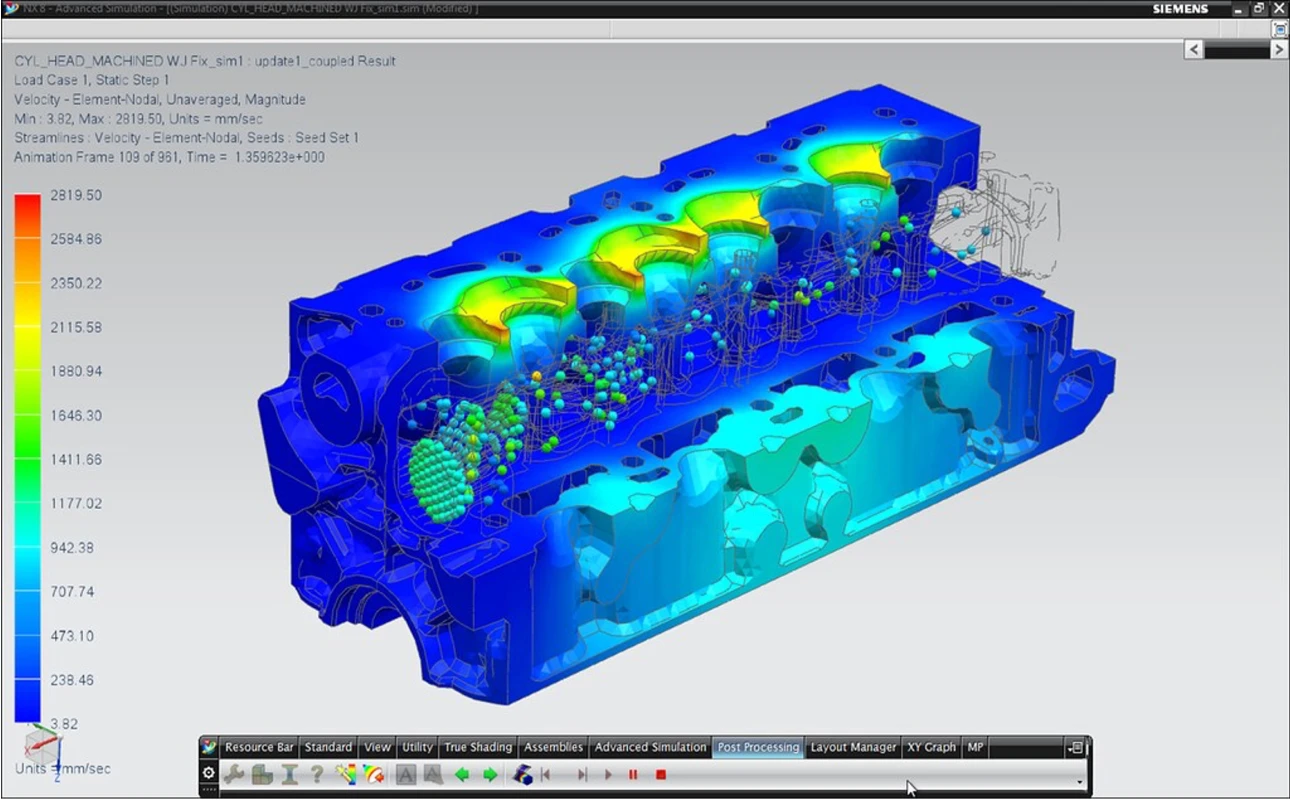
Computer-aided engineering (CAE) is a major source of engineering data. Finite element analysis and computational fluid dynamics (CFD) generate field values over discretized geometries. Neural networks process those fields to build models of real-world scenarios. Data science connects raw data to the decisions made during AI product development.
Engineers use machine learning to extract patterns from large simulation datasets, such as CAE data, to improve decisions about modifications to industrial designs made by operators or algorithms.
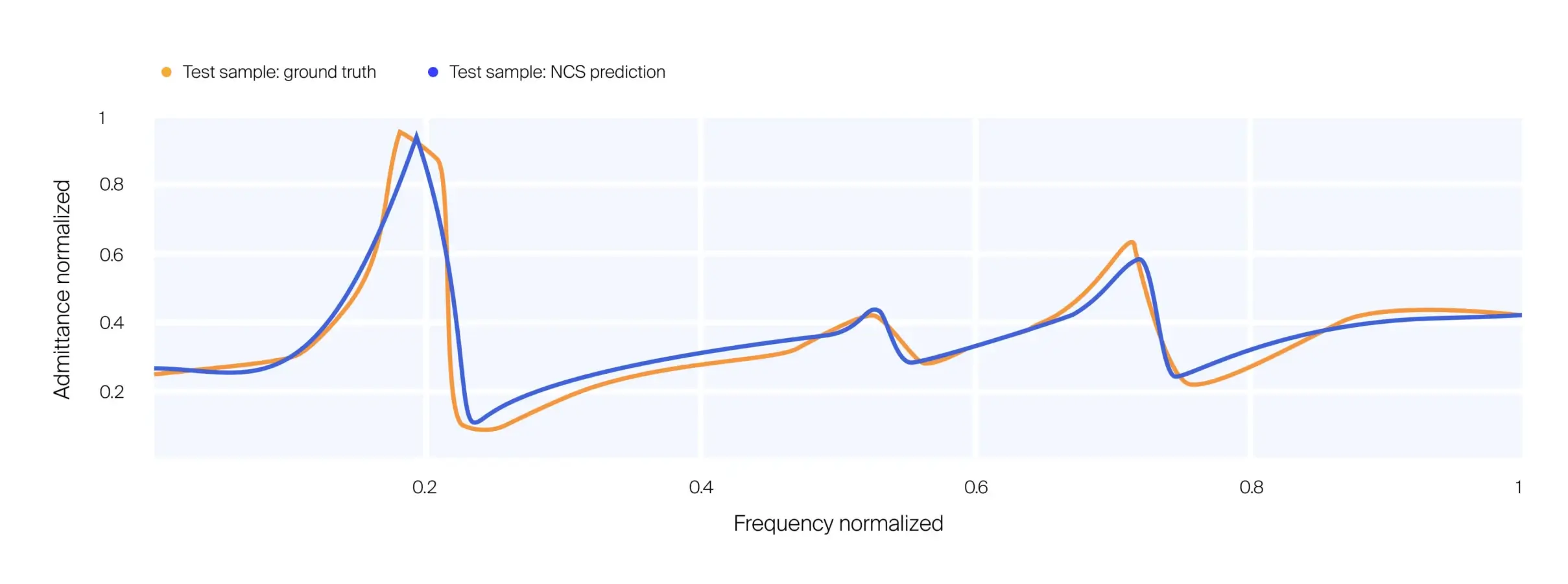
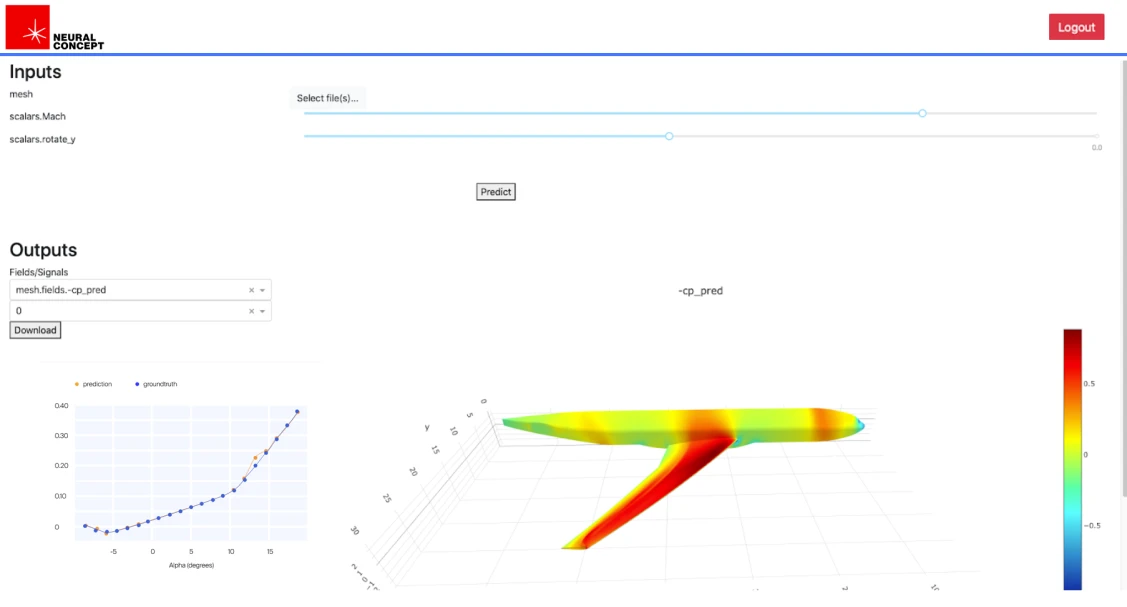
AI-driven systems trained on CAE results predict physical fields over a discretized geometry using 3D deep learning in near real time. An optimization algorithm then couples with the trained model, calling it in place of the solver.

In industrial engineering, machine learning supports predictive analytics for failure prediction, risk assessment, and process optimization. Models that analyze simulation and operational data improve productivity, optimize workflows, and enable data-driven decisions in manufacturing and supply chain operations.
History of AI applications in industrial engineering
In the 1950s and 1960s, rule-based systems explicitly encoded expert rules, but limited computing power restricted their use to small problems. Investment in AI research declined in subsequent decades.
Machine learning methods became practical again in the 1990s as computing power increased. By the early 2000s, data-driven models like support vector machines and neural networks delivered usable results for industrial classification and prediction tasks.
Deep learning expanded AI’s capabilities in the 2010s. Convolutional and recurrent neural networks achieved practical accuracy in vision, language, and autonomous systems. In industrial engineering, these methods supported supply chain optimization, predictive maintenance, quality control, and factory automation as part of broader manufacturing automation applications and advantages.

AI-powered autonomous robotics extended factory automation to material handling, sorting, and assembly. These systems connect to smart devices through the Internet of Things (IoT), forming 'smart factories' in which AI algorithms analyze vast amounts of sensor and real-time data across production environments and adjust operations to optimize performance. The same architecture applies across industrial environments, from a single work cell to a multi-plant network.
Industrial Design and Industrial Engineering now converge around AI-driven technologies.
Integrating AI with simulation software, such as finite element analysis (FEA), enables engineers to explore and validate a wider range of durable, energy-efficient designs within set timelines and to enhance performance without physical prototypes.

AI in industrial engineering delivers three core benefits: higher process efficiency, real-time decision-making, and predictive analytics, which are central to Industrial AI’s transformation of manufacturing.
In additive manufacturing, AI supports real-time monitoring, defect detection, and automated design. Monitoring the melt pool during a build allows corrections within the same job, improving quality and process scalability.
AI and process optimization
AI processes real-time manufacturing data, allowing adaptive responses to demand shifts, equipment variability, and disruptions. In manufacturing, AI algorithms reconfigure assembly lines and adjust material flows to optimize throughput at bottlenecks, advancing efficiency while maintaining line performance.

Machine learning enables industrial engineers to assess potential changes to complex processes before implementation. Simulations predict how adjustments to scheduling, equipment use, or logistics will affect performance, using data on machine availability, shop-floor activity, and resource deployment. Testing changes in simulation reduces the cost of unsuccessful modifications.
Predictive maintenance costs with AI in industrial engineering
Analytics models applied to production records identify inefficiencies such as delays, workforce imbalances, and excess energy usage. The recommendations they produce increase throughput at the identified constraint.
AI-powered predictive maintenance increases productivity and reduces costs. Sensors provide continuous data on temperature, vibration, and power consumption. AI algorithms detect anomalies, forecast failures, and trigger early interventions, reducing downtime and maintenance costs while improving asset reliability in line with machine learning-based predictive maintenance practices.
Economic and operational benefits of AI
The implementation of AI in industrial engineering and maintenance delivers measurable benefits:
Lower costs: proactive repairs are less expensive than emergency fixes on a stopped line.
Minimized downtime: early warnings help prevent unplanned downtime by enabling maintenance teams to schedule repairs during planned stoppages.
Extended equipment life: AI predicts potential failures and keeps machinery operating under optimal conditions, which delays replacement.
Fewer unplanned stoppages increase efficiency, measured as throughput per operating hour.
AI in supply chain management addresses inventory optimization, demand forecasting, and logistics routing, all of which affect profitability and customer satisfaction. Supply chain management AI keeps inventory levels aligned with forecast demand and adjusts delivery routes in real time, applying predictive maintenance algorithms to critical equipment to improve efficiency and maintain optimal stock levels while reducing shortages, costs, and delivery times.
Robotics and automation in industrial engineering
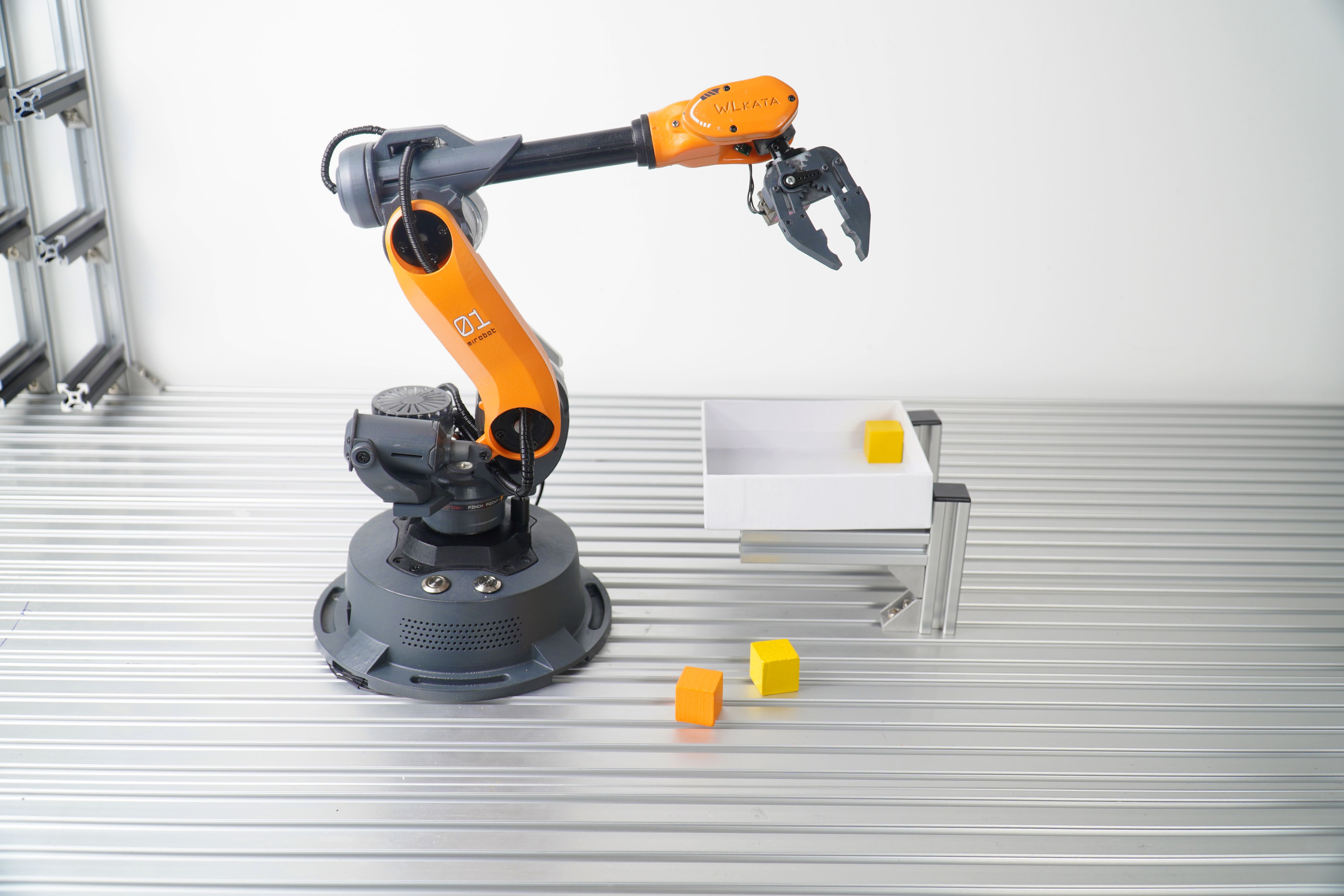
AI elevates robotics from fixed automation to adaptive systems. Machines adapt to changing environments and perform complex tasks in industrial settings.
AI in industrial engineering: intelligent robotics
AI algorithms allow robots to learn from recorded experience, recognize patterns, and refine their actions. On an assembly line, an AI-equipped robot performs repetitive tasks, detects variations in components, and adjusts its movements to complete the assembly without stopping the line.
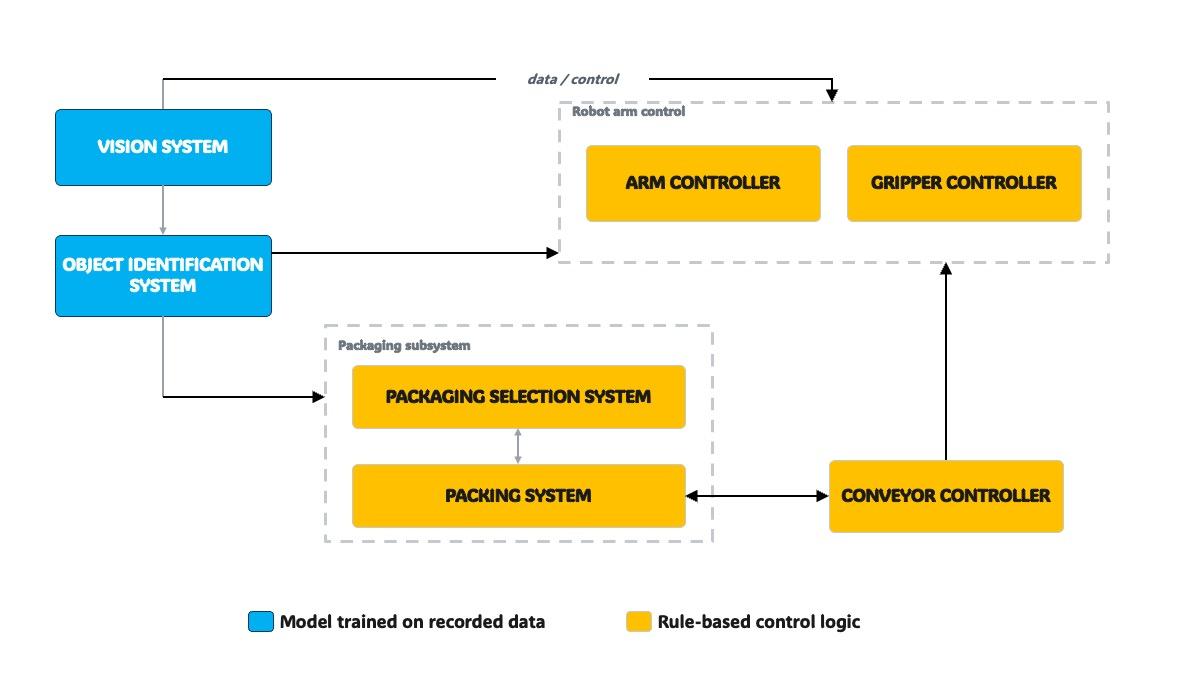
The substitution is localized. Within a packing robot control system, the vision system and the object identification system apply models trained on recorded images, while the arm controller, the gripper controller, and the conveyor controller continue to execute rules written by an engineer.
Safety and precision
AI-enhanced robots improve workplace safety by performing hazardous tasks in place of operators. They maintain position tolerance in welding, cutting, and assembly, driving improved product quality.
AI's role in professional development
AI reshapes complex industrial processes and the skills that those processes require of engineers.
Access to learning resources
AI-driven platforms accelerate learning for industrial engineers. Generative AI supports summarization, drafting, and document review, enabling faster access to technical knowledge and more effective integration of new technologies.
Emerging career opportunities in AI
AI adoption creates demand for specialized roles. Examples include data scientists and Artificial Intelligence consultants. Engineers with expertise in AI and industrial systems develop applications that connect the two disciplines.
Engineers who combine industrial process knowledge with model-validation skills perform the review AI-generated control outputs require. Capturing measurable value from an AI initiative beyond a pilot requires a trusted partner with documented deployments within the same industry. A model trained on a manufacturer’s process data remains specific to that manufacturer, turning accumulated production data into a competitive edge.

AI implementation
Implementing AI within an existing plant depends on three conditions: data quality, workforce skills, and change management.
AI algorithms and data analysis
AI systems require high-quality data to deliver reliable insights. Incomplete or inaccurate records lead to flawed predictions. Organizations must collect and validate data before developing models.
AI integration requires a workforce skilled in data analysis and AI tools. Insufficient proficiency can hinder integration. AI systems may also perpetuate biases present in their training data.
Industrial engineers must ensure AI solutions are fair, transparent, and ethical. Change management is critical to address potential employee resistance. Clear communication and early involvement of operators and stakeholders build trust and support adoption.

Operational Technology (OT) data architecture and human control
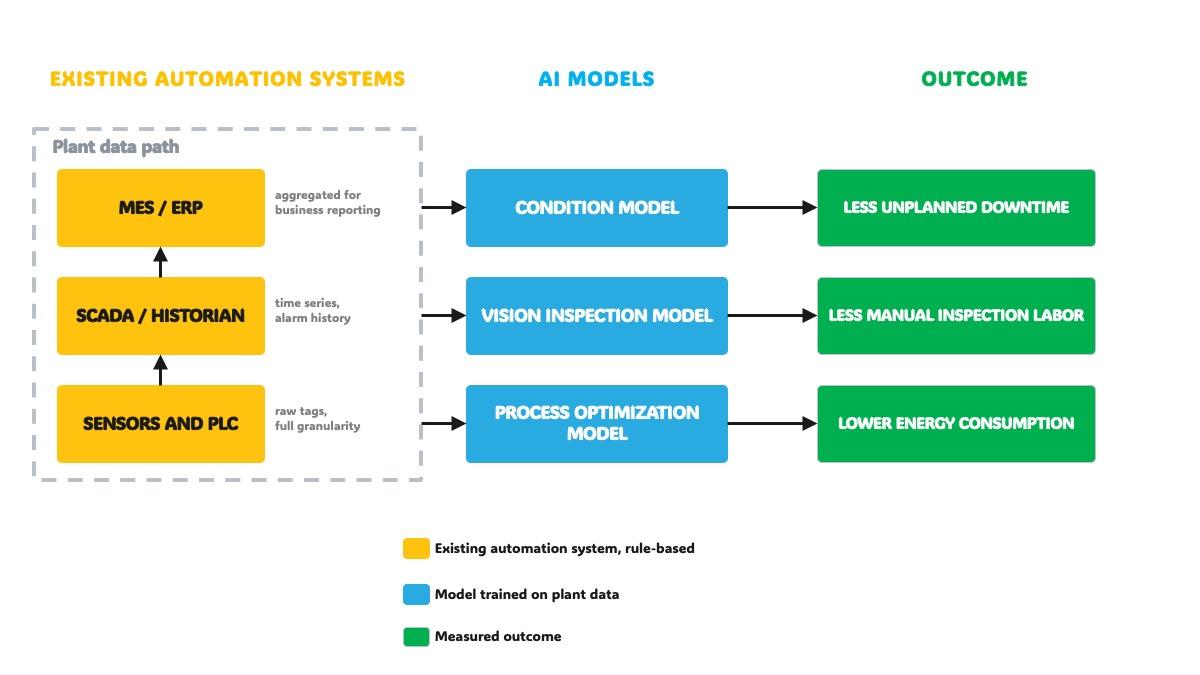
Industrial automation data architectures are rarely standardized. Depending on the plant, equipment, system integrator, and existing software stack, PLC data may pass through SCADA and historian systems before reaching MES (Manufacturing Execution System), ERP, or other enterprise applications.
Data at the MES or ERP level is often aggregated for business reporting. The raw sensor readings, alarms, and PLC tags required by AI applications are frequently missing from these layers. An audit of OT architecture, data granularity, historical coverage, and access requirements should precede any AI project.
The three model types the article covers all draw on the same path. A condition model consumes vibration and current histories; a vision inspection model consumes images captured on the line; and a process optimization model consumes setpoints and throughput records. Each of them requires the granularity available at the sensor and PLC layers, which is why an audit starts there rather than at the reporting layer.
Automated technical documentation is a practical application of generative AI in controls work. A generative model reads PLC or HMI project files, including XML exports, and produces first drafts of PLC logic flowcharts, functional test plans, and HMI screen manuals.
Experienced automation engineers must review AI-generated documentation and other control-related outputs before use. A language model that generates documentation text does not have access to the process context of a specific plant. Its output can therefore contain hallucinated instructions that create safety, reliability, or product-quality risks. This limitation applies to text-generating models and differs from physics-aware models trained on a plant’s own simulation and measurement data.
An AI industrial automation project must be built around a defined process, use case, or industry and validated in a real operating environment. Generic solutions do not transfer across applications without proper validation.
AI in quality control
AI improves industrial quality control by enabling inspections that are faster and more repeatable than human-only processes.
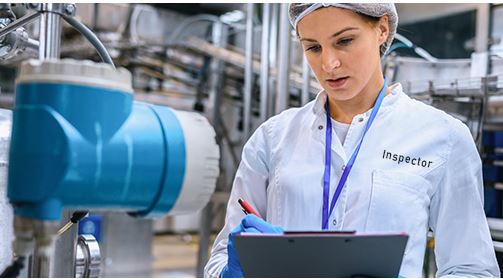
Machine vision detects defects at high speed on production lines, and human inspectors review the flagged parts.
Machine vision inspects each part at line speed, extending coverage from samples to full production volume.
Digital twins test and refine process settings before live implementation, reducing the number of trials on the running line and helping improve quality.
AI supports root-cause analysis by identifying defect patterns and the underlying production issues that cause them, thereby improving product quality.
Reduced scrap lowers material consumption and energy use, reducing the manufacturing process’s environmental impact and supporting sustainability goals.
Recykal, a waste-commerce platform, connects waste generators with aggregators and recyclers, which supports material sorting, recycling, and reuse within a circular economy.
Rockwell Automation’s FactoryTalk Analytics and comparable AI-powered control systems monitor workflows and automate adjustments, which improves operational efficiency.
AI defect detection and predictive maintenance complement each other because defect detection evaluates the quality of a produced part, while predictive maintenance anticipates equipment failure.
Conclusion
AI in industrial automation replaces fixed control logic with models trained on sensor and vision data from production lines. Manufacturers use these models for predictive maintenance, automated quality checks, and process optimization to address unplanned downtime, manual labor, and energy consumption.
Three conditions determine the result: data with sufficient granularity at the OT layer, automation engineers who validate the model's output, and a defined process for the model to apply. In these projects, the industrial engineer defines the process boundary and validates the model output against measured results.
Glossary of industrial automation terms
The terms below name the systems referenced throughout this article. Each entry states the system's function and the data it holds for an AI project.
ERP (enterprise resource planning): the business layer for orders, inventory, and planning. Its data is aggregated for reporting, which puts it at a higher level of granularity than most models consume.
Historian: the time-series database that records tag values and alarms over long periods. It supplies the historical coverage a predictive model needs, including recorded failures.
HMI (human machine interface): the operator-facing screen that displays machine state and accepts commands. Its project files, including XML exports, are the input for automated technical documentation.
MES (manufacturing execution system): the layer that tracks production orders, routing, and performance between the control systems and the business systems. Its records are already summarized by order or by batch.
PLC (programmable logic controller): the industrial computer that executes control logic on a machine or a line, reading sensor inputs and driving actuator outputs on a fixed scan cycle. It holds raw tag values at full granularity, which is the level most AI models require.
SCADA (supervisory control and data acquisition): the supervisory layer that collects data from PLCs across an area, presents it to operators, and passes it to storage. It carries alarms and setpoints alongside process values.
Where an AI project stops being a pilot
The three conditions above (granular OT data, engineers who validate the output, a defined process) decide whether a model leaves the pilot stage. A fourth decides whether it stays useful: the model has to sit where the work already happens, next to the CAD and CAE tools and the control systems a plant already runs, rather than beside them as a separate tool nobody opens twice.
That is the layer Neural Concept builds for physical products. The pattern holds across process types. Subaru brought a stamping simulation from three hours down to two minutes, which moves the check from an overnight batch into the design conversation. OPmobility reports up to 75% shorter end-to-end development time and up to 10x faster simulation. In both cases the solver stays the reference and the model changes how many options get evaluated before one is committed.
Ready to put a trained model on the data your plant already records?
Explore the platform →FAQ
Can AI replace an industrial engineer?
AI augments industrial engineers by automating routine tasks, but human expertise remains essential for complex problem-solving and accountable decision-making.
Will industrial engineering become obsolete?
Industrial engineering remains a distinct discipline. It evolves with AI, emphasizing roles in AI integration, optimization, and system design.
What industries benefit most from AI in industrial engineering?
Manufacturing, logistics, energy, healthcare, and automotive sectors benefit most from AI-driven efficiency gains through process optimization. Each sector runs high-volume processes that generate the continuous data an industrial AI model needs.
How can small and medium-sized enterprises (SMEs) adopt AI in industrial engineering?
SMEs should begin with a single AI application, such as predictive maintenance, inventory management, or simulation-based predictive analytics. Cloud-based solutions and pre-trained models help reduce initial investment.
What data does an AI project in industrial automation require?
AI projects require raw sensor readings, alarms, and PLC tags at the necessary granularity, along with historical data that includes examples of the events to be predicted. Data aggregated for MES or ERP reporting is often too coarse for this purpose.
Sources
The tools, platforms and figures named in the text, with the reference for each.
NVIDIA, DeepStream SDK — the real-time video analytics toolkit cited for visual inspection on assembly lines.
Enhancing energy distribution through dynamic multi-hop for heterogeneous WSNs dedicated to IoT-enabled smart grids, Scientific Reports 14, 30690 (2024) — source of the distributed IoT figure.
Recykal — the waste-commerce platform cited for material sorting and reuse.
Rockwell Automation, FactoryTalk Analytics — cited for automated workflow monitoring and adjustment. No stable public product URL at the time of writing.
Google Translate and DeepL — the machine translation services cited for technical translation.
Image credits, given in each caption: Scientific Reports, Wikipedia, victoryepes.blogs.upv.es, electronics-lab.com, people-equation.com, aix.web.tr and imsforum.com. The two schematics of the packing robot controller and of the plant data path are original.