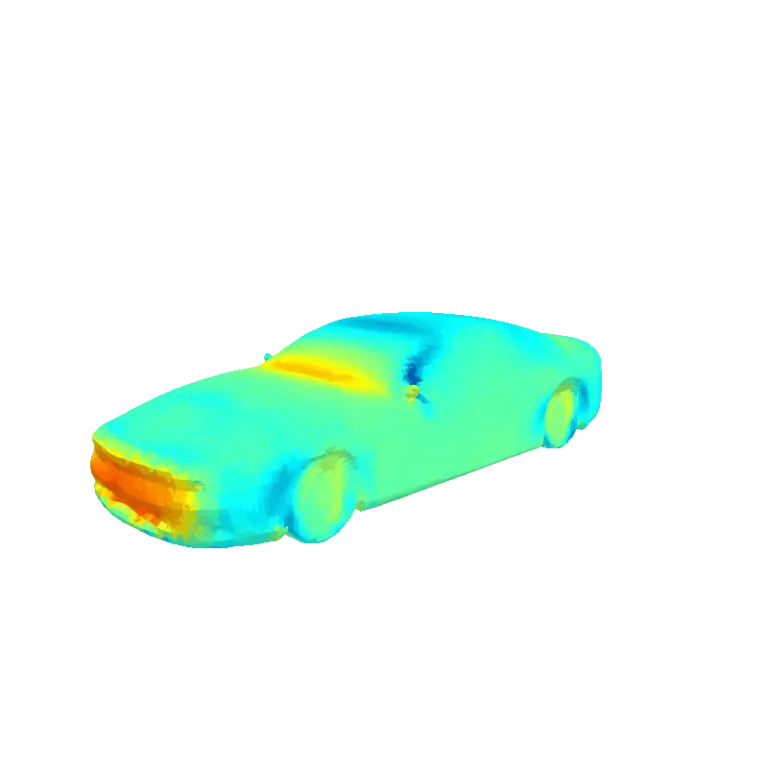
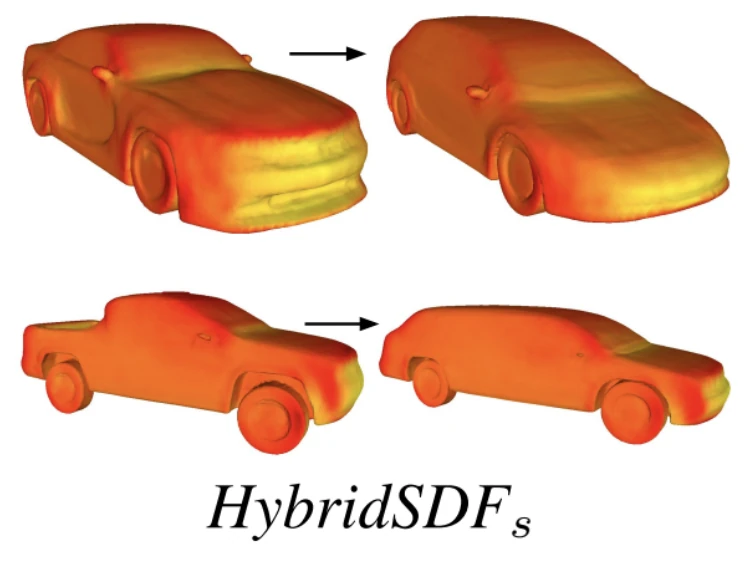
We have been collaborating with CVLab EPFL, to push to the extreme the concept of shortcutting design to simulation. We are reconstructing 3D Shapes from sketches and predicting the aerodynamics in real time. This demo concept tool would allow designers to refine geometries from single pen strokes, without any use of the complex CAD software.
Such an approach can be used at the very early stages of concepts, allowing for much faster design iterations. In this video, we show the example of a car design, where the user can get a full car3D geometry from sketches. The Sketch to 3D reconstruction part is based on the methods developed by the CVLab team, and will be presented at this year’s ICCV Conference. With these sketches, some design changes can be enforced easily. Furthermore, this tool is easy to deploy and robust to style changes.
Finally, a Neural Concept model was coupled, predicting physical quantities directly on the 3Dgeometry. For example, the designer can get the aerodynamic performances of the 3D car, directly from the sketches made.
With this workflow, the technical gap between very early design and simulations could be filled. This would allow for much faster iterations between the Design and Development teams in a company, as they are now able to work with common data, format, and information.
We are happy to pursue this successful collaboration with CVLab, on this topic along with many others, guiding companies faster towards radically better products.