Skip to content
Neural Concept Connect 2026 · Bay Area ✓ · Next: Munich (Nov 24) · Tokyo (Feb 3, 2027) Apply for your spot
Neural Concept
Get started

Neural Concept and EPFL CVLab at NeurIPS: “MeshSDF: Differentiable Iso-Surface Extraction.”

In short

A joint Neural Concept and EPFL CVLab paper, to be presented as a Spotlight at NeurIPS, introduces MeshSDF. It makes deep signed distance function 3D generative models differentiable by removing the Marching Cubes limitation, reasoning about how surface sample locations vary with respect to the underlying deep representation.

Key takeaways

  • MeshSDF produces explicit surface mesh representations from deep signed distance functions, differentiably.
  • The Marching Cubes algorithm was the limitation that made previous approaches non-differentiable.
  • The key insight is differentiating the 3D location of surface samples with respect to the underlying representation.
  • The paper is a joint Neural Concept and EPFL CVLab work, selected for a NeurIPS Spotlight presentation.
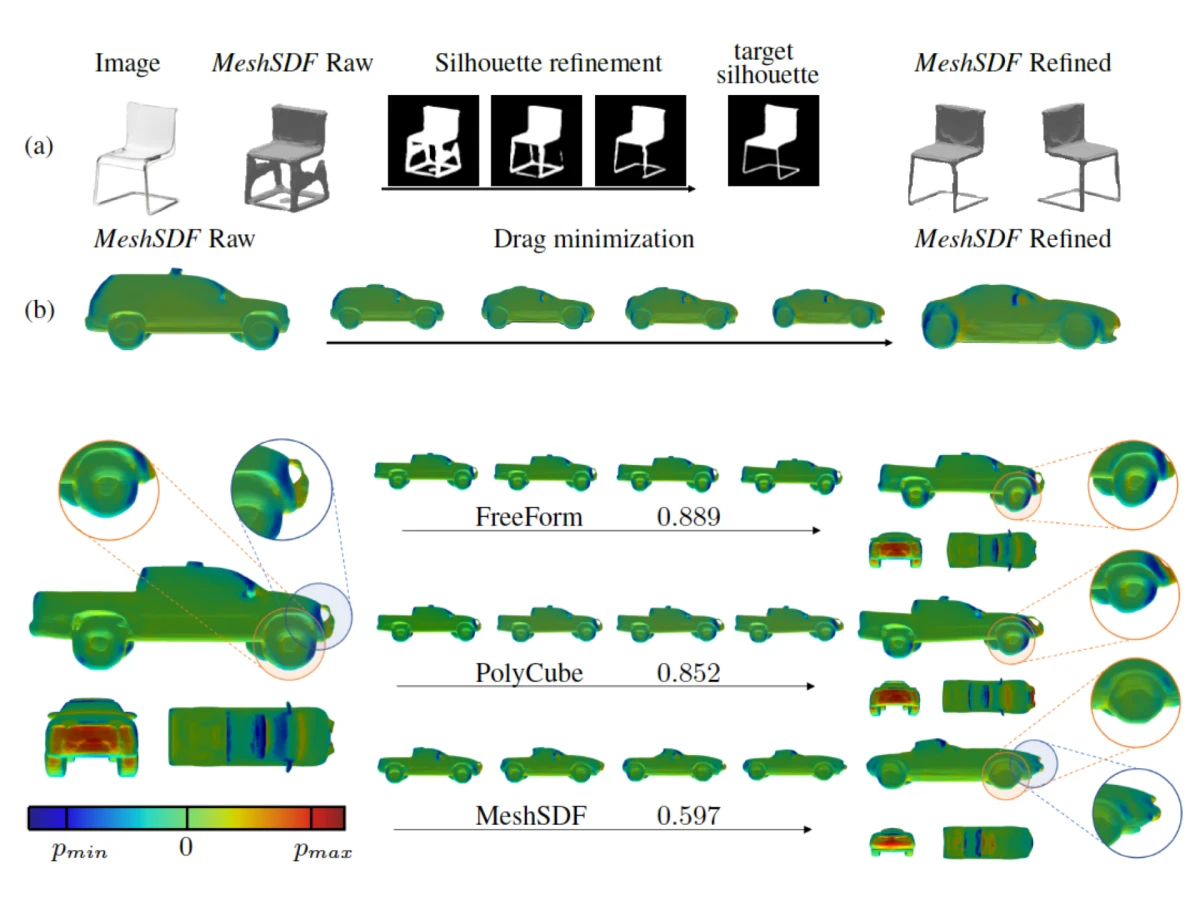
MeshSDF results: chair refined from a silhouette, and car shapes optimized for drag vs FreeForm and PolyCube baselines

A joint paper of Neural Concept and EPFL CVLab will be presented as a Spotlight presentation at Presentation for Neural Information Processing Systems Conference (NeurIPS) to reach a broader public to talk about MeshSDF that makes Deep SDF-based 3D generative models (VAEs) differentiable.

During the session, the team will introduce a differentiable way to produce explicit surface mesh representations from Deep Signed Distance Functions by removing the limitation of the Marching Cubes algorithm. The key insight is that by reasoning differentiate the 3D location of surface samples with respect to the underlying deep implicit field. The team exploit this to define MeshSDF, an end-to-end differentiable mesh representation which can vary its topology. They use two different applications to validate their theoretical insight: Single-View Reconstruction via Differentiable Rendering and Physically-Driven Shape Optimization.

The Neural Information Processing Systems Foundation is a non-profit corporation whose purpose is to foster the exchange of research on neural information processing systems in their biological, technological, mathematical and theoretical aspects. The Conference on Neural Information Processing Systems is the main venue where the most groundbreaking scientific publications in machine learning are published every year, with more than 10,000 attendees.

Read the full paper on : https://arxiv.org/abs/2006.03997