This twenty-minute webinar compares deep learning approaches with the reduced order modelling and response surfaces industry uses today, focusing on performance and capability. Geometric convolutional neural networks build surrogate models of numerical solvers like other learning methods, but without the drawbacks that limited previous surrogate approaches.
Key takeaways
The comparison is against reduced order modelling and response surfaces, the surrogates industry already trusts.
Geometric convolutional neural networks avoid the drawbacks that constrained earlier surrogate models.
The stated consequence is democratisation: advanced analytics and optimisation reaching beyond specialist teams.
The format is a twenty-minute webinar, framed technically around performance and capabilities.
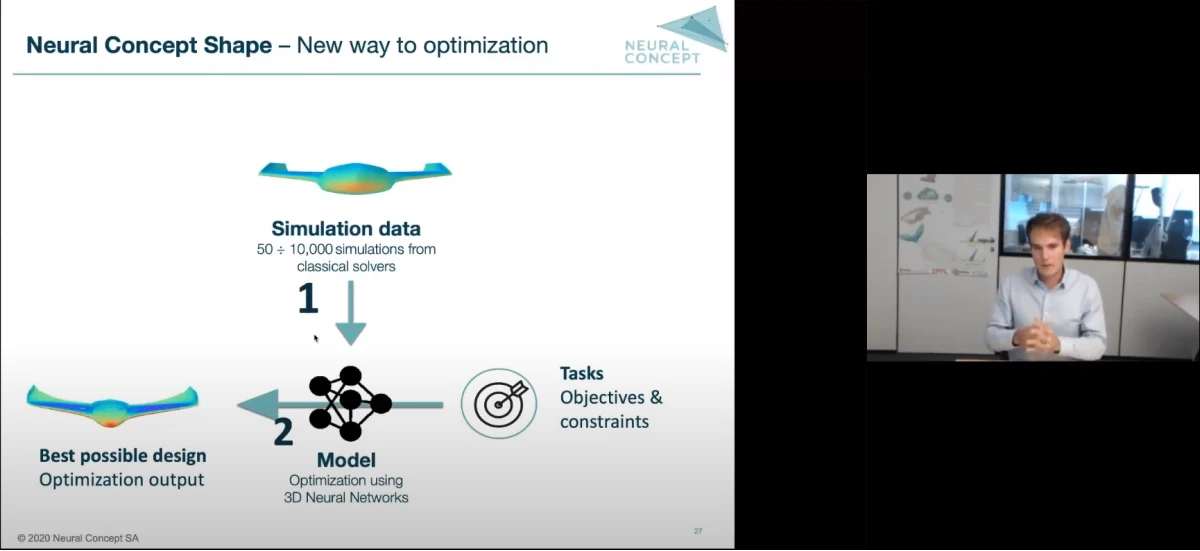
In this 20 minutes webinar, we will compare Deep-Learning based approaches to traditional reduced order modeling or response surfaces, today used in the industry. We first will look at the differences from a purely technical perspective with an emphasis on performance and capabilities. This analysis will help us understand the ongoing revolution towards the democratization of advanced analytics and optimization in engineering.
Like other learning-based methods Geometric Convolutional Neural Networks can be used to build surrogate models of numerical solvers. However, it suffers none of the drawbacks of previous surrogate methods. It is agnostic to the shape parameters as it processes directly the mesh representation of the design. Hence, optimization or design parameters are decoupled from the learning problem and a single predictor can be trained with a large amount of data and used for many optimization tasks.
Unlike Kriging methods, the engineer does not have to choose and stick to a specific parametrization from the beginning to the end of experiments. Optimizations can be naturally warm-started using data from previous campaigns. Furthermore, it can leverage the transfer learning abilities of Deep models to blend simulations from multiple sources and with multiple fidelities.
Pierre received an engineering degree in Applied Mathematics and a Masters degree in Operations Research from Ecole Polytechnique. After working as an Engineer for Credit-Suisse in London, he joined the Computer Vision Laboratory at EPFL. He got his doctoral degree in early 2018 under the supervision of Prof. Pascual Fua and Francois Fleuret. His research focused on Deep Structured Learning and Variational Inference applied to Computer Vision. As a result of his doctoral thesis, Pierre took the leap as an entrepreneur and founded Neural Concept in 2018.