Skip to content
Neural Concept Connect 2026 · Bay Area ✓ · Next: Munich (Nov 24) · Tokyo (Feb 3, 2027) Apply for your spot
Neural Concept
Get started

Modelling Facial Geometry using Compositional VAEs

In short

This method learns non-linear face geometry representations with a variational auto-encoder using multiple levels of hidden variables. Lower layers capture global geometry while higher ones encode local deformation, producing a parameterisation that decomposes the human face into semantically meaningful levels of detail for model fitting under geometric constraints.

Key takeaways

  • A hierarchy of hidden variables separates global face geometry from local deformation.
  • The resulting parameterisation is semantically meaningful, not only statistically convenient.
  • Model fitting can then capture varying levels of detail depending on the constraints applied.
  • The work was published at CVPR and the paper is available for download.
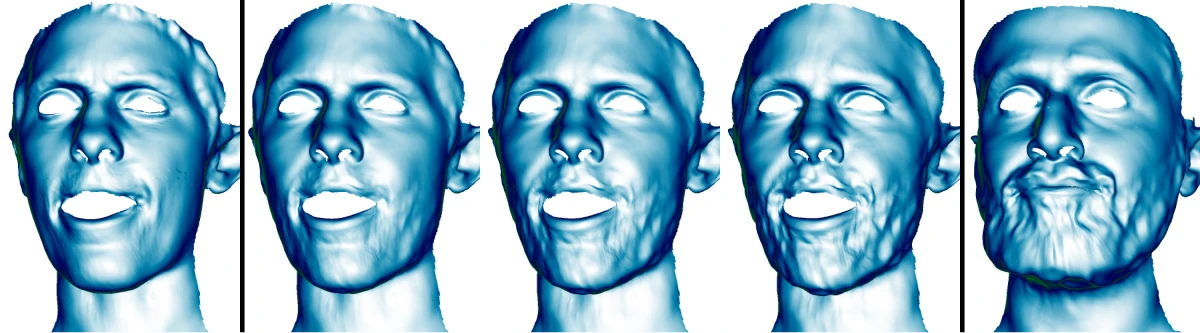
3D face meshes generated by a compositional VAE, from smooth global geometry to fine detail such as wrinkles and a beard

We propose a method for learning non-linear face geometry representations using deep generative models. Our model is a variational auto-encoder with multiple levels of hidden variables where lower layers capture global geometry and higher ones encode more local deformations. Based on that, we propose a new parameterization of facial geometry that naturally decomposes the structure of the human face into a set of semantically meaningful levels of detail. This parameterization enables us to do model fitting while capturing varying level of detail under different types of geometrical constraints.

Download here: CVPR 2018 Publication